Happy Thanksgiving from the US!
Although for me the idea of cultivating thinking thanks is not just limited to a “Thanksgiving” holiday, I am still so grateful that there is a focus on gratitude this week! In order to celebrate that, I have compiled some cool examples of how to implement being th(i)nkful.
Examples of Being Th(i)nkful
 THE DAILY EXCHANGE. Every day Elisa and Nicole text back and forth things they are #thinkful for. They have developed a pattern to spur each other on to look for things that they are thinking thanks about that day. Both of these ladies live in a climate where a long winter is approaching and it becomes harder to feel thankful and more necessary to think thanks. I welled up with tears to read that they were doing this. How cool! Having an accountability partner to keep you on track helps incredibly.
THE ICEBREAKER. Last Tuesday evening I was speaking to a ladies’ group about being th(i)nkful and at the end of our time together, the leader suggested that we play an icebreaker game.
Everyone got a 3×5 piece of paper and we wrote down one thing that we were thankful for. It could be anything: a breeze in the air, beauty of nature, clean white sheets, laughter. We then folded the papers in half and placed them in a basket. When all the papers were completed, Allyson, the leader, opened and read each paper. She did this two times. The game consisted of trying to figure out who wrote each one of the papers. The first person made a guess. If she was wrong, the next person got to guess, moving clockwise around the room. When a person guessed correctly, the person, whose thankful item had been discovered, moved to sit by the one who guessed correctly. They now formed a team and were given a bonus turn. The game continued in this manner until all the peoples’ thankful items were revealed. If a person guessed someone’s item correctly, and that person was part of a team, the whole team moved by the one who guessed correctly.
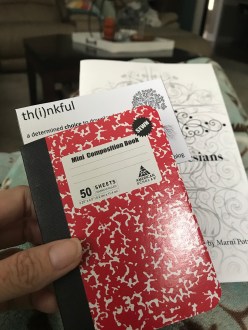 TH(I)NKFUL JOURNAL. My friend Marni sent me this picture. She had been given a small journal. It was to inspire one to write down one thing every day that your were th(i)nkful for. Our brains develop neural pathways by doing something over and over again. At first it feels like you are carving a difficult path through the woods, but as you do it over and over, it starts to happen automatically.
TH(I)NKFUL JAR. Another idea is to have a big jar with little papers and pens nearby. As you or your family go through the week, each person writes down something or someone that they are th(i)nkful for. At a time where all are present, somebody opens the jar and reads all the papers. On a bigger scale this could even be a year long project.
AT THANKSGIVING. If you are having a Thanksgiving dinner this week, maybe around the table each person could give one thing they are thinking thanks about this year.
TH(I)NKFUL VOLLEY. “th(i)nkful volley” is passing an imaginary “ball” back and forth where the person receiving the ball gives one thing they are thinking thanks about. David and I often will engage in th(i)nkful volley while driving on a trip. It has helped us get a better perspective on how we should view life!
TH(I)NKFUL EDIFICATION. Warning! Powerful! The “th(i)nkful list.” In a group of people, give each person several strips of paper correlating with the number of other people in the group. Write one person’s name on each of the papers. Then write down one thing you are thankful for about that person. Collect the papers and then have a narrator group each person’s strips of papers. Then, have the narrator read all the things people were thankful for about each person. This has the potential to be life-changingly powerful. 🙂
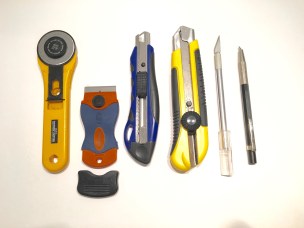 There are ways to build thought patterns within our minds to always be on the lookout for what we can think thanks about in every situation – I’ll call them “carving tools.” Carving a groove – creating a mental preoccupation with thankfulness – is a safeguard that can keep our hearts and souls from destruction. There are times when it is easy to identify what to be thankful for, and there are times when being thankful is the last thing you want to be. A cool side benefit of this groove is that as you carve out the brain pattern, it becomes easier and easier to “get in the groove” – to spontaneously recognize the things to be thankful for.
 se the tool of choosing to think thanks and then express that thanks orally or in a written form. I put on the “glasses of gratitude” and look at everything around me and in me through those lenses. God has promised that He is sovereign and is going to give me all I need to do His will if I will appropriate that grace (I Cor.10:13).


 Eternity Glasses
 The Lord IS our Rock, and He wants us to meditate and give thanks for that.
 This is a picture of our son, Nicolas, and his beautiful Julia. They gave me a special present this year for my birthday – a Daily Gratitude Journal! In this journal there are only blank pages divided by a line in the middle and a space on which to put the date. You could use really any kind of notebook to do the same thing. The idea behind it is to get into a pattern of writing down your th(i)nkful list. At the end of the day you take a moment to reflect on what you were thankful for that day.
 I started doing that after getting this book from Nick and Julia. Some entries are not so full. Some entries can barely fit all that I want to record. But the beautiful thing that I find happening to me is that, as I go through my days, I make mental notes of the things I need to remember to record that evening. This goes for easy days, as well has hard days.
 learned a gem that afternoon. Our group sang songs for them and in return they wanted to sing for us. They did a much better job. 🙂 One of the songs they sang was “Hold on to Jesus, Hold on, Hold on, Hold on.” I thought to myself that wow, that doctrine was so shallow. They should have been taught deeper truths. However, the gem I discovered was that the most important thing to do when going through horrendous difficulties and challenges is to “Hold on to Jesus.”
 th(i)nkful