Create an Obstacle
How do you stop movement along a well worn pathway? You put a log in the way. You create an obstacle.

When driving down this road, all of a sudden there is no way that I can continue driving when I reach this log. I am going to have to do something different. I have to carve a new pathway around the obstacle.
The best way to stop doing something is to replace it with something else.
At first this new pathway feels so hard and unfamiliar. It has not been worn down and made smooth by people walking on it repeatedly. It is new and a bit bumpy. The way is not obvious. I may have to improvise as I go along.

This new path has to be developed and that takes time and effort. Step by step you begin. Baby steps, that is. In time and through repeated efforts, you mat down the grass and smooth out the path. You may need to get a shovel and dig out a big stone or cut back a root that is sticking out. It begins to change, little by little. One day you could even run that new path with no problem.
Our brains are very similar. To break behavior that is not pleasing to the Lord, we call on Him to help us reset our minds and carve a new path of thinking.
Carving a New Path
When stopping a sinful habit of complaining and grumbling, it will normally take something big, like a log across my familiar path, to stop it. Sometimes a family member will mention your negative attitude – they are throwing some branches across the path to get you to change. But you don’t.
Then the Spirit convicts you strongly about your complaining spirit during your pastor’s message, or you are dismissed from a ministry, or passed over for a promotion at work, because you are so negative – and that’s when the tree falls across the path. You disregarded branches, so God sent you a log. Now, you deliberately resolve to do things differently.
“Do not be conformed to this world, but be transformed by the renewal of your mind, that by testing you may discern what is the will of God, what is good and acceptable and perfect.”
Romans 12:2
As we continually present ourselves as a living sacrifice to the Lord, He will enable us to change. We desire to be conformed to His will (I Thessalonians 5:18), but it is not easy to leave the broad and easy road of complaining to follow God’s ways through the woods.
So, when forging a new pathway, it is profitable to have a basic plan in hand. How would you lay out a plan for creating a new neural pathway in your brain? Does God really expect me to do this? What are the benefits? How hard will it be?

Setting Alarms
You could set up an alarm system for yourself. What little alarm could go off when I begin to go down that old blocked dead-end road?
- Maybe I could cut out a little red stop sign that would be a visual reminder throughout my day that I need to stop my normal pattern of grumbling and complaining.
- Maybe I need an accountability partner (your kids would be glad to help!) to give a funny sign when I begin my old pattern of complaining – the slash of a hand across the throat, or dotting fake tears down the face with an index finger.
Reprograming by Recounting
Psalm 9 has some great advice for us. The psalmist says, “I will recount all of your wonderful deeds.” He had discovered the worth of the gratitude neural pathway. Learning to recognize and recount God’s work in our lives brings glory to God, but also helps our brain change as we turn an action into a habit. It gets our perspective on who God is, His character and His sovereignty. It fosters our ability to trust in Him.
Set up a routine of saying three things you are choosing to think thanks about at a certain time and place each day. When you wake up, try to think of those three things before you even get about of bed. If you’re not a morning person, you could wait until after coffee. Maybe it can be at dinner time; if you do it then, you may inspire other family members to follow. The routine is strongest if you see your hand write the words. Get a basic journal and begin recording these three things right before bed; you may have added more by then. 🙂
At first it will not feel natural to do this – it’s a brand new pathway through the woods! But I can promise you that after keeping this pattern for a month, it will begin to be so natural that it barely takes a minute or two to complete this. The reset of your mind is taking shape. You are becoming more focused on the Lord God. The pathway in your brain is developing.
The blocked mental path has now made way for a different one ~
A mental path that will become easier and easier to go down as we obey the Lord in calling out to Him for grace.


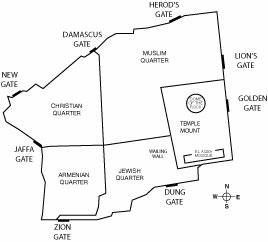


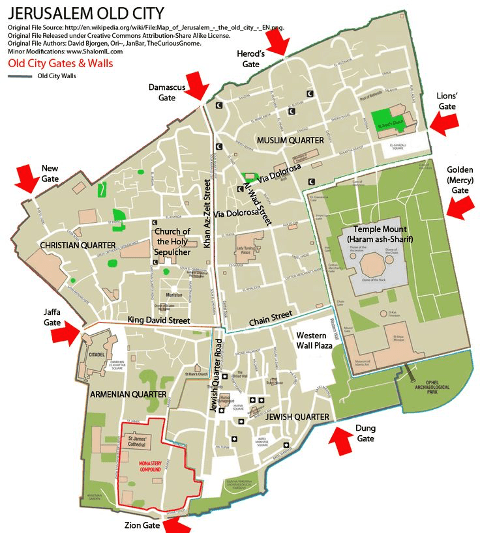
 The Dung Gate and the Just Gate could easily be connected by the fact that our just reward for our sin is death. All our righteousness is as dung, filthiness (Is. 64:6). We justly deserve punishment, but God instead has given us His righteousness.
 What a neat picture for the Golden Gate to be linked to the Pure Gate. That gate will be opened when the Pure and Holy One comes. The Messiah has already entered the predecessor of this gate once before riding on a donkey a few days before He died to pay for my sin. Soon He will return to claim His rightful kingdom.


 There is nothing in Scripture about a hill called Golgotha or a mount called Calvary. “The place of the skull” was next to a road; it still is today. Romans crucified criminals beside the main road to teach a lesson to passersby of what happens when you disobey Roman Law.

 No surprise. It will probably be the most popular verse for 2020 as well! Humans are typically anxious people. Do any of these words describe you?


 Think of a dog chasing a cat. The cat has no desire to stay put if a huge German Shepard is charging its way.
 (like a journal or a ring with index cards).
 He said that, in order for us to learn to be good counselors of others, we first had to be able to self-counsel. Our assignment was to identify a sin pattern that we personally struggled with and to track it for six weeks.
 Locating or identifying the temptation is a huge part of victory (James 1:14). Personally I struggle with worry. It is insidious and sneaks into the depths of my soul. I want to comfort-eat to relieve the pressure that I feel and get my mind off the vexatious thoughts. When I react sinfully, I feel badly afterwards because I know that I have not responded in a Christ-honoring manner. So if I am able to shine the flashlight on the temptation by locating it, that is a great start.
 Lord is the next key. We are told in James 1:2 that we are to count it joy when we are tested. Jesus said we should ask the Father, “do not to lead us into temptation.” He doesn’t tempt us with sin, but He allows the situation to make us stronger under pressure (vv. 3-4), and to motivate us to call out to Him for help (vv. 5-8).
 Lingering with the Lord and sharing honestly with Him what I am struggling with, and even what I am tempted to do in sinful reaction, is like releasing the pressure that the temptation builds up. The sin especially flees if I speak it out loud or write it down. You shock yourself as you see your hand spell out the sin.



 This passage hits us with a surprise. Paul exhorts us to fight sexual immorality, impurity, covetousness, filthiness, foolish talk and crude jokes … with thankfulness. Paul didn’t simply shout “stop it,” like Bob Newhardt. He said to replace the sinful behavior with thanksgiving. We fight back against sin with thanksgiving!
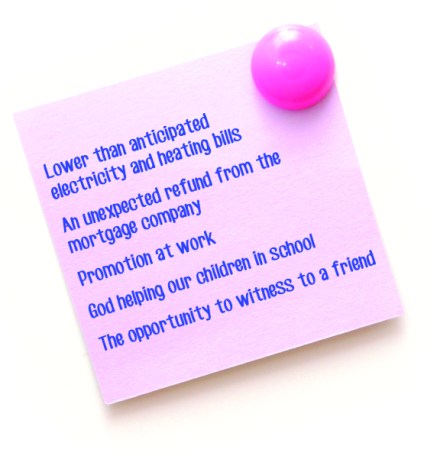 things written out in an area easily visible like on your refrigerator and when that temptation comes, read those 4-5 things out loud and thank God that He is God, and you are not, and He is trustworthy and will measure out grace and strength to do His will.
 in the wrong order. We tend to look first at our circumstances and try to interpret God’s love and care, which seems missing.
 The strength of being th(i)nkful can only come from trust in a sovereign Creator and God that is good and worthy.

 let me instead be th(i)nkful for my car, for my ability to drive to the shop, push a cart, have the funds, make decisions from often hundreds of choices … and so on. As the familiar meme says, “what if we had tomorrow only what we thanked God for today?”
 Nick and Julia had been reading different things to try and find some answers, and they had come up with a plan. As Nick started to talk to his child he laid down some rules that the child needed to follow when he began to feel great anger. The idea was to help him get control of these overwhelming feelings he was experiencing. They called it “Take 5.”
 One evening their little guy was allowed to stay up after the others had gone to bed, and just Daddy, Mommy, and the little victor each got to enjoy a Take 5 bar. Hearing about this made my heart smile.
 In other words they are not good bedfellows. One has to leave.
 The ‘D’ verse was “Do all things without murmuring and disputings.” (Phil. 2:14).
 You refuse to think the grumpy thoughts of complaining and instead exercise your will to think thanks about whatever is in front of you.
 th(i)nkful