The wind was howling. Its strength visible by the leaning of the trees along the coast of the Indian Ocean. Storms here come in such varieties. Some park over the sea and churn buckets of water on the earth below reshaping large rivers and beaches overnight. Some have gusts that shake the very foundations of the earth, twisting infrastructure and edifice alike. And some have all of the above.
How do you feel in a storm? Do you remember cosy times cuddled by a fireplace reading and not worrying an iota? Perhaps you have a different recollection of a storm that wreaked havoc on your life and took precious things from you?
Rescue workers go on high alert during such storms. They have been trained to know what are the first and foremost things to get accomplished. They have tools and equipment that are essential, and tough vehicles that can chew their way through the rubble and high waters to get into ravaged places to rescue the perishing. So thankful for these people.
How wise is the person that prepares ahead of the storm so that when it hits, he is ready. This is true when you are at sea perhaps more than any other place. Whereas the ground tends to be firm, and can even be burrowed into for safety, the sea can be a merciless place that tosses you about for days and even weeks without a break.
Almost the very definition of hopelessness is someone adrift at sea in a horrible storm with no motor, no sails, no oars, and no anchor.
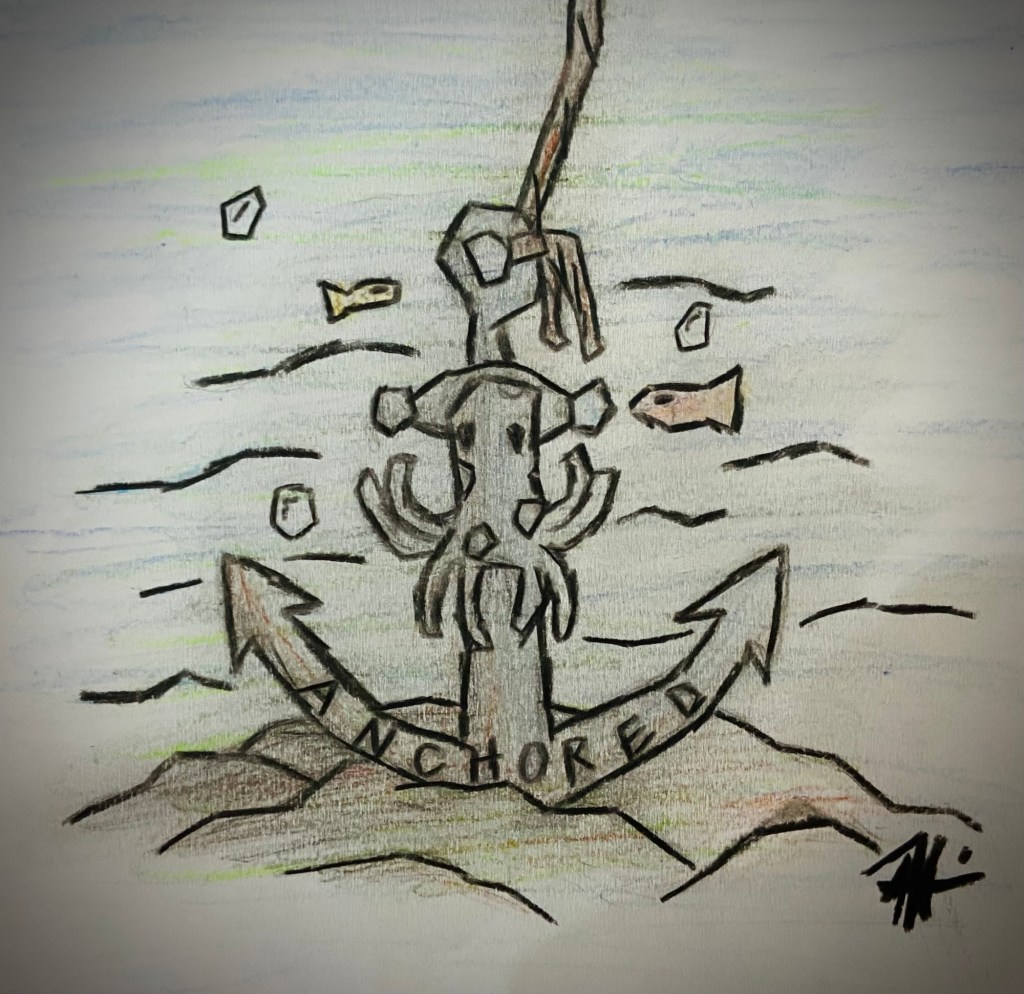
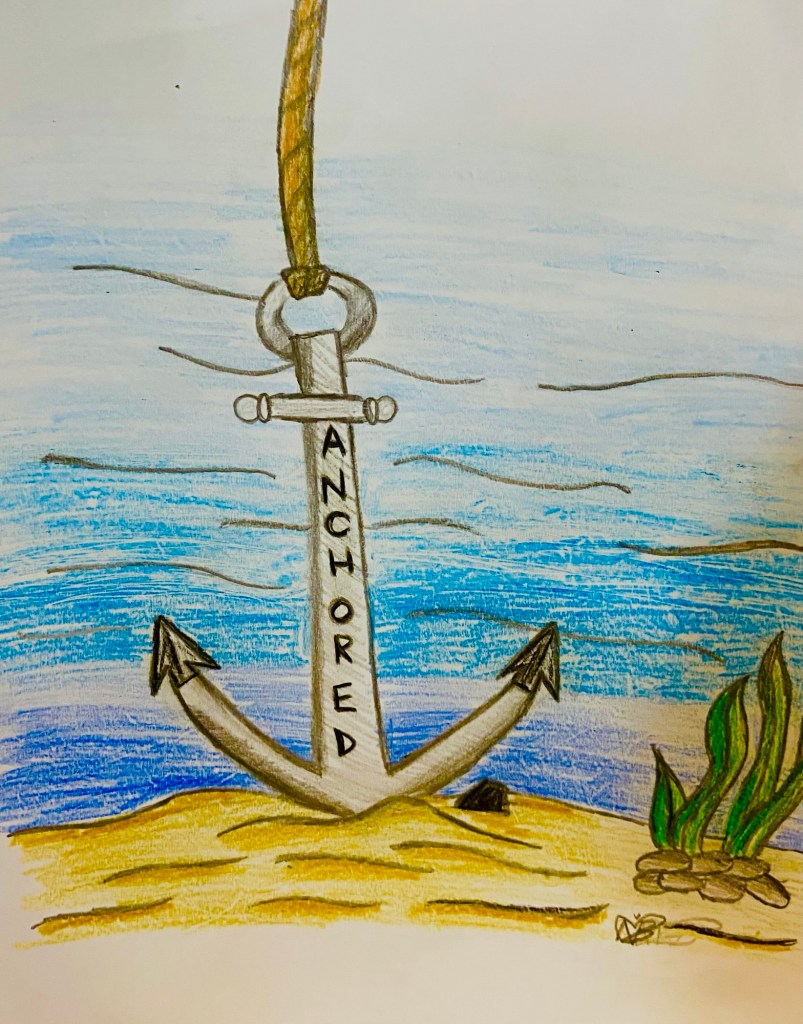
Anchored
Maybe you feel that a storm is raging inside you. Outside, you may appear just fine to others. But in your thoughts and emotions, you are in a horrible storm battling the foreboding winds of change, loss, challenge, or uncertainty. Dark clouds on the horizon vow that even more is coming. Alone, your tears fall like heavy rain. Your thoughts spin and lurch like a rudderless ship with the sails all torn. Hope seems like a bad joke. You don’t know what to think or do next. I know. I have been there, too.
Credit: J. H. Brown
Emotions are real, but they are not reality. When we are in a storm, we must send our minds down beyond our circumstances, down to a deeper reality … and give our emotions a bit of time to follow. You see, we have an anchor. Our minds have a chain of truths that go down deep and are connected to an anchor set firmly into a Rock that does not move. We are connected. We are held. We belong. We are tethered in the storm by the Author and Measurer of the storm. The storm teaches us the power of the Rock and underscores the need for a good anchor that can hold us fast in the dreadful waves that throw our souls back and forth. ⚓️
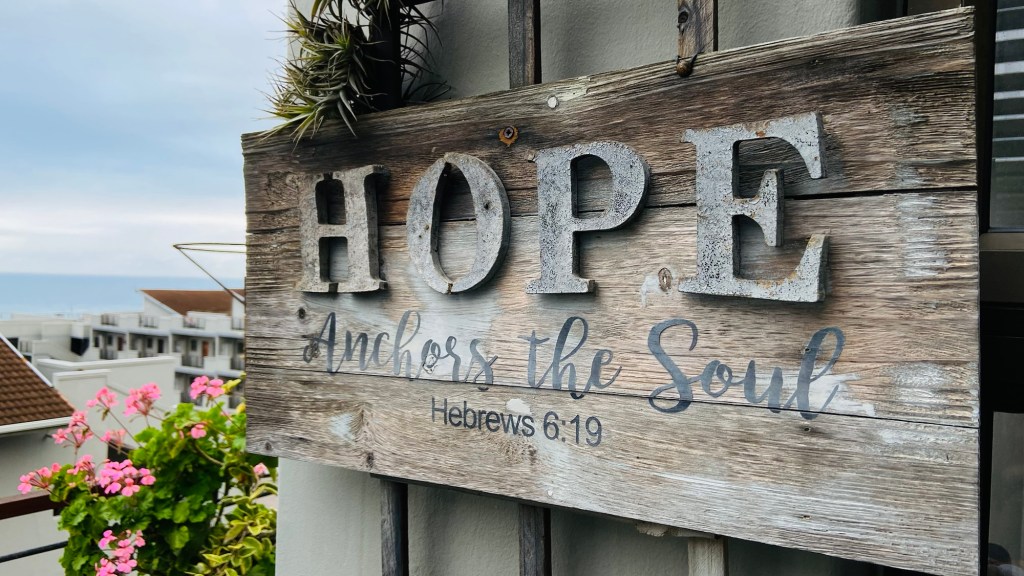
“We have this as a sure and steadfast anchor of the soul, a hope that enters into the inner place behind the curtain,”
Hebrews 6:19
Go from Anxious to A.N.C.H.O.R.E.D.
I came across a helpful tool recently. It gives a simple reminder to the person who is the midst of a storm of anxiety, but desires to gradually leave that state and feel anchored.
A — Acknowledge God’s Sovereign Presence — Psalm 23:4; Psalm 139:1-12; Joshua 1:9; Isaiah 41:10,13; Psalm 46:1
N — Name the Fears and Lies Beneath the Anxiety — Psalm 139:23-24; Psalm 19:14; Lamentations 3:40
C — Confess Unbelief and Self-Dependence — I John 1:9; Psalm 32:5; Psalm 51:10; Proverbs 28:13
H — Hold Fast to God’s Promises in Christ — Proverbs 3:5; Isaiah 26:3; Hebrews 10:23
O — Orient Your Mind to Scripture — Lamentations 3:21; Psalm 119:11; Joshua 1:8; Psalm 1:2
R — Redirect Desires Toward God’s Kingdom — Colossians 3:1-2; Matthew 6:33; Psalm 37:4
E — Entrust Cares to God Through Thankful Prayer — Philippians 4:6; Psalm 37:3,5; I Peter 5:7; I Thessalonians 5:16-18; Psalm 28:7; Colossians 4:2
D — Do the Next Faithful Step — Psalm 37:23; Proverbs 3:6; Micah 6:8; Philippians 3:13-14; Proverbs 4:25-27
@Biblical Counselors Society
Are You Anchored?
You may think you are anchored, but when a raging storm threatens your tranquility, your anxieties become apparent. Perhaps your anchor and chain of truths are not sufficiently strong. Perhaps they are not set into the Rock but are unhelpfully dragging along the bottom. You are being thrown and tossed, bruised and broken.
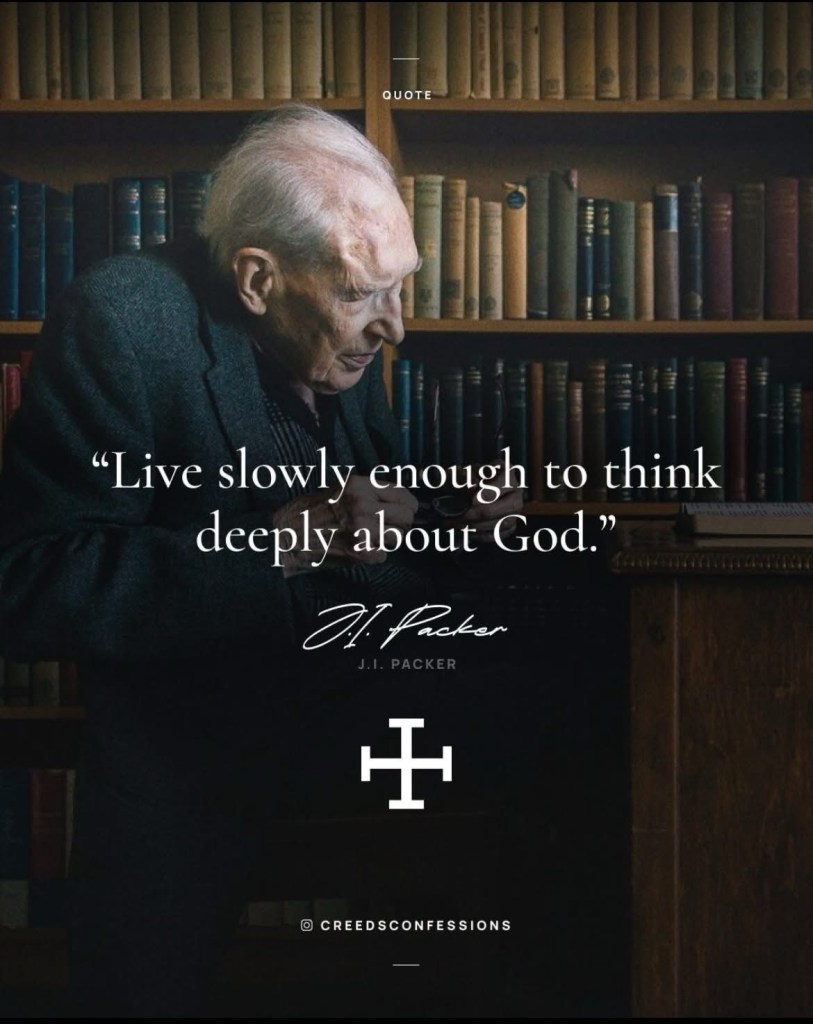
The world becomes a strange, mad, painful place, and life in it a disappointing and unpleasant business, for those who do not know about God. Disregard the study of God, and you sentence yourself to stumble and blunder through life blindfolded, as it were, with no sense of direction and no understanding of what surrounds you.”
J. I. Packer,
Knowing God
The world experiences peace circumstantial, but the Christian’s peace is not anchored in happenstance or circumstance but in the character of our Heavenly Father.”
Jonny Ardavanis, Consider the Lilies
“Now may the Lord of peace Himself give you peace at all times in every way. The Lord be with you all.”
2 Thessalonians 3:16
I want to end by encouraging you to write out the acronym for A.N.C.H.O.R.E.D. and look up the verses that support it. It will be a step of establishing a secured anchoring in TRUTH.
Christ The Sure And Steady Anchor
Christ the sure and steady anchor in the fury of the storm When the winds of doubt blow through me and my sails have all been torn In the suffering, in the sorrow when my sinking hopes are few I will hold fast to the anchor, it shall never be removed
Christ the sure and steady anchor while the tempest rages on When temptation claims the battle and it seems the night has won Deeper still then goes the anchor though I justly stand accused I will hold fast to the anchor, it shall never be removed
Christ the sure and steady anchor through the floods of unbelief Hopeless, somehow, o my soul now lift your eyes to calvary This my ballast of assurance see His love forever proved I will hold fast to the anchor, it shall never be removed
Christ the sure and steady anchor as we face the wave of death When these trials give way to glory and we draw our final breath We will cross that great horizon, clouds behind and life secured And the calm will be the better, for the storms that we endured Christ the shore of our salvation, ever faithful, ever true We will hold fast to the anchor, it shall never be removed
The brakes did their job, but you could smell burnt brake pads. The accident did not happen, but man, was it close. My heart rate was accelerated and I felt uncomfortable.
Have you ever been extremely close to a wreck? It instills a deep desire in you to try to avoid those situations in the future. I remember my Driver’s Ed teacher in high school saying we should stop with enough distance to see the tires of the car in front of us.
Let me introduce you to a really cool word!
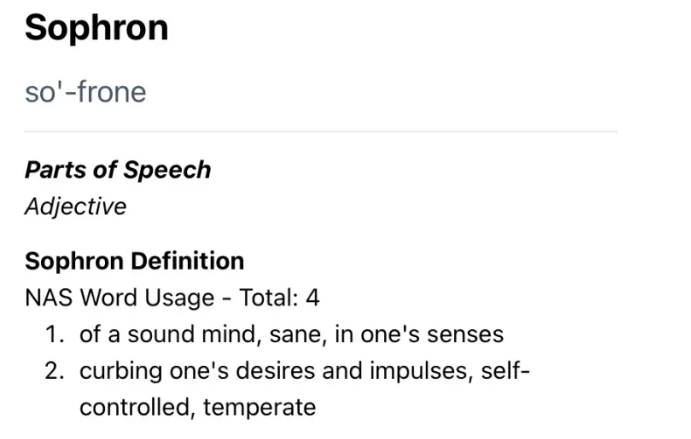
Are you familiar with the word sophron?
Such a great word!
Quick meaning could be ~ put on the brakes ~ according to Nancy Wolgemuth in her book, “Adorned: Living Out The Beauty of the Gospel Together” (p. 163).
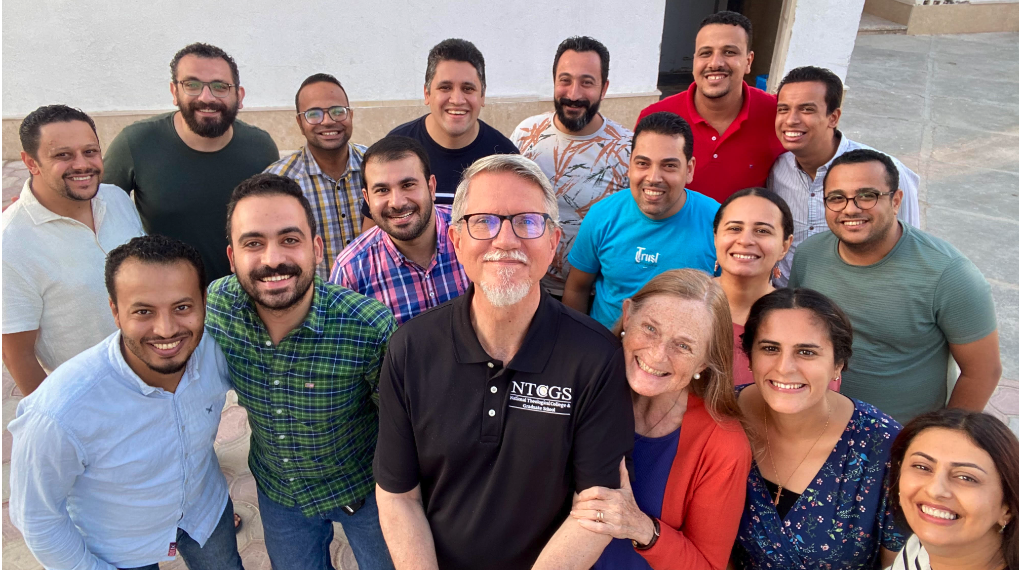
Sometimes there are natural pauses where it is easy to use the time to reflect on the things you are thankful for. Like we just finished a weeklong module of teaching in Egypt. It was easy to stop, during the week and after the week was done, to recount what we were thankful for.
That we had the joy of teaching this material to godly adults
The students were enthusiastic and loving toward us and the teaching
That we ourselves were encouraged by reviewing the truths from God’s Word
That we had a chance to help buy new TV’s to replace the old small ones, improving future visual learning in that classroom
Camaraderie with fellow staff and teachers
But sometimes, it is not so easy to stop and list things you are thankful for, especially when something or someone needs fixing! The Apostle Paul was concerned for the churches every day (2 Corinthians 11:28), yet when he wrote to those churches about urgent issues they were facing, he would put on the brakes and begin his letters by giving thanks for them before he would address different matters.
Self-Controlled Th(i)nkfulness
Reading through Titus 2, we find an exhortation for sober-minded self control.
Older men are to be sober-minded, dignified, self-controlled, sound in faith, in love, and in steadfastness. Older women likewise are to be reverent in behavior, not slanderers or slaves to much wine. They are to teach what is good, and so train the young women to love their husbands and children, to be self-controlled, pure, working at home, kind, and submissive to their own husbands, that the word of God may not be reviled (Titus 2:1-5).
Paul’s words are commending seriousness. There is a need for women to exercise self-control. Leaders in the church also need these qualities.
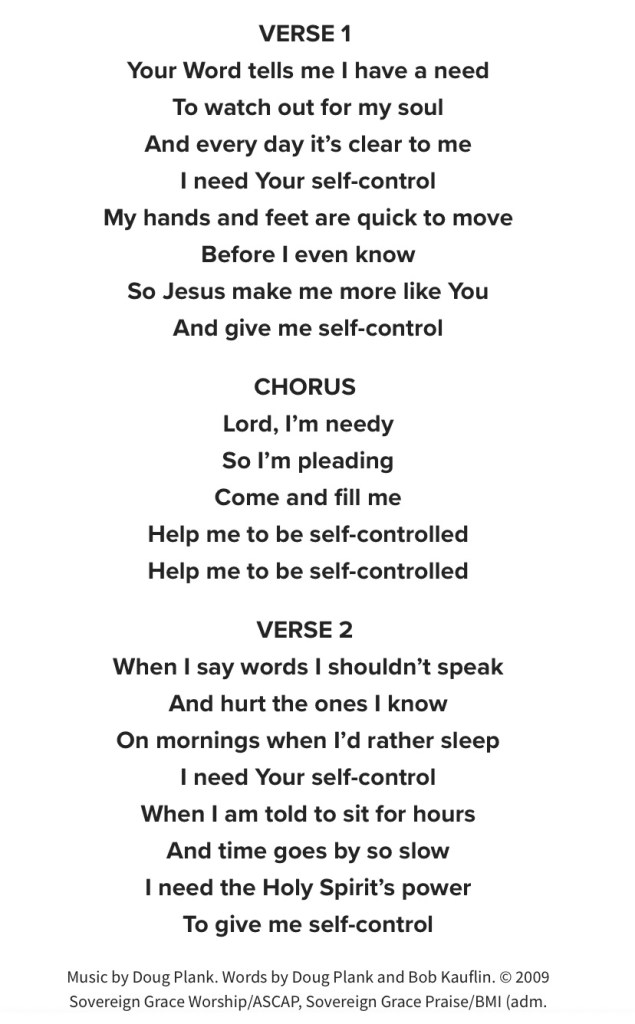
A new song we sang a few Sundays ago at our Phoenix Fellowship here in Durban, South Africa, drove home this point. The unusual title of the song was, “Give Me Self-Control.”
Self control is curbing your impulses and emotions, but it also includes controlling your pace, your pauses, and your pondering such that you keep a sane and sound mind. So many people are “run” by their job, their children, their pets, or the expectations of family and friends. Putting on the brakes to think thanks is an integral part of regaining a sound mind.
Resolutely untangling myself from the anxious demands of the next item on my to-do list, I have an opportunity to regain a balanced perspective, to see the strong hand of my sovereign God above all that is happening, to be mindful of hasty choices I am making, and to recommit myself to live slowly enough to discern His will and way for me.
I know that He desires me to think thanks in every circumstance because He tells me in His Word (I Thessalonians 5:18). But most often I need to stop in order to think. The impulse to be driven by outside demands must be controlled. So, choosing to be characterized by sophron, I am in a good place to develop a practice of thinking thanks.
Putting on the brakes in my life doesn’t mean I am not still busy doing the job set before me. It means that I am allowing the Holy Spirit to help me proceed with self control and wisdom.
When we’re not sophron, we don’t have any margin or heart for kindness.”
“Adorned,” Nancy DeMoss Woldemuth
A Little Introspection
Are you sophron? Does that describe or characterize you? It should.
Why not start fostering that quality in your life today?
Take a moment to put the brakes on. Slow down your pace and emotions, cherish your pauses, and meditate on truth. Regain a sound mind through self-control. You did that by stopping to read this blog post. Well done! The Holy Spirit is with you, inside you, and can help you become peaceful and trusting of the Lord’s sovereignty in your life.
Write down seven things that you are thankful for right now. And a step further share those seven things with a good friend. It’s edifying to them, too.
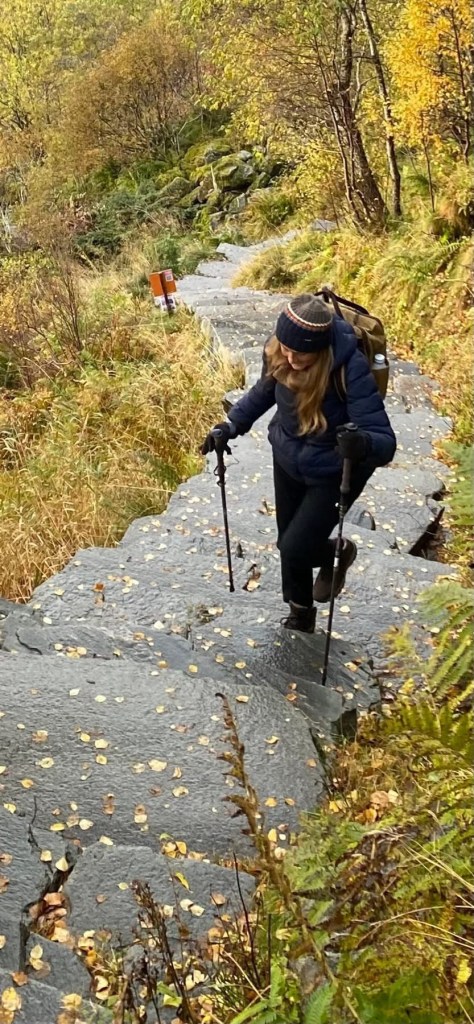
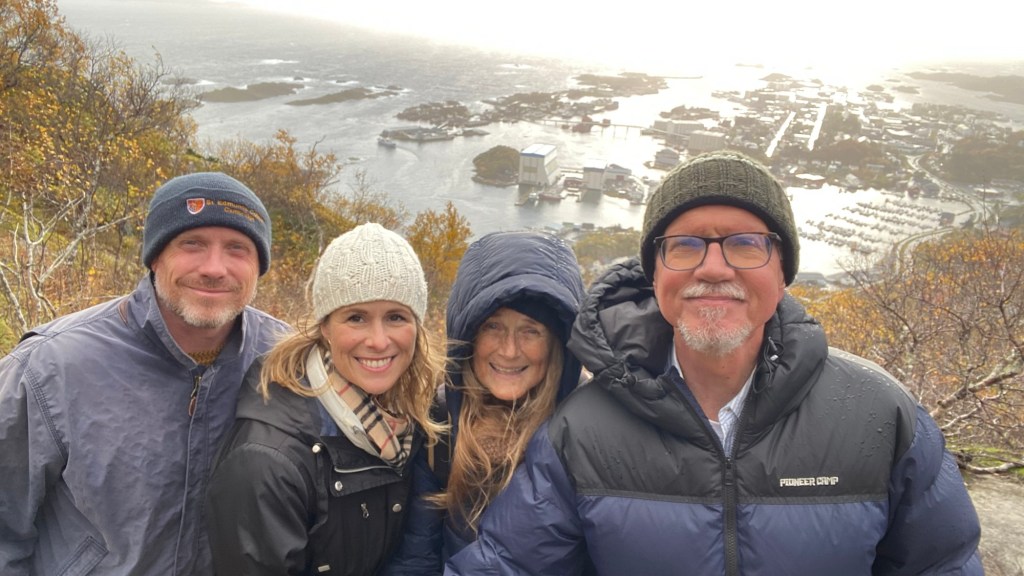
“Don’t give up! Lean in! Use those muscles!” We had the privilege to climb a mountain in Norway recently. As our age climbs, the mountains are harder to climb. We had to reawaken muscles who thought they had reached retirement.
The view was worth it as we looked out over a seaside town through sunshine and light hail. But it was hard going up … and then hard in a different way going back down.
You have to want to achieve the goal. Then you push and take steps to make it happen.
One foot in front of the other, step by step, you push forward. It was my first time to use hiking poles for balance and support. Very helpful! Felt professional.
Thinkful Muscle
Choosing to download grace from the Lord to think thanks about every circumstance in my life takes muscle. It takes the heart: “I want this change in my life.” It takes the will: “I will choose daily or as often as needed to stop and speak or write out things I am thankful for.” It takes the mind: “OK, now looking back through this day or this circumstance, what can I be thankful for?”
This does not come naturally, at least not to start with. But after those muscles have been engaged and used repeatedly, it does begin to come more automatically. That is a benefit of being “in th(i)nkful shape.”
Friend, when you choose to ask God for grace to process things with gratitude, you are exercising yourself towards godliness. You are obeying God’s command to give thanks in everything.
But honestly, it can feel like climbing a mountain. Every step feels hard and you have to choose to pursue your goal.
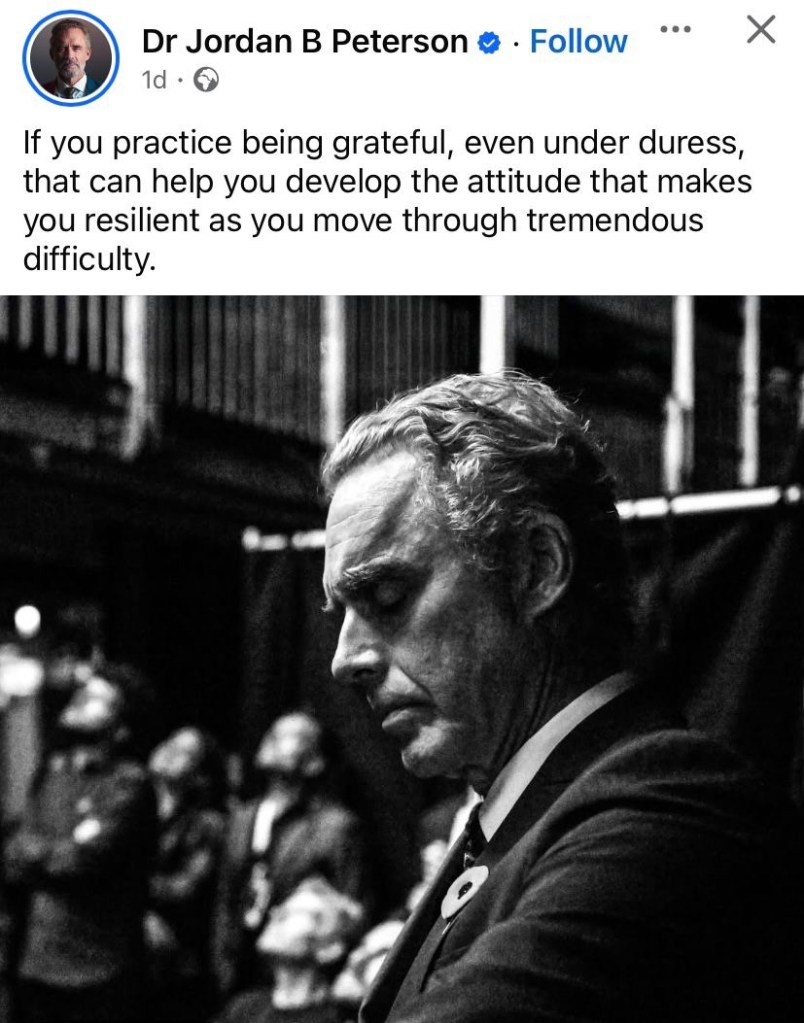
If you practice being grateful, even under duress, that can help you develop the attitude that makes you resilient as you move through tremendous difficulty.
Dr. Jordan B. Petersons
Even people who are not believers realize the importance!
Muscle Development
To get fit, you need a plan. David and I tried to take lots of walks on the hills around where we live to prepare for our mountain hike. We chose hills that were steep to begin to push our thigh muscles to get ready. Yes, it was a bit uncomfortable. We would sweat and breathe heavily, and some people who watched us pass by wondered if we would pass out, or pass away, before reaching the top … but slowly, it got easier.
The same is true with developing your thinkful muscle. Although it may feel awkward and unnatural, you choose to write down some things you are thankful for. Maybe it’s just one a week at first, but you build up to one a day, maybe even three+ a day.
As that gratitude muscle gets fit, it will amaze you how quickly you can blurt out one thing after another of what you are thankful to God for, even during difficulties.
That is climbing the Thinkful Mountain!
Joy Along Life’s Path
As I was pushing my leg muscles climbing up the mountain, I would take a pause and turn around looking how far I had already gone and the view from where I was.
It gave me inspiration to go on (and needed oxygen). We also met some who were descending because they were afraid of getting caught in a heavy downpour. Fully understandable! The one lady looked at me and said in Norwegian that she had some regret though that they had turned around.
If you pursue getting your thinkful muscle fit, I believe you will have no regrets. Becoming more of a natural at giving thanks to God for Who He is and all He does, will pour courage and joy in your heart.
Oh, just give it a break! I want to relax and just veg out for a while.
Vegetate means to relax in a completely passive or mindless way.
“I am so weary and tired. I can’t think straight. Just need to refuel and restore.”
These are such common phrases. Our jobs, families, schools, and ministries are demanding and pushing us to perform, even through stress and discomfort. No wonder we have a desire to veg out.
May I please alert you‼️
When you are vulnerable and passive, there is danger lurking. Yes, you do need to rest and restore, but be careful how.
Whatever we passively allow into our minds will actively affect us. It goes into the database of the soul, our minds, and begins to influence us.
“The heart of him who has understanding seeks knowledge, but the mouths of fools feed on folly.”
Proverbs 15:14
Feeding as Meditating
We are what we think about.
“For as he thinketh in his heart, so is he:“
Proverbs 23:7 (KJV)
But the motivator for what we think about is our heart. We think what we think because our hearts want what they want. The heart determines what we feed on in the idle moments. Sometimes it’s not bad. We just need to check it.
Absent strong medication, most of us can’t go into a state of just not caring. The mind will receive input even if we are not seeking to actively acquire knowledge.
The area to continually check is our hearts. What do I really want in my heart?
“Keep your heart with all vigilance, for from it flow the springs of life.”
Proverbs 4:23
News?
For so many of us, conditioned for years by 24-hour news and social media, our hearts want us to be informed. Many don’t want to find out the latest shocking events one or two days later. AI evaluated a number of sources to report where 18-24 year olds get their news.
Fascinating!! What you read and see surely will color the way you perceive something.
In the olden days, it was the town crier calling people out into the town square to share news.
That is where we get the word for “church.” Ekklesia means “called-out ones” – people called out of their homes and businesses to gather together in the town square to hear the news and official announcements.
When Jesus came as the true Messiah, many had not heard the news. The news of the gospel was to be proclaimed everywhere. That news is still being shared all over the world. One by one or in big groups the gospel is declared.
As Western culture moved into the 18th century, the printed page became popular as a source of news. People would buy gazettes and then newspapers.
Whatever was printed in the newspaper or broadcast of the radio hourly was carefully curated and presented to us as objectively as possible. What we read or heard in those days we took at face value. It had authority.
Today we have a superabundance of ways to get information, and in this populist era, everyone has a voice, and mainstream legacy media outlets, discredited as authorities, are seen as just a few of thousands of biased voices with hidden agendas. No one can be trusted. Difficult as it may be, we use discretion in the selection of our sources, and be careful of our level of daily intake.
Guidelines for the Mind
Our Father in heaven who has created us and controls all things, has given us guidelines for how to walk worthy in the Christian life.
He encourages us to renew our minds often.
” Do not be conformed to this world, but be transformed by the renewal of your mind, that by testing you may discern what is the will of God, what is good and acceptable and perfect.”
Romans 12:2
Firstly, we need the fresh water of the Word of God every day to satisfy us and renew our perspective (John 4:10). I have a morning appointment with the Creator … like at 6 am at the breakfast table, He is waiting for me. I need to talk with Him and hear from Him before jumping into news or texts.
Secondly, we need to view current events with the glasses of thinkfulness. God has given us His Word as an anchor (Hebrews 6:19) and light for our path (Psalm 119:105). He says to think thanks for everything.
“… giving thanks always and for everything to God the Father in the name of our Lord Jesus Christ,”
Ephesians 5:20
Thirdly, build up your “big God” belief system. Have you compared the amount of time you spend getting news with the amount of time spent on a sovereign God who is orchestrating all of those events in the news towards fulfilling His plans and purposes (Daniel 4:34-35, Acts 17:26-27)?
Many Christians have a “small God” – a God who is overworked and distracted and not paying sufficient attention to some details. They are more oriented horizontally than vertically. They care a whole lot more what people around them think about something compared to what the Lord thinks about the same thing. God warns us that the fear of man brings a snare, but whoso trusts in the Lord will be safe (Proverbs 29:25).
We need to move to a “big God theology” and to a vertical orientation, confessing what is true from heaven’s standpoint. God is infinite mind (never misses the smallest detail). God has steadfast love and faithfulness toward His children (micro-orchestrating every detail in our lives, struggles, and deaths for our good and His glory). And God is omnipresent, omniscient, and omnipotent (ruling over the affairs of men and nations – those that are war-torn and those that smugly feel they have achieved utopia).
Recently I was made aware of how trusting completely in God’s sovereignty actually helped two friends of mine who had gone through the loss of a spouse. They grieved, but there was hope in that God was working a plan, and His peace and plan eased their suffering sooner than others around them. We cannot always see His plan behind the path that He chooses for us, but He asks us to trust Him (Isaiah 43:2).
Fourthly, roll over your soul-weights and anxieties on the Lord, with thanks. When the Lord tells us not to be anxious in Philippians 4:6, He gives a way to process our concerns. He encourages us to bring our burdens and troubles to Him wrapped up in thanksgiving.
“Do not be anxious about anything, but in everything by prayer and supplication with thanksgiving let your requests be made known to God.”
Remind yourself that God CAN be trusted in every detail. Give thanks for the Lord delivering us from the dominion of darkness and transferring us to the kingdom of His beloved Son, in whom we have redemption (Colossians 1:13-14).
Fifthly, be discerning. How can a person know where to “feed?”
First of all, pray that God would give you wisdom and guide you.
Seek godly counsel from trusted mentors.
Curate your feed. Unfollow accounts that bring anxiety and follow accounts that edify.
Limit your time and platforms.
Turn off notifications.
Engage in real-life activities.
Consider a tech Sabbath – no phone from Friday sundown to Saturday sundown.
“Set your minds on things that are above, not on things that are on earth.”
David was doing his simple magic trick for some little children during an evening fellowship meal at Fellowship Bible in Springdale, AR. The kids were intrigued that the wad of paper that disappeared could, seconds later, be pulled from their ear.
While David was keeping these little ones spellbound, a lady introduced herself to me and we began chatting. Cathy and her husband knew some of the same people we did from Citadel Bible College years ago. She had grown up as a MK in Congo, and then later with her husband, they had served the Lord for thirty years in Mindanao, Philippines. They moved back Stateside about six years ago.
When I asked how that transition had gone, she smiled and said it was very, very difficult.
Change is Hard!!
And a big change, like changing countries, is even harder.
Many people moving cross-culturally have fought heart-wrenching struggles. Exchanging the familiar for foreign, replacing routine with constant trial-and-error, and discovering new types of humor, privacy zones, and communication styles is exhausting. All the changes slide them down into a spiral from which they can’t find their way out. Culture shock is mental-emotional trauma, and even more tricky is “reverse culture shock,” because people don’t expect to feel like strangers when they return to their old “home.”
Mentally choosing to go down the different path of trusting in God’s Word and His promises, instead of the natural path of worrying thoughts and doubts, takes a huge and persistent amount of effort.
“Trust is not a passive state of mind. It is a vigorous act of the soul by which we choose to lay hold on the promises of God and cling to them despite the adversity that at times seeks to overwhelm us.”
Jerry Bridges
The New Motto
As Cathy continued her description she mentioned something that intrigued me.
“It was like a never ending funeral leaving the Philippines for me. Till my kindergarten roommate Marilyn wrote me. She said, ‘I know it’s hard coming home. But I want to challenge you to embrace this new change with Joy.’ That made a whole big change in my thinking and emotions. I have had such Joy here embracing what this season has brought.“
Cathy shared how she decided to follow the advice from her friend and “embrace with joy” this new season. It was a mind game. Instead of recounting the hardships, sorrows, and frustrations, she would look for the joy, the gifts from the Lord, that were all over the place just waiting to be discovered.
She chose to journal and write down these gifts. Some gifts were hard, but it was amazing to find nuggets of joy embedded even in the hard things. I was reminded that in the gold mines under Johannesburg, gold appears as black spots in the otherwise gray rock. The black is chiseled out and with heat the gold takes on its familiar color. God’s hard things have to be refined with thankfulness to draw out their true color and worth.
Terry and Cathy now do a Neighborhood Bible Club where they live. Cathy also gets to spend time with her grandson teaching him.
Why Embrace New Seasons?
Why do we need to embrace new seasons with joy? Because it gives the honor and credit to the One who made the change and controls all things in my life. To fuss and fight and complain and lash out is an empty effort to seize control.
Down deep, we believe God has done something wrong – He has left things too ambiguous, hasn’t fixed what I want fixed, has been too slow, isn’t listening, doesn’t care – and we embrace a host of slanderous thoughts and lies. We say we are frustrated with our circumstances, but actually we’re frustrated with the God behind those circumstances.
God knows what He’s doing! He can be trusted! We need to say this over and over to ourselves as we wait upon Him and His timeline. He is the sovereign, dependable Shepherd who is micromanaging the details of our lives, even through the valleys of dark shadows.
It is best to let God be God as the Author of our lives and the changes He leads us through. Scan the names in the Hebrews 11 “Hall of Faith” and see how many of those people God took through massive changes and cross-cultural moves. God moved them to new places and into new seasons … and they stayed faithful because they trusted in God’s character!
How Do I Embrace New Seasons?
If He has allowed a difficult change in your life, go to Him and pour out your heart before Him because He is a refuge for us, but make sure you TRUST Him!!
“Trust in him at all times, O people; pour out your heart before him; God is a refuge for us.“
Psalm 62:8
So if I was to begin to try to embrace a new season in my life, how should I do that? Can I suggest baby steps?
Firstly, maybe ask for God’s help and get a journal to record just three things a week that have brought you joy and for which you can be thinkful. Then after a few weeks, try to find one or two joys each day. I think you will discover them when you put the right glasses on. They are all over.
When a person gets a proper view of how infinite God’s mind is, how steadfast His love and faithfulness to us is, how comprehensive His knowledge of our details is, and sees how much the whole creation is filled with His glory, it results in submission to whatever He ordains. There is blessing and praise that come with that mindset (Proverbs 31:30). This is a beautiful thing that happens to a person who fears the Lord.
Learning How It Works
When David showed the little girls how the magic trick worked, they became so excited to try it themselves. They struggled at first – it was a new skill – but with practice they, too, in time would be able to give joy to others.
Governing your thoughts is no easy trick, but in time you, also, can learn the “magic” of embracing your new season with joy. Step by step God is teaching us to trust Him and embrace whatever He sends.
All four ladies were chatting pleasantly as they drove up to the intersection. Adaleen’s window was halfway down due to the hot temperatures outside. Out of nowhere the assailant’s hand reached in through the open window and pulled the keys out of the ignition, stalling the car. Shock gripped all the women. Adaleen crossed her hands on her chest and became completely still.
Her coworker in the front passenger seat quickly locked the doors as the assailant had forced the locks open. The war of unlock – lock went on for a second or two. Then the hijacker put a knife to Adaleen’s neck. She did not see the knife, but the passenger in the back saw it, and proceeded to throw her lunch pail at the man, which caught him off guard. At that very moment, a security guard drove up behind the car being hijacked. When the attackers saw the guard, they ran. The guy who had taken the keys threw them behind him as he ran.
A Guard’s Witness
The guard came up and checked on them. After telling him that no one was hurt, he asked them to drive up the road a bit to get out of this dangerous area. He wanted to chat with them. They did so. The guard said, “God protected you. I never come down this way, but for some reason I did today” (thank you, God!).
Wow! All four of the women were so shaken up. The one lady who had thrown her lunch pail, realized that her ID as well as her brother’s insulin medicine was in the pail that the men had taken. So they needed to go to a chemist (pharmacy) to get more medicine.
The Test of a Wrong Response
The first pharmacy was located right next to a liquor store. Adaleen was the only believer in the car. She is a young Christian who was baptized only last December, but before Christ, she struggled with sinful addictions. One of the other ladies said she would run over to the liquor store and buy some alcohol for Adaleen so she could stop shaking, but Adaleen said no, she would instead go home and talk to God to calm her.
That phamacy didn’t have the insulin needed so they had to go to a second pharmacy which was located right close to where Adaleen used to buy weed (marijuana). She was again tempted, but refused to run to those sources to cope. She dropped off her friends and headed home to her little flat, where she lives alone.
Th(i)nkful – The Right Response
That evening was the time that we normally met online for counseling, so a little after 7 pm, I got the whole story. Our church text group lit up with thankfulness and prayers for Adaleen because we were all sure that she wouldn’t sleep so well that night.
My heart was so touched with all that Adaleen had experienced just a short time earlier. As some of you may remember, I also experienced an attempted hijacking years ago in Johannesburg with my daughter Elly. When you have a traumatic experience like that, it is so easy to go right back to the emotions you experienced when you later hear a similar story. I sought to help Adaleen as much as I could. We read Scripture and we prayed. I shared what had been helpful for me to think about when I went through that test. Adaleen was shaken, but it was amazing to me that somehow this young believer was so fully conscious that the Lord had been with her and helped her.
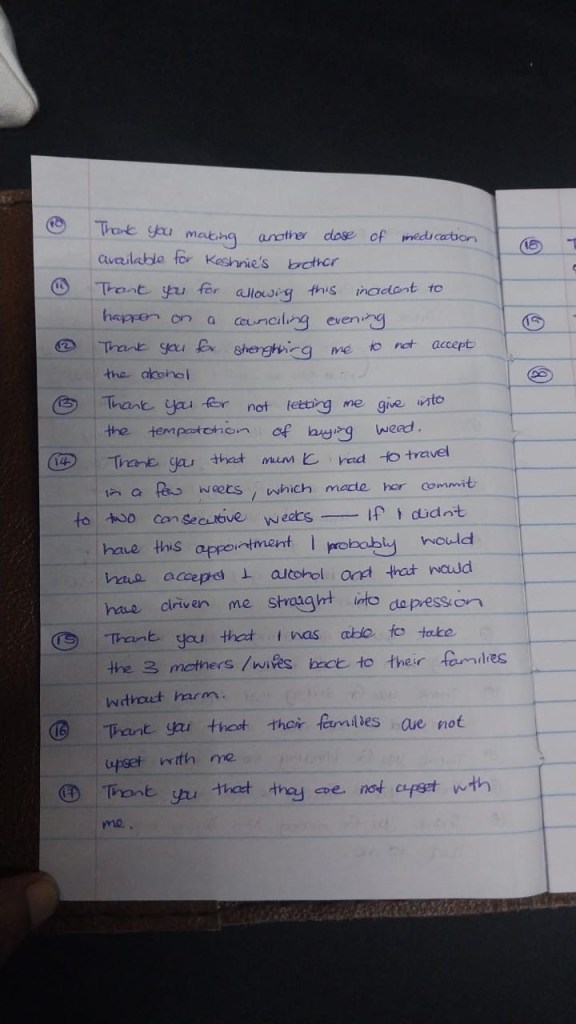
I asked her to write down things that she was able to thank God for in the ordeal. I said to please send me screenshots of what she wrote down. Adaleen wrote down twenty different things for which she thanked God. She was able to go to sleep and even slept well. Praise You, Father!!!!
The next day Adaleen went to work again, and her co-workers could not believe how calm she was. They said she must be in denial or not processing the trauma correctly. Adaleen used the attention she had to give God all the glory. She said that God had saved her. God helped her. God had given her good sleep and was giving her peace.
The Aftermath
The aftermath of a very traumatic experience is delicate and important. To choose to take every thought captive is extremely difficult.
“We destroy arguments and every lofty opinion raised against the knowledge of God, and take every thought captive to obey Christ,”
2 Corinthians 10:5
It involves thousands of decisions. We can do the right thing initially – the first big decision is usually the hardest, but then the reinforcing echo-decisions are of critical importance.
I have found that having a friend to walk through that pivotal time is so helpful. Just touching base with a daily text on how things are going can be the thing needed to stay on track with choosing to think thanks.
Ataraxis, Not Anxiety
Ataraxis: (Ancient Greek), a state of tranquility, freedom from anxiety and mental disturbance
Ataraxis was a new word for me. I love the meaning. However, true tranquility can only come from one source! When Paul exhorts the Philippian believers to not be anxious, he wrote that they should instead pour out their specific burdens to the Lord with thanksgiving, and then the ataraxis of the Lord, which defies understanding (as it did with Adaleen’s coworkers) would keep, hem in, shield and protect them (Philippians 4:7).
I wonder if you have ever taken God up on His challenge in Philippians 4:6-7. When a new challenge comes your way, I urge you to try. It may not be an attempted hijacking with a knife at your throat, but whatever is trying to hijack your thoughts and lead you to despair, arrest it! Emotions are real but they are not reality. Still, they can be wild animals that continuously claw and bite at your soul.
Choose to take those thoughts captive. With strength and clarity, think thanks for God never leaving or forsaking you during the incident He chose in order to build your proven character. Thank Him for using every and all things to conform you to the image of Jesus Christ (Romans 8:28-29). It may be a wresting match in your mind, but as you win with the Lord’s help, ataraxis comes. It may seem illusive at first through the fire and fog of the trial, but it will eventually come into focus.
And the peace of God, which surpasses all understanding, will guard your hearts and your minds in Christ Jesus.
Mission for Karin Brown: flight from Istanbul to Kigali, Rwanda, 3:40 am, establish contact with Swedish traveller, share the gospel.
Have you ever seen a clear direct appointment from the Lord? I had one of those recently. It caused me to be full of gratitude. I got to be th(i)nkful!!
David and I travel a good bit. It is part of our job. It is wonderful being in these places, mixing with God’s people, and doing ministry. But traveling here and there as we grow older is challenging, with jet lag, lost luggage, cancelled flights, headaches, contracting illness from a few hundred other people flying in the silver tube, and so on. My husband teaches Ethics and Apologetics and we have as a value that, as much as possible, we like to serve together as a couple. We can experience the joys and trials together and it binds us closer. We also get the privilege of exemplifying what a godly marriage should look like although we are far from perfect and rely heavily on our precious Saviour’s help.
On one Turkish Airlines flight over Saharan Africa, in the early morning hours, we were cruising along in a packed plane. The African gentleman next to me had been quiet the whole trip, wearing earphones most of the time. I want to be ready to share the gospel whenever the opportunity arises, but not push when it doesn’t seem to fit. In fact, I was struggling with a pretty bad headache and some nausea and trying to choose profitable thoughts over grumbling.
Well, all of a sudden it was time! The man next to me began with a question. “Are you getting off in Kigali, Rwanda, or continuing on to Entebbe, Uganda?” I stated that we were going to Uganda and that my husband David was planning to teach a block course in Ethics close to Kampala.
This led to more questions and in time he revealed that he lived in Sweden, but was originally from the Congo. His family had been refugees from the Congo when he was young and had to flee to north Uganda bordering South Sudan. Both of his parents had passed away. They were brought as refugees to Sweden. He now was a Swedish citizen and lives outside Stockholm.
Well, I began to speak Swedish since I am fluent in that language. How sweet and odd to converse with this Congolese man in Swedish! He shared that he had heard about Jesus in the refugee camp and trusted in Christ. He is now married to a lady from the Congo, and they are part of a church called Livets Ord (The Word of Life) in Sweden.
We talked about the gospel and that the only hope for every human is to have a renewed personal relationship with God through the saving work of Jesus. I even got to mention I write this blog and gave him a card to check it out.
Prepared and Ready
A man once said, “When you put a believer and unbeliever together, the only thing you need to do to put both on edge is to mention the word ‘gospel.'” Years ago, I used to be terrified to share the gospel. Would I do it right? Would I leave something important out? If they trusted Christ based on what I told them, would it be a still birth?
Now, many years later, I have had lots of practice, and as with music and sports, it gets much easier with practice. It’s still a little nerve-wracking as I move through a gospel exchange, but it’s God who saves, not me. He opens eyes and hearts. My job is just to listen and to share truth with grace.
Afterward, you feel thankful for whatever truth you were able to speak, even if the Lord uses it to only move them a tiny step closer to saving faith. God gives us grace to think and speak; God gives them grace to see and believe. God gives us more grace to pray for them and be thankful for the encounter. It’s all about grace.
Part of the trick to being thankful about a gospel encounter is to do your preparation before God’s appointments arise. Do I have a list of “What to do if’s”?
Do I know the worldview and beliefs of the person to whom I am speaking?
Do they need relationship more than truth right now, or truth more than relationship?
Can I share the gospel points clearly with confidence?
Do I have on my phone verses that could help?
Do I have an awareness that there are no mistakes in what God brings into my life and at what time He does this?
Do I diligently pray for and look for appointments to reflect Christ?
Do You Have Appointments?
Of course you do! The Lord is shaping you for the work He has prepared for you to do.
For we are his workmanship, created in Christ Jesus for good works, which God prepared beforehand, that we should walk in them.
Ephesians 2:10
Be quick to sense His leading and obey. You only see a limited view.
Thank you, Father, that You do see the full picture and can be trusted. Help me remember that my job here on earth is to be Your ambassador and reflect Jesus to a needy world.
The Tebow Missionaries
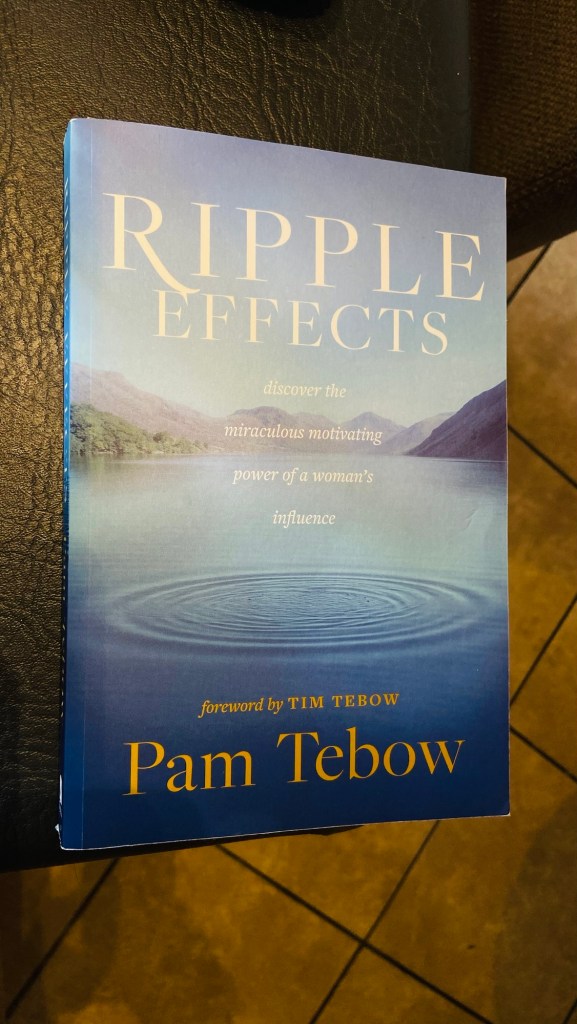
Did you know that Tim Tebow, the American football player, grew up as a missionary kid in the Philippines? I came across this book lately, and have received blessing and challenges from it! Some of the stories and challenges sound familiar.
Pam Tebow shares how she was given multiple appointments to reflect Christ and share the gospel through difficult and challenging times. In fact, the level of difficulty of what she endured turned up the volume on what she was saying. Pick up a copy!
Future Appointments
Next October, Lord willing, we will be in Norway for a conference. David is teaching on developing a Biblical Worldview. I mentioned this to my new contact in the plane flying over Africa. Who knows! Maybe David and I will see him again!
My job is to show gratitude to my Saviour by being available to testify for Him whenever He asks. The fruit is His business.
Be ready! You may have divine appointments coming up.
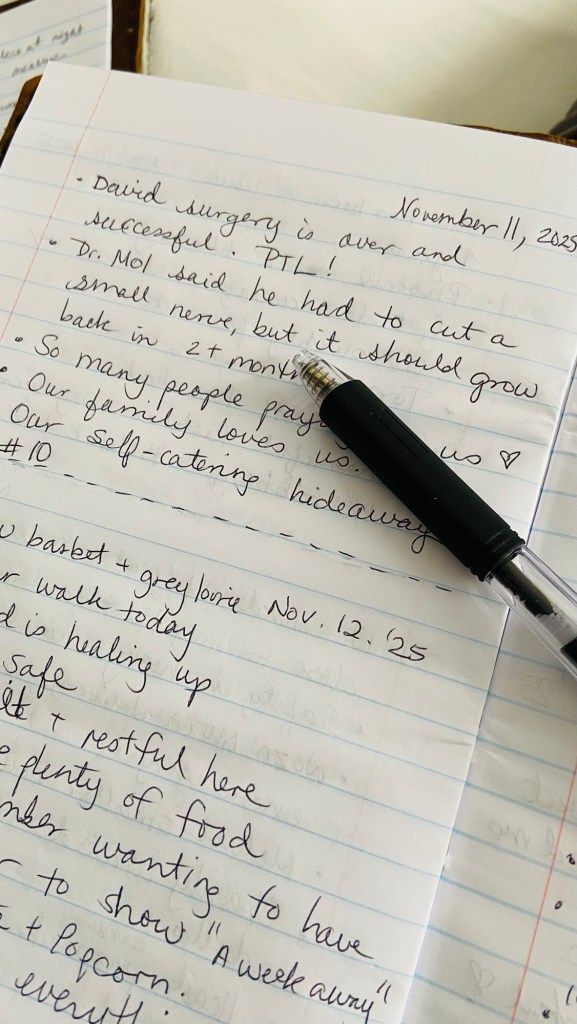
I told David I was recording things in my th(i)nkful journal. Every evening before bed, I seek to count and express things for which I thank God. I find that it is not difficult at all. I usually don’t have enough room in my journal. Over time, the discipline becomes a delight as God gives you a heart to look around and recount His good gifts.
When I first started this habit in July of 2017, it took some conscious thought to discover items to write down, but now…. super easy. As I am going through my days now, my th(i)nkful search engine stays busy in the back of my mind. Is this something that I will record tonight in my th(i)nkful journal?
In giving counseling homework, I am adamant about including thinking thanks. I want my counselees to write down things daily, or to verbally express things, that they are thankful for. I want to inspire them to begin to count.
Take Into Account
The definition of count is take into account. I think of a bookkeeper who carefully logs the correct numbers to keep accurate records.
I will recount the steadfast love of the LORD, the praises of the LORD, according to all that the LORD has granted us,
Isaiah 63:7
… that I may recount all your praises,
Psalm 9:14
We give thanks to You, O God; we give thanks, for Your name is near. We recount your wondrous deeds.
Psalm 75:1
But we your people, the sheep of Your pasture, will give thanks to you forever; from generation to generation we will recount Your praise.
Psalm 79:13
I shall not die, but I shall live, and recount the deeds of the LORD.
Psalm 118:17
The Lord seems to want us to recount His blessings. To recount is to count again, which means stopping, backing up in time, and counting again. It’s like the word “recollect” – which means to collect again because, like doves when their cage is opened, things we can be thankful for fly away.
Do you recount? Do you recollect?
Count It All Joy
There is another place in the Word where we are exhorted to count. In James 1:2 it states that we are to “count it all joy” when we meet various trials because they have a purpose to produce steadfastness in us. This is a different kind of count. It means to consider, deem. We are to regard the trials in our life as joy.
That’s a little harder. We like counting good things, but counting hardships as joy?? They don’t seem to belong in the joy column! There’s a dark, dismal, disaster, discouragement column for those! We have to look carefully at the verses.
“Count it all joy, my brothers, when you meet trials of various kinds, for you know that the testing of your faith produces steadfastness. And let steadfastness have its full effect, that you may be perfect and complete, lacking in nothing.”
James 1:2-4
There’s a purpose to the trial, a greater good God is accomplishing. The testing of our faith produces steadfastness – “sticktuitiveness” – the ability to stay steady and not freak out under pressure. One way to look at it is that we are like functioning, active products that the Lord is manufacturing. You wouldn’t want to use an appliance or drive a car that had never been tested. That testing-refining-testing-improving process is what matures us, helping us to become “just perfect” for the job God has for us to accomplish.
So, we have to value, and even celebrate, our trials because God is using them to make us different from our original selves, to reconfigure our thoughts, desires, behaviors, and responses to be like His Son. As we increasingly understand the character of God, we can try to figure out and appreciate what He wants to do in us through the trials. This is not so easy and sometimes takes years.
Count Your Many Blessings
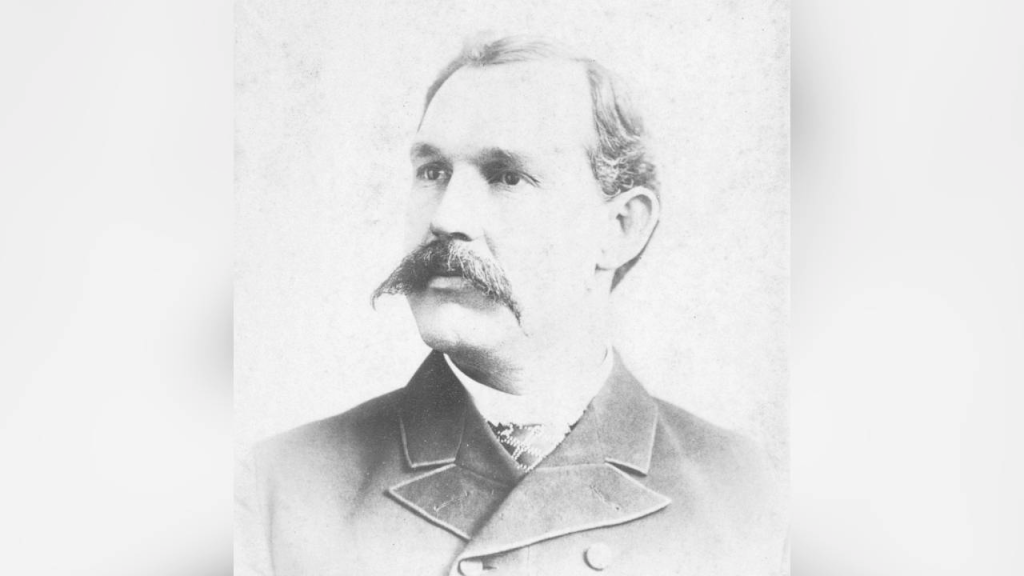
Johnson Oatman, Jr. was born in Medford, NJ. He lived from 1856-1922. Count Your Blessings, written in 1897, was Oatman’s masterpiece and E. O. Excell wrote the music for it.
Johnson is known for writing many hymns, but this one is his most popular one. It seemed to find favor with God’s people right from the beginning. While in London, revivalist Rodney “Gipsy” Smith announced the hymn to his audience by saying, “Down in South London the men sing it, the boys whistle it, and the women rock their babies to sleep to the tune.”
When upon life's billows you are tempest tossed,
When you are discouraged, thinking all is lost,
Count your many blessings, name them one by one,
And it will surprise you what the Lord hath done.

  REFRAIN: Count your blessings, name them one by one;
  Count your blessings, see what God hath done;
  Count your blessings, name them one by one;
  Count your many blessings, see what God hath done.

Are you ever burdened with a load of care?
Does the cross seem heavy you are called to bear?
Count your many blessings, ev'ry doubt will fly,
And you will be singing as the days go by. [Refrain]

When you look at others with their lands and gold,
Think that Christ has promised you His wealth untold;
Count your many blessings, money cannot buy
Your reward in heaven, nor your home on high. [Refrain]

So, amid the conflict, whether great or small,
Do not be discouraged, God is over all;
Count your many blessings, angels will attend,
Help and comfort give you to your journey's end. [Refrain]
Maybe you need to do some counting, even as a family around the Thanksgiving dinner table. We discover that when we begin to number the many blessings, our perspective changes. We are so incredibly blessed. God has been so good to us. We have been redeemed and given an overwhelmingly different future if we have placed our faith in the work of Christ on the cross. If we face trials, we know that we have a Divine designer and developer managing every detail for our long-term good and His long-term purposes. Even if we face leaving this world, we can be at peace because our mind is stayed on the Lord and we trust in Him (Isaiah 26:3).
I will give thanks to the Lord with my whole heart; I will recount all of your wonderful deeds.
She lied! There was actually no doubt about the action. It was a blatant, outright falsehood. How could Sam forgive her? The damage to his trust, to their relationship, had been done. Why did he need to tell her the truth anymore? Why not betray her trust as she had done his? That seemed fair.
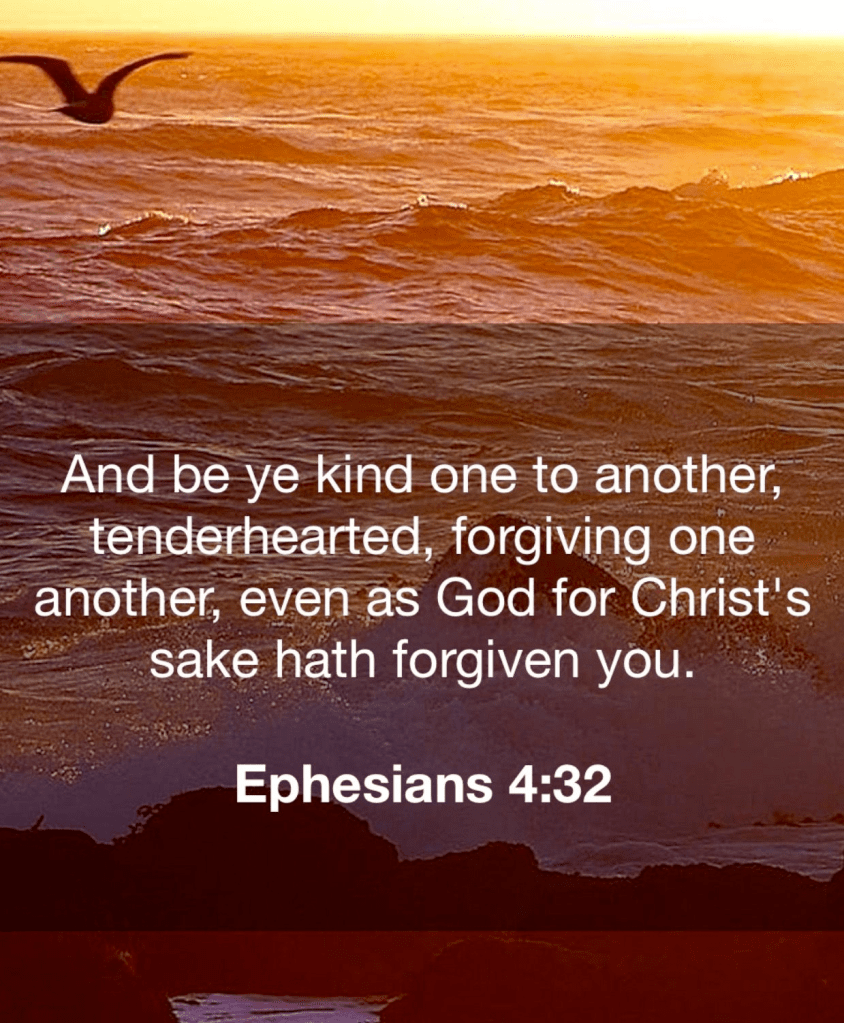
As Sam met with his friend and shared about his pain and anger, the friend pointed him to Ephesians 4:32. “Be kind to one another, tenderhearted, forgiving one another, as God in Christ forgave you.” The contrast was glaring. Sam’s friend suggested that the response to the hurt be kindness in return. What??
In Scripture, we often see the irony of opposites. Tozer once wrote about these opposites. “[A Christian] empties himself in order to be full, admits he is wrong so he can be declared right, goes down in order to get up, is strongest when he is weakest, richest when he is poorest, and happiest when he feels worst. He dies so he can live, forsakes in order to have, gives away so he can keep, sees the invisible, hears the inaudible and knows that which passeth knowledge.”
Now, when we have been mistreated, abused, and sinned against, it is correct to confront in love and to speak truth to the offender. But you also need to forgive, not because they deserve to be forgiven, but because God through Christ, has forgiven you. We don’t forgive because we don’t really appreciate the depths to which we ourselves have been forgiven.
Forgiveness Linked to Being Th(i)nkful
When a person is working through what it means to forgive and not harbor bitterness, there’s a battle within. It feels wrong that the offender doesn’t get what they deserve. And then there is an ‘aha’ moment when we realize that we don’t forgive an offender because they deserve to be forgiven. We forgive because we are so enormously thankful for how God forgave us through Jesus. Forgiveness begins with thankfulness. How thankful we are that we didn’t get what we deserved!!
Think about this admonition.
“Bless those who persecute you; bless and do not curse them. Rejoice with those who rejoice, weep with those who weep. Live in harmony with one another. Do not be haughty, but associate with the lowly. Never be wise in your own sight. Repay no one evil for evil, but give thought to do what is honorable in the sight of all. If possible, so far as it depends on you, live peaceably with all. Beloved, never avenge yourselves, but leave it to the wrath of God, for it is written, ‘Vengeance is mine, I will repay, says the Lord.’ To the contrary, ‘if your enemy is hungry, feed him; if he is thirsty, give him something to drink; for by so doing you will heap burning coals on his head.’ Do not be overcome by evil, but overcome evil with good.”
Romans 12:14-21
As we think thanks about God’s forgiving us for the millions of evil thoughts, motives, actions and words we have had through our lifetime, and continue pondering the new foundation of the Word, the Spirit and a clean conscience He has given us to stand on, we can release the stone of unforgiveness towards the one who has maltreated us. It may take time. It may need to be worked through with a counselor. But as we think thanks on how God has forgiven us, it gives us a motive to forgive, too.
Releasing Them Releases Us
We don’t forgive others just because we have been forgiven. We also forgive because harboring bitterness and waiting to take revenge is a toxin that poisons us, not them; a cage that imprisons us, not them. Harboring unforgiveness and bitterness has mental, emotional, and biological consequences for us.
There is a release and renewed vigor when we choose to forgive. There is a wonderful freedom that comes from forgiving a person that has hurt us, even if that person has since died. God has created us and He knows that forgiving is what will eventually bring deep healing. The irony is that people often hug their prison cage and sip at their poison. God forgives us so that we can release others and thereby release ourselves. The Lord will deal with the wicked and the unrepentant.
Sure, the optimal scenario is when the offender comes and seeks forgiveness. Until then, we give “accorded forgiveness” based on our own resources as those who are thankful that we have been forgiven much. But when an offender seeks forgiveness, then we enthusiastically give our “completed forgiveness.” Forgiving doesn’t mean forgetting, but it is one big decision followed by a thousand small decisions not to bring the matter up again by way of revenge. Forgetting is weakness. Forgiving is strength.
To forgive is to imitate the God who forgave us and continues to forgive us even when we fail to ask. We are so very thankful for His steadfast love and faithfulness, and our forgiving others begins with that thankfulness.
“We don’t forgive because we don’t really appreciate the depths to which we ourselves have been forgiven.”
A thinker recently told me, “Every mature man needs to figure out who is his god.” I liked that. Do you know who is your god and how you worship that god? You do worship, you know. Whether you are aware of it or not. Every human being worships something or someone.
Do you realize that with any other god beside the One True God, you can never be fully thankful.
A god, or idol, is anything that wins over the true God when two ways diverge. When you come to a fork in the road that requires a choice, you pick what you worship.
Counselors have identified three main gods or idols: the god of comfort, the god of control, and the god of people-pleasing, but they take on varied mantels to attract us and pull us in.
Tim Keller identified several similar Idols: power, work, achievement, image, dependence, independence, religion, irreligion, inner ring, racial/cultural, ideology, materialism, family, relationship…..
Most of us feel a pang of guilt when these idols are mentioned. Most of us could raise our hands that we battle with more than one. There is one sure thing: these gods always disappoint and fall short. These gods will leave you unthankful because they cannot be relied upon.
If you have formed a relationship with the One True God, Yahweh, His character and promises are unchanging, and though His ways lead into deep darkness at times, we know that He is micromanaging every detail for His plan and glory and for our good.
You want to worship such a God the way that He desires you to worship. He desires to cleanse you from your sin and to make you new. His new life and indwelling Spirit changes you from the inside out. He begins to renew your mind as you put off the shackles that belong to another god, and put on the things that please the true and righteous God.
As we conform to the image of the Lord Jesus, we become less us and more Him. We live life with a different perspective than someone who lives for the deceptive and disappointing gods of this world. One of the elements of Christlikeness is to live life thinking thanks to the Father (Matthew 11:25, Luke 10:21, John 11:41, Colossians 1:3).
As we think thanks, we learn to see His fingerprints in our every day lives. Our minds look for things to give thanks for on a continual basis.
The beautiful thing that happens to us when we worship the One True God is that He satisfies us. In His presence is fullness of joy (Psalm 16:11).
Deep Darkness
One of the true tests of what your worship happens when you are going through difficulties. It is easy to be thankful and trust God when things are going smoothly.
What about in ‘deep darkness?’
Psalm 23:4 says that even though I walk through the valley of the shadow of death, I will fear no evil, for You are with me; Your rod and Your staff, they comfort me.
The “shadow of death” can be literally translated as “deep darkness.” Even in the times of deep darkness I do not need to fear evil. The reason the psalmist gives is because the Shepherd is with me, His rod and staff comfort me. If you have the god of comfort, you will be very uncomfortable. If you have the god of control, you will be outraged. If you have the god of people-pleasing, you will struggle to keep your friends and family happy in the deep darkness.
Thinking thanks even in the deep darkness seems almost impossible even with the One True God. It feels like it is hard just to breathe. Yes, it is very hard. And it may take a long time before we are able to get to the point where we can even contemplate thinking on something that we can be thankful for.
But when we finally look up, we will see that we did not wander off on our own; the Shepherd has been there. Then we can begin to see things that are gifts from the Shepherd, and then follows a slow release of a deep joy that builds as we gain perspective from a distance.
He has not left me to wither up by myself. He is with me!
Just that thought is enough to give you cause for thinking thanks. He has not forsaken me. He cares about me intensely. He has even counted all the hairs on my head. He loves me with an everlasting love that will not end (Jeremiah 31:3).
God’s Trusted Character
So who is your god? Do you know? Have you identified who it is?
The gods of this world that I am tempted to worship are temporal. They do not satisfy. Yes, maybe there is quick, temporary satisfaction, but they will never follow you into the deep darkness. Only One Shepherd will.
If you worship the God of the Bible, you have the confidence that He is the Blessed Controller of all things. He will work all the difficult things together for my good, conforming me into Jesus’ likeness.
Actively pursue thinking thanks. Figure out a way that works for you. Whether you say it orally to someone daily or write it down or make a voice message to someone. Weave it in to the fiber of your life. Obey the Shepherd who walks with us and guides us.
“Give thanks in all circumstances; for this is the will of God in Christ Jesus for you.”

























 th(i)nkful