Second Right

Anxiety My Enemy

Anxiety is not my friend.

I have had a propensity towards being anxious as long as I can remember.  Philippians 4:6, which says, “Don’t be anxious about anything,”  has been a place where I have parked often.

Recently I had a friend point out some valuable insights into that passage. When you consider the verses that surround the famous verse 6, you get a better picture of what Paul was exhorting the Philippians to do.

4 Rights

Let’s take Philippians 4:5-9 apart. There are 4 Rights in this passage – Right Awareness, Right Praying, Right Thinking, and Right Practice.

1. Right AwarenessRight Awareness

(v.5 CSB) Let your graciousness [gentleness, reasonableness] be known to everyone.  The Lord is near.  When we are in a conflict or facing hard circumstances, that pressure can cause our words and reactions to be filled with spikes and poison.  We need to realize that God is right here in our presence (Matthew 28:20, 1 Corinthians 6:19, Hebrews 13:5-6), and we are right there in God’s presence (Ephesians 2:6, Hebrews 10:19-22)!

Every sin that we commit is a result of a wrong view of God. If we practiced His presence, we would sputter and fume less and speak to Him more.  Jesus tore down the curtain into the Holy Place by His work on the cross, and we are allowed to enter in without a priest and speak to the God who created or permitted these circumstances!  The Lord is near is a great reminder that we should turn our thoughts toward Him and pour out our hearts.  He is there observing us; He fights for us; He prays for us. He is at hand in formulating the trial and filtering the toxic to get us to trust Him and talk to Him.

2. Right Praying.

(vv.6-7) Do not be anxious about anything, but in everything by prayer and supplication with thanksgivingRight Praying 2 let your requests be make known to God. And the peace of God, which surpasses all understanding, will guard your hearts and your minds in Christ Jesus.

This SECOND RIGHT is the one I want to emphasize. In the middle of instructing us to ask God to respond to our needs in specific ways, Paul adds “with thanksgiving.”  We are to pray earnestly (“please help with this”) with thanksgiving (“thanks for this”). We need to think thanks about what is testing us and express that thanks to God.

How do we do that?  We choose to look for things that we can be th(i)nkful for right in the difficulty.  It is after praying this way that the supernatural peace comes that will guard our hearts and minds in Christ Jesus. In fact, some would argue that thanksgiving is the trigger for downloading God’s peace.

3. Right Thinking.Right thinking

(v. 8) Finally, brothers, whatever is true, whatever is honorable, whatever is just, whatever is pure, whatever is lovely, whatever is commendable, if there is any excellence, if there is anything worthy of praise think about these things.

Having rolled my burdens onto the Lord, it is amazing how quickly I grab them back and then stress over them as though I am the only God who can fix them.  Paul writes that the battle is in our meditations. I need to focus on what’s true, honorable, right, pure, lovely, commendable, excellent, and praiseworthy.  By way of contrast,  what we should not think about are things that are untrue, improper, dodgy, blameworthy, evil, dubious, unethical, shameful, ignoble, and disgraceful, to name a few.

4. Right Practice.

(v.9) What you have learned and received and heard and seen in me – practice these things, and the God of peace will be with you.

So after we have now learned this new way of living – right awareness of the Lord’s presence right here, right now, right praying that always includes thanksgiving, and right thinking that fuels our outlook and conduct, we are to DO this over and over.  We practice this.  We are not just hearers of the Word, but doers.

Second Right

Being th(i)nkful is a direct cure for anxiety.  When we worry, we are not trusting that God is in control.  When we are th(i)nkful, we are resting in His sovereignty and choosing to meditate on all the things we can be thankful for instead of untruths that fuel our anxieties.

Dr. Shelbi Cullen, my counseling internship professor at Master’s Seminary, shared these thoughts to help me help others, but I have found that it is first helping me.  🙂

  1. Remember that the Lord is right nearby.
  2. Pray hard with thanksgiving.
  3. Think the right way.
  4. Practice these things.

Practice th(i)nkfulness to vanish anxiety

ALMOST ~ AM LOST

On Israel’s Shore – Caesarea Maritima

Herod the Great built Caesarea in about 10 BC.  He did the impossible – conquered an unruly sea and built jetties and an entire port on the Mediterranean Sea, complete with lighthouse, temples, a palace, and a hippodrome for chariot races and gladiator games. This city was home for Rome’s leaders – Pilate, Herod Antipas, Herod Agrippa I and II.

About 30 years after Jesus died, this city was the setting for Acts 26:28 where the imprisoned Apostle Paul gave his defense to King Herod Agrippa II and Festus.  Paul skillfully related his testimony, his story of conversion, and gave a reason for his life’s commitment to spreading the gospel.  In response, Agrippa uttered his famous words, “You almost persuade me to become a Christian!”

The Problem With “Almost”

Our guide for our recent study trip to Israel chose that setting to share his own personal testimony.  As we stood cooling off our feet in the beautiful Mediterranean, he described that as a rebellious young man, he decided he was finished with church and God and was leaving home to live his own life.

As a token gesture, he went to his home church to say “good-bye.”  That evening, the sermon was on Acts 26:28.  The speaker emphasized the irony of the word ALMOST.  If you switch the L and the M in that word, you come up with a related concept ~ AM LOST.  Being almost a believer is the same as being totally lost. How very, very sad.

IMG_5978

The result in our guide’s life was that God’s Spirit used that to break his rebellion and catapult him into seeking an intimate life-giving relationship with the Lord.  Eventually he went into ministry and has been training church leaders for 25 years.

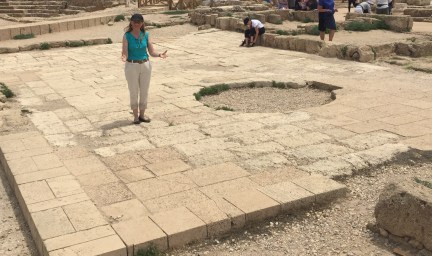
We climbed up a small hill from the beach and walked out on to the very stone pavement where Paul spoke these words. How sobering to realize the ongoing living power coming from the Biblical account that took place right where we stood.

And how amazing to think that Paul’s words to “give thanks always for all things” were written during this imprisonment.  I am th(i)nkful for our brother Paul’s faithful testimony during that long test that God sovereignly allowed in his life. How often we become very impatient with how God has written our story.  We chafe and complain because it is hard for us and we don’t see the reason for the difficulties. Ever spend three years in prison for no good reason and wonder what God is doing?

Th(i)nkful For Grace

One of the outstanding lessons for me is that I am so incredibly thankful for “grace” – unmerited help and assistance from God.  That same grace that helped Paul through all he experienced as he was imprisoned and beaten is also fully available to me.  The grace that helped our guide respond to the challenge of Acts 26:28 is freely presented to all who desire to believe. Th(i)nkful that God is so merciful and faithful, quick to forgive, and slow to wrath.

Irony of the Aqueducts

Herod’s masterpiece on the Mediterranean – like so many other things he built in Israel – is in ruins, barely visible, just toppled rocks that beg for imagination.  The Caesarean aqueductsIMG_5834 that used to bring down fresh water from the foothills of Mt. Carmel are now dried and cracked.

But God’s living water, reflected in the life, words, and ministry of Paul, is still flowing steadily for all who would drink. People like our guide are still brought to life by the words of the living water uttered on that stone platform in Caesarea years ago.  And the flow, growing stronger and stronger these days, is reaching into the spiritual deserts of countries and communities that have never heard. Sola Deo Gloria!

Lives Still Transformed

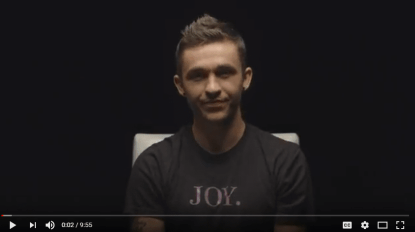
Paul gave a compelling testimony of the saving and transforming power of Jesus Christ. So did our guide in Israel.  Your story is powerful, and no one can argue with it. Our friend Josh Chapmon is a videographer who has a ministry helping Christians record videos of their testimony simply using a smart phone to upload them to the internet. Check out God’s story in the life of Chris Dew!


Then Agrippa said to Paul, “You almost persuade me to be a Christian.”  And Paul said, “I would to God, that not only you, but also all who hear me today, might become both almost and altogether such as I am, except these bonds.”

Acts 26:28-29

What is Th(i)nkful?

Definition

Th(i)nkful: a determined choice to download grace/strength from the Lord to think thanks about every circumstance in my life and to express that thanks orally or in a written form.

So…practically what does that really look like?

30,000 Feet Up

In counseling we are taught a principle to use when helping someone who is, as we say, “lost in Manhattan.”  They’re in a maze of tall troubles; they spin around disoriented, feeling lost and hopeless.  How can we help them?

2018-4-17

It is called getting them “30,000 feet up.”  Imagine yourself pulling them up to 30,000 feet and then looking down at their problem – viewing things, you might say, from God’s viewpoint.  The giants are now small.  You can look down on streets and see the main roads out of the city.

Getting a better and higher perspective on what really matters can be the key that gives hope and helps us cope. What is the big, big picture? We were born, we live, and we will die. What is going to really matter in the long run?  Will it matter 100 years from now?  And for all the darkness in the city of my life, where are the lights?  Where are the signposts?  Who put them there for me, and how can I tell Him “thank you?”

Th(i)nkful Created

I stumbled over the th(i)nkful concept while going through a difficult time in my life.  I knew from scripture that I was to give thanks in every circumstance, but I was hard-put to do just that. As I studied out the etymology of the word thanks, I discovered that it came from the ancient root word tong which meant to think/ feel.  Expressing thanks is based on 1) stopping, 2) reflecting on your circumstances, and 3) choosing a positive thing on which to focus.  Thank comes after think.  Expressing thanks doesn’t just happen naturally, and especially not when times are hard.

So th(i)nkful was created to encourage us all to forge a life-pattern of repeatedly stopping, thinking, choosing the good, and expressing our thankfulness for, and our thankfulness to … the One who is the source of every good and perfect gift (James 1:17).

This life-pattern is being th(i)nkful, first thinking, then choosing the good, then giving thanks.  Expressing the thankful thoughts, either orally or writing them down, enforces the brain neuron pathway. Every time you push yourself to be th(i)nkful you secure that brain pattern a little bit more. You choose to focus on the things you can give thanks for.  You also need to give the gift of your gratitude to the One who deserves it.  We are thankful to, not just thankful for.

Th(i)nkful List:

  • I have a brain that allows me to think
  • Phil. 4:13 promises me strength to obey God when He asks me to give thanks always
  • the blessings that follow gratitude, like peace, contentment
  • discovering joys and pleasure that I take for granted, like when pain goes away
  • th(i)nkful journals that allow me to record my thankful thoughts
  • reading the journals later remind me to continue to think thanks in the present
  • focusing on my blessings, minimizes my difficulties


2018-4-17 1


I choose to focus on the silhouette in this picture.  Daming Lake, Jinan, China

Godliness with Contentment is Great Gain

Contentment

The Battle for Contentment

Contentment is being totally at peace with having nothing more and nothing else.  It is therefore the greatest wealth a person can have.  Contentment is simply wanting only what I already have.  There is no angst; no imagining, no further search.

Have you ever felt totally content?  OK, maybe after a big meal on a soft couch when you are dosing off to sleep. Most internet pictures for contentment have people relaxing in tranquil surroundings. But have you ever chosen, independent of circumstances, to be content?  It seems almost impossible for us as humans.  The relentless stream of advertisements on TV or websites are designed to ensure that we are never content; after all, one week of nationwide contentment could destroy our economy!

We all, it seems, have the “dis-ease of discontent.”  Our hearts long for more comfort and convenience, greater perfection in our things and relationships.  We try to satisfy this internal quest for harmony and heaven by relentlessly striving to achieve it here and now.  So, we never have enough or have it exactly right. We are discontent.

The Source of Contentment is Within

D. Martyn Lloyd-Jones, in Spiritual Depression: Its Causes and Cures, writes that the “godliness with contentment” mentioned in 1 Timothy 6:6 is the best virtue combination a believer can have.  The first is vertical; the second horizontal.  Both come from within. Both are independent of our outward circumstances and physical conditions. Both communicate, “all I need is a deep relationship with God – not much else matters.”  Lloyd-Jones points out that this brings great gain, a phrase not often used in Scripture. Contentment is the greatest wealth.

Contentment and Ambition

But are we to become a blob? Can athletes and scholars and artists achieve great things while being content?  The Scripture is clear that we can have godly ambition.

  • Firstly, we should have an insatiable quest to know, love and serve Him with our whole heart and life (Psalm 27:4. 63:1, Philippians 3:10).  I must never become content in my spiritual life.
  • Secondly, we should push to wholeheartedly do with excellence things that honor God by reflecting His image in us (1 Corinthians 10:31, Colossians 3:23-24).  We must be content with the gifts, appearance, power and possessions He has given us, but then use them all wholeheartedly for His glory.

Ungodly ambition is the drive for fame, validation, power, wealth, possessions and pleasures to fill up a personal void with the stuff that promises happiness and satisfaction … and that stuff will never be enough.  This is why Puritan writers felt that ambition was one of the most deceitful sins.  Many leaders “attempt great things for God” out of unholy ambition.

Being Th(i)nkful Brings Contentment

When I learn the discipline of thinking thanks, contentment oozes slowly into my heart. Gratefulness focuses on what I have, not on what I lack.  It takes away the fuel of discontent; the fire goes out.  Nothing really changes in my life, except for what I am thinking about and expressing.  I choose to be th(i)nkful.

Southern-Africa-Panorama-MapDavid and I are moving back to South Africa in a few months. We will go alone to this land; we will leave family behind.  We plan to study the Zulu language diligently, and then teach the Bible, theology and counseling to emerging Zulu leaders, and help them begin a church-planting movement.



As I am thinking about the changes that lie ahead, there are days when I struggle to think thanks.  I am tempted to think about precious children and grandchildren who will be out of reach.  That is so hard and heavy for me.  But when I think about how God has given me joys in the journey that are undoubtedly His fingerprints of mercy, I am th(i)nkful.  He will help us.  He will measure out grace. I have already started a th(i)nkful list about our move.

Join me in the discipline of thinking thanks so that together we can cultivate contentment, and in the process become more godly.

Godliness with Contentment is of Great Gain ~ I Timothy 6:6

Ministering Thoughtfully

The Power of Compassion

visiting-in-hospital-small-e1517239570647.jpg

Family Visit To Grandmother In The Hospital

Have you ever had someone come visit you in the hospital when you were sick?  Isn’t it amazing how you remember that so well?  The morning my mom died, our pastor’s wife, a dear personal friend, came to our house.  She didn’t say much, she went into the kitchen and started to do my dishes.  She was just there.  Wow!  I can hardly think back on that without tears.

What makes those visits stand out so much in our memories?  The answer is “connection,” a bond formed simply through a quiet presence and a listening heart.

Consider the difference between empathy and sympathy.  Recently I watched a 2.53 minute YouTube video by Dr. Brené Brown on that topic.  Although I may not agree with all she said, she gave me food for thought. Empathy connects a person who is going through something hard with someone who cares and listens.  When a person is going through a challenging time, the last thing they may want to hear is: “Just write down things you are thankful for.” You first have to have the connection.

oops 5


“People don’t care how much you know until they know how much you care.”

― Theodore Roosevelt

How Do You Inspire Others

Come. You need to be there. Two of the greatest promises the Lord has given us are, “I am with you always,” and “I will never leave you nor forsake you.” Being there for someone is being like Him.  We worry about what to say, but that’s not our main role. A cat or a dog can be a comfort, and they say nothing – they are just there.

Listen.  Maybe the person does want to talk about what is troubling them. Good.  Just listen.  Tell them that you are thankful they shared with you, that you can imagine it is so hard.  In time, if connection is made and the person feels safe, they may be open for solutions, but don’t rush that.  Let them become thirsty for options and ready to hear.

Pray.  Pray for them specifically, and pray for you to have wisdom. Pray for grace for them to pass this test. God is the One that untangles the mess. We cannot help everyone, but need to do the will of the Father – like Jesus did.  Discover what that is through the Word and the Spirit’s guidance.

Serve.  Look for practical things you could do for them that would be helpful. Make a meal.  Take care of their kids.  Bring a present.  Send a personal note or text.  Visit them in the hospital.

Recall. One of the most powerful ways to inspire others is to share your own story, how you came through a struggle.  No one can argue with that.  It is yours.  If you personally have been helped by cultivating gratitude in your thoughts, you can share that.

Own. Being th(i)nkful works, but you must own it yourself before you can do it well. To own something you have to believe in it. You have to be convinced that God actually means what He says in I Thessalonians 5:18. “In every circumstances give thanks; for this is the will of God in Christ Jesus concerning you.”  When sharing the concept of thinking thanks, give the other person time to own it themselves before trying it.

Share. Tuck in your pocket I Corinthians 10:13 in case you get the chance to share the promises located there. God says that He will “with the testing make a way of escape.” Notice that it is with the testing, not from the testing.  God helps give us escape while the testing is ongoing. Could a possible ‘way of escape be thinking thanks?

Three Lessons from Having Received Ministry

  1. Thank the Lord for motivating the person who did the compassionate thing and reached out.
  2. Express to that person how incredibly helpful it was to receive their ministry.
  3. Be inspired to BE that to someone else.

oops 4

Th(i)nkful: a determined choice to download grace/strength from the Lord to think thanks about every circumstance in my life and express that thanks orally or in a written form.


Th(i)nkful in Shungnak, Alaska

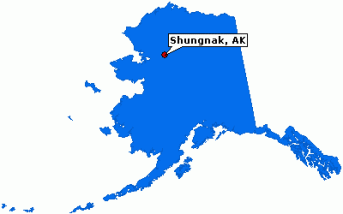
Do you know where Shungnak, Alaska is?

Alaska2

I did not.  I knew that it was very far north and that the pictures reminded me of Brumunddal, Norway, where I grew up.  I know where it is now.  Carl Boley writes a blog from his adventures these days as a first year teacher in Shungnak (he’s also on Facebook). He shares fascinating insights of how life functions in this remote Alaskan village that you can get to only by plane or sled.

His last two posts really caught my attention.  When the dark time settles in up in the very far north, it is easy for “emotional darkness” to reflect the physical conditions.  People really battle depression.  Alcoholism and suicides are common.  In Carl’s November 24 post, although the deep darkness and cold were still intensifying, he chose to list things that he was thankful for.  What a post!  He skillfully picked seven things for which he expressed gratitude.

Listing Things You are Thankful for

Alaska 12

After reading Carl’s post, I was so encouraged and challenged!  I could feel hope and warmth even though I know that circumstances are getting even more difficult – the high tomorrow is -28F!

This was such a good reminder.  My circumstances can have two reads: I can read the cold darkness and be as accurate as a thermometer, or I can choose to think thanks in the same situation, finding the warmth and light, and by finding it, magnifying it.

Although the simple, childlike activity of listing things I am thankful for doesn’t seem earth-shattering, it can actually shatter my earthly perspective and reveal God’s treasures amidst the ghostly shadows and acrid dust. The God who is sovereign in every detail of my situation has provided a way of escape for me to handle difficult things.  I can choose to think thanks, and then I can choose to express it to Him and to others.

Th(i)nkful: a determined choice to download grace/strength from the Lord to think thanks about every circumstance that comes my way and express that thanks orally or in a written form

 Check out Carl’s Blog at: Boley in the Bush Blog.


Pathway through the Woods

Brain Neural Pathwaywooded debris 1

Cultivating  th(i)nkfulness can be compared to carving a path through the woods.  It  seems overwhelming at first with debris and obstructions.  It takes great effort to remove fallen logs and roots.  You may need some tools like a spade and a chainsaw, or good sharp clippers.

Our brains are similar in that forging a new brain pattern or neural pathway in order to create a new life habit is daunting at first but gets easier with time. God has created our brains to be able to do this.

Neuroplasticity is the ability of the brain to form and reorganize synaptic connections, especially in response to learning or experience or following injury.

How Do I Do It?

The first practical step you do when beginning to carve a brain path, is to deliberately lay out a plan. Your goal is to have your thoughts automatically head towards what to think thanks about in any given situation. You begin to search in your thoughts for things that you can be thankful for.

If you are in an unusually happy situation, it’s not very hard to find things to be thankful for. Even in normal, day-to-day times it’s not hard to begin to discover th(i)nkful items.

However, when hard times come, the difficulty  level rises to delineate thankful items. Let me illustrate with this example from my friend Dawn:

“My heart was tempted to complain about the mounds of laundry today. The Holy Spirit reminded me, “Be thankful. Think thanks.”

So as I’m folding I start saying in my mind…
Thank You, God for these clothes.
Thank You for your provision of new and used hand-me-downs.
Thank You that they are clothes we got to choose and that we like them. 😊
Thank You for the little (and big) legs that move to make these pants dirty.
Thank You for the soap to wash them.
Thank You for the washing machine that washes and I don’t have to do it by hand.
Thank You for the tumble dryer that works in my basement, and that I don’t have to air dry them in the cold.
Thank You for the dryer that gets the wrinkles out so I don’t have to iron.
Thank You that I am able to be at home and squeeze this chore in between schooling.
Thank You for the energy and wellness to do this. I’m not sick in bed.
The list could go on…
Be th(i)nkful. Think thanks when you’re tempted to complain in your heart.

She chose to download grace and begin carving the neural brain pathway of thinking thanks about the situation.  She then expressed it.  Engaging in the discipline of being th(i)nkful ended up not only helping her mindset, but encouraging others to do likewise.

Patiently Conquer Step by Step

The habit of cultivatipath through woodsng thinking thanks takes time.  You have to see progress in little steps at a time.  Think about that path through the woods. As you step by step conquer the mess, soon the path becomes apparent.
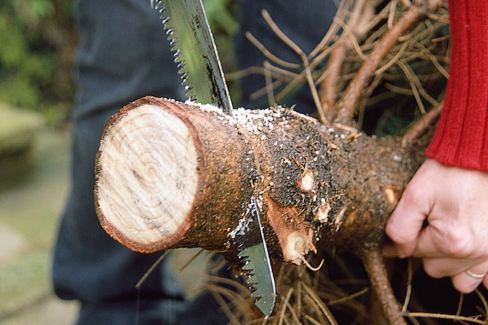

In time you will be able to run that path.  How cool!!

This exercise is much more that just creating a better mindset for us.  Practicing th(i)nkfulness is an act of worship to our Redeemer who has given us a command.  Give thanks in all circumstances.  He knows that being grateful is a key to our sanctification and maturity in Him.

So… I just wanted to get you started this year on developing that brain pathway through the ‘woods.’

Who doesn’t enjoy a walk in the woods anyway?? 🙂

wooded-path-e1513099191945.jpg

Cutting Produces Thirst

Cutting the Christmas Tree

David and I just picked out our Christmas tree.  The fresh scent of Fraser fir filled our senses as we browsed through the trees available.  We finally settled on a lovely tree that looked full and balanced.

After we paid, the attendant cut off the lower branches to make it manageable to put into the Christmas tree stand, and he cut a fresh piece off the trunk.  The purpose of cutting the main trunk was to open up the pores and allow the tree to drink in a lot of water, thereby allowing it to stay fresher longer.cutting a fir tree 1

The pores had begun to close after the initial cut a while back when it was brought from the farm in North Carolina. Without water, those exposed fibers were dead now. The trunk needed a fresh cut to open those pores again and satiate the thirst of the poor thing. This cut was for the good of the tree, to enable it to fulfill its purpose well. Now the tree could stay hydrated longer to keep its needles, and grace a family’s living room.

A Fresh Cut Will Make Me Thirsty

I thought about how this compares with our lives.  Our spiritual “pores” will often close or grow calloused over time; I don’t feel the need for God, and I don’t talk with Him, like ever.  It is when I receive a fresh “cut” – the pang of a trial – that the pores are wide open and thirsty again. My life is a Psalm again – crying out to the Lord and taking hope and courage in my Rock, my Fortress, and my Deliverer.

Familiarity and sameness is lovely and predictable, but they can make me grow apathetic.  I especially am a person that loves to cling to schedule and expectations.  I have found over time though, that what I need to cling to is the Lord and rest in His values and expectations, His schedule.  He often will allow a fresh cut to make me more thirsty for Him and not get too comfortable in my routine in this world.

When I have developed the habit of being th(i)nkful, there is a coping mechanism that is engaged when the cut happens. I know what to do. I begin to draw up the character and purposes of the Water of Life, and brainstorm things that I can think thanks about in the difficult situation.  Stress, anger, fear, or sadness may try to get me off track, but if I download the grace the Lord offers, and engage my thoughts to think thanks and express that thanks, there is a peace that begins to flow.

Cutting a fir tree 4

Let the fresh cuts of the Lord in your life open you wide to drink deeply from the One who offers living water that satisfies your soul.

“It is good for me that I was afflicted, that I might learn your statutes”
Psalm 119:71


Th(i)nkful – My Needs Are Met

Redefining “Needs”

Do you ever feel like you need something else to really do the will of God?  If just something was changed a little bit, or if I was able to have access to that, or if I didn’t have this, then I could be free to really be thankful and do God’s will. I Timothy 6:6-8 says:

“But godliness with contentment is great gain.  For we brought nothing into this world, and it is certain we can carry nothing out.  And having food and raiment, let us be content.”

The Greek word for raiment is skepasma and it means covering. Most people think that is referring to clothing, but it also means any kind of shelter from the elements – a roof over my head, even just for a night.  When I start evaluating my “needs” from the perspective of having food to eat today and clothes to put on my body – like two-thirds of the world struggles to have every day – there is SO much to be th(i)nkful for. Most of our “needs” are just wants, and we must never use them as an excuse to say without them we can’t really do God’s will.

Psalm 136:25-26 states, “He gives food to every living thing. His faithful love endures forever. Give thanks to the God of heaven. His faithful love endures forever.”

IMG_2561.JPG

The picture above is from a market in China.  The colors burst forth.  I love just looking at the varied shapes and textures represented. Our God is amazing.

God has provided all I need to do His will

That thought hit me the other day.  My goal in life is to please God, and I have access to everything I need to do that. 2 Corinthians 5:9 says that Paul made it his ambition, whether at home or absent, to be pleasing to God.  I want to be like that, too.  I know that God’s goal for me is to be conformed to Jesus (Romans 8:28-29).  He also mentions in that passage that every single thing in my life will work towards the good of making me like Christ.

My job is to discover what His will looks like for me. In some ways that can be a bit tricky, but what I have found over the years is that it usually is not so much that I don’t know what His will is, as that I really don’t want to do what His will is. I want to do my will.  I feel like I know what is best, and if God would just answer my prayers and let me have my will, things would turn out great.

I know one thing that is definitely part of the Lord’s will for my life. I have NO doubt about it.  I Thess. 5:18 states, “Give thanks in all circumstances; for this is the will of God in Christ Jesus for you.” I am to express thankfulness all the time.  It is to bubble out of me non-stop.

Water Pouring into BottleHow are you doing at that?  Does it come out of you non-stop throughout your day?  Start with just being thankful that you could take that last breath. You ate today. You are wearing clothes.  You can see with your eyes to read these words.  You have access to the internet and this blog and whatever device you are using.  You have just been able to read truths that will never lose their potency. One of those truths being that godliness with contentment is great gain.

“God has promised to supply our needs. What we don’t have now we don’t need now.” Elisabeth Elliot

Let your eyes peruse the following truths and be th(i)nkful.

  • Luke 12:31 – Seek the Kingdom of God above all else, and he will give you everything you need.
  • Philippians 4:19 – And my God will fully supply your every need according to his glorious riches in the Messiah Jesus.
  • Psalm 34:10 – The lions may grow weak and hungry, but those who seek the LORD lack no good thing.
  • Psalm 84:11-12 – For the LORD God is a sun and shield; The LORD gives grace and glory; no good thing does He withhold from those who walk uprightly. O LORD of hosts, How blessed is the man who trusts in You!
  • Matthew 7:11 – So if you sinful people know how to give good gifts to your children, how much more will your heavenly Father give good gifts to those who ask him.
  • Luke 12:24 – Look at the birds. They don’t plant or harvest, they don’t have storerooms or barns, but God feeds them. And you are worth much more than birds.
  • Psalm 104:21 – The young lions roar after their prey, and seek their meat from God.
  • Psalm 145:15-16 – The eyes of all look to you in hope; you give them their food as they need it. When you open your hand, you satisfy the hunger and thirst of every living thing.
  • Psalm 36:6 – Your righteousness is like the mighty mountains, your justice like the ocean depths. You care for people and animals alike, O LORD.
  • Psalm 136:25-26 – He gives food to every living thing. His faithful love endures forever. Give thanks to the God of heaven. His faithful love endures forever.


Overcome Evil with Good

CourtroomChoosing to Forgive

Last week, a friend of mine, a precious older godly lady, attended the trial of the man who killed her husband. Four years ago, her beloved’s life was snuffed out by this drunk driver.

Finally, she would have the chance to speak with him face to face.  She had come to peace with God’s sovereign choice to take her husband home when He did. She just wanted to tell the man that she forgave him. At the end of the trial, he was sentenced to 15 years without parole … and she got the opportunity to let him know that he was forgiven.

After prayer meeting, she wanted to tell David and me some things that she was thankful for in the middle of this trial. I just had to relate these to you!

  • She was so very thankful that her husband died instantaneously;
  • She was thankful that he knew the Lord as his personal Savior; he was ready for death and ready to meet the Lord;
  • The morning of his accident, he had forgotten his car keys, so he rang the front doorbell and my friend quickly grabbed the keys on the counter knowing exactly what was going on. She handed him the keys, and while he normally would have grabbed them and hurried off, for some reason, he stopped and gave her a sweet kiss. She didn’t know it was their last one, but later she saw that it was a gift from God.

th(i)nkful – Overcoming Evil with Good

light shining onLife (and the sovereign God behind it) will bring opportunities for us to choose to overcome evil with good, darkness with light. Romans 12:17-21 talks about what to do when we are served evil. Verse 21 says to not be overcome by evil, but to overcome evil with good.

Joseph told his brothers who sold him into slavery, “you meant it for evil, but God meant it for good” (Genesis 50:20). When we can see a sovereign God weaving His perfect purposes behind all of the damage others may do to us, we feel compelled to join Him in the good He is accomplishing through it.

One of the ways we can overcome evil with good is to exercise being th(i)nkful.  Just like what my friend was doing during the trial.  The facts of what happened in the accident were hard to hear again, but she saw God’s fingerprints and mentally searched for things to be thankful for.

This is not easy to do.  It is difficult, but it is possible.  Perhaps in the beginning it will only be tiny baby steps of expressing th(i)nkfulness. Little by little, discovering things to think thanks about will surface, and as we express those things, we overcome the darkness with light.

Spiritual Truth in the Eclipse

The solar eclipse coming across the U.S. on August 21, 2017 illustrates this perfectly. Believing scientists tell us (watch the video “Privileged Planet” – at 27 minutes in) that although the sun is 400x larger than the moon, God placed the moon at the perfect distance (400x closer) so that, during the totality when they examine the corona, they can detect the types of gases burning in the sun and learn about solar winds – things only possible in a total eclipse.

The spiritual truth is that when God’s face is eclipsed by the harshness of life, 1) the darkness is temporary and the light will return, and 2) if we study the situation, we will find that there are things about God we can only learn during the darkness of such an eclipse.

  1. “The first thing that you have to do if you’re going to forgive a person is to receive the grace of God.  Until you receive grace from God, and His forgiveness of you, you will not be in a position to forgive somebody else. 
  2. The second thing?  Acknowledge the wrong. Name it, whatever it was.  Name it in the presence of Christ.  Be straightforward with Him. 
  3. Number three, lay down all your rights.  Forgiveness is the unconditional laying down of the self. 
  4. And now, number four? . . .If that person asks forgiveness, forgive. . . if he does not. . .forgive him anyway in a private transaction with God.  Ask for grace to treat that person as if nothing had ever happened. Stand with Christ for him.”

Elisabeth Elliot (after her husband was killed by Auca Indians)