Envelop?
The scent was faint at first, but slowly the delicious smell grew stronger as the Swedish Tea Ring was baking in the kitchen. The tantalizing odor enveloped me as I studied in the next room.
Have you ever used the verb envelop?
Envelop: to wrap around something completely; to surround, either literally or figuratively
Literally, fog can envelop a city, or a mom can envelop her child. Figuratively, peace can envelop your mind, or Christ can envelop your life. In fact, the Apostle Paul’s use of “in Christ” and “in the Spirit” has this idea of enveloping a person totally.
Envelop Your Prayers
Thankfulness should wrap around our prayers completely. When I come to God with my circumstances or with people that I am lifting up to Him, I am giving Him no new information – He knows and has ordained what is happening. In reality, I can bring Him two things: thankfulness for the situation or person, and a petition for His help. To truly envelop a prayer with thanksgiving, you start with it and end with it.
This is the key difference between praying to a sovereign God and asking favors from the genie of the lamp. Many Christians treat God like a genie: “Please do this, and do that, and when you’re done, I need this as well.” There is no recognition that the genie has caused our circumstances for His glory and our good, and we don’t say thanks because the genie is our servant. It is said that if we treat our friends like we treat our God we wouldn’t have friends. To say thanks is to fully acknowledge that He is in control and is working out a perfectly calculated plan.


So, we should begin and end our prayer with thankfulness. Paul gives us multiple examples of praying with thanksgiving.
“Continue steadfastly in prayer, being watchful in it with thanksgiving.” Colossians 4:2
“Do not be anxious about anything, but in everything by prayer and supplication with thanksgiving let your requests be made known to God.” Philippians 4:6
“Rejoice always, pray without ceasing, give thanks in all circumstances, for this is the will of God in Christ Jesus for you.” I Thessalonians 5:16-18
Paul also demonstrates how he envelops his prayers with thankfulness when praying for people.
- First, I thank my God through Jesus Christ for all of you, because your faith is proclaimed in all the world (Romans 1:8)
- I give thanks to my God always for you because of the grace of God that was given you in Christ Jesus (I Corinthians 1:4)
- I do not cease to give thanks for you, remembering you in my prayers (Ephesians 1:16)
- We always thank God, the Father of our Lord Jesus Christ, when we pray for you (Colossians 1:3)
- We give thanks to God always for all of you, constantly mentioning you in our prayers (I Thessalonians 1:2)
- We ought always to give thanks to God for you, brothers, as is right, because your faith is growing abundantly, and the love of every one of you for one another is increasing (2 Thessalonians 1:3)
- First of all, then, I urge that supplications, prayers, intercessions, and thanksgivings be made for all people (I Timothy 2:1)
- I thank my God always when I remember you in my prayers (Philemon 1:4)
Trust Foundation
One key to praying thankfully is having the “foundation of trust” in good shape. I am currently working through Ole Hallesby’s book on Prayer and he writes:
“We realize that this deficiency in our prayer life is really due to the fact that we do not trust our blessed Lord. We think that we understand better than He does when and how our prayers should be answered.”
In order to envelop thanksgiving into our prayers, we have to trust the Lord God with all our mind, soul, and heart. He is completely trustworthy. On that basis I can be th(i)nkful and agree to receive what He is doing in my circumstances, though I don’t understand the whys and what fors, and may never understand them.
Th(i)nkful for Carmen
Her life is not easy. She has difficulties that many of us are not familiar with.  But our friend Carmen loves God and runs to Him in prayer, with thankfulness.
This precious lady in Pennsylvania is a prayer warrior for us and the mission work here in South Africa. She thanks God on our behalf and provides prayer cover for us continually.
She is growing spiritually and envelops her prayers to the Lord with thinking thanks. And I reciprocate, thanking my Lord for her as I lift my prayer to Him.
So How Do You Start?
The beauty of being th(i)nkful is that it is not hard. Even if you have not been in the habit of enveloping your requests to God with th(i)nkfulness, just start with one thing. Here are some examples:
- Thank You, God, for the people who pray for me
- Thank you, God, for the opportunity to trust you and your character today
- Thank you, God, that I am not alone in my struggles, but I can come to you
- Thank you for the access and freedom I have, through Jesus, to come boldly to the throne of grace
- Thank you for the grace that is helping me start a new neural pathway of thinking thanks
- Thank you for the person that shared the good news of hope with me
Why not start right now in enveloping a prayer to God with thankfulness?


 Think of a dog chasing a cat. The cat has no desire to stay put if a huge German Shepard is charging its way.
 (like a journal or a ring with index cards).
 My life in the will of God right now is a bit crazy. We have two “homes” – an apartment in Amanzimtoti, South Africa, and a mission-owned house in Atlanta to which we return twice a year while we train new missionaries. It is bizarre to leave home … to go back home!
 The Apostle Paul writes that the message about Jesus should be at home in us profusely, filling every room, like that Yankee Candle. His Word should fill and flavor our thinking, influencing what we want, what we mediate on, and eventually what we say and do.


 You feel like you got such a good deal. You received a benefit, but did not have to pay for it. In Norwegian and a number of other languages, the word gratis is actually used for the word free. You did not pay for it. It was gratis.
 In Namaqualand, South Africa, there is a beautiful burst of glorious flowers that come gratis with the first rains that end the dry season. An otherwise parched desert produces this kaleidoscopic carpet. What a great metaphor for a dry heart, full of ingratitude, experiencing the spring rains of God’s grace resulting in a variegated burst of th(i)nkfulness.

 The Apostle Paul used this wardrobe principle in “the twin epistles” – Ephesians and Colossians. If you are following Jesus,
  How often do you put on gratitude? Do you know where it is in your closet? Do you even own the garment? You might need to go shopping.
 Romans 12:2 says we are transformed by renewing the mind – learning to think God’s thoughts. Life isn’t about me; it’s about God. He is not my genie; I am His servant. Earth is the unbeliever’s only heaven, and the believer’s only hell. Hard times aren’t a disaster; God designs them to refine, strengthen, and improve me as an image-bearer of the Creator.
 A few years ago Dr. John Piper, a leading pastor in the States, was diagnosed with cancer. He published an interesting
  The Power of a Speaker
 But Jesus also wants to speak through you. Lack of gratitude is common; it leaves you at the audience level and gives you no platform from which to speak. Similarly, drawing attention to yourself, your courage, and your virtues in your triumphs and trials also falls flat with most people.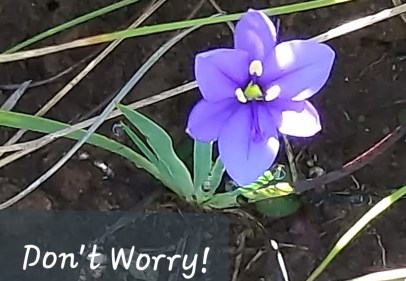
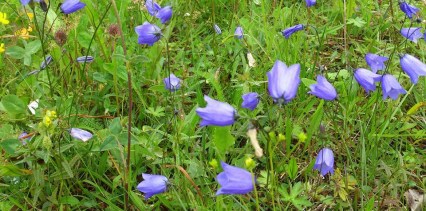 But if God so clothes the grass of the field, which today is alive and tomorrow is thrown into the oven, will he not much more clothe you, O you of little faith?
 Zooming up from Zululand, where we live now at the bottom of the earth … to Norway at the top of the earth, let me take you on a short trip. I grew up in a little town called Brumunddal, Norway. My father built a house that we called ‘Solheim’ on the hillside of Bjørgeberget.
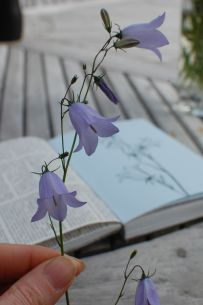
 They happened to bloom close to my birthday in July. I was so thrilled to find such beauties in the meadow on my birthday. I loved them. These wildflowers were so very delicate … frail … exquisite.
 Marc and their daughter are her joys. She has a strong love for the hurting; that does not mean just humans, but also animals of all kinds. 🙂 She struggles to see someone in pain and works so hard as a doctor to help.





 He said that, in order for us to learn to be good counselors of others, we first had to be able to self-counsel. Our assignment was to identify a sin pattern that we personally struggled with and to track it for six weeks.
 Locating or identifying the temptation is a huge part of victory (James 1:14). Personally I struggle with worry. It is insidious and sneaks into the depths of my soul. I want to comfort-eat to relieve the pressure that I feel and get my mind off the vexatious thoughts. When I react sinfully, I feel badly afterwards because I know that I have not responded in a Christ-honoring manner. So if I am able to shine the flashlight on the temptation by locating it, that is a great start.
 Lord is the next key. We are told in James 1:2 that we are to count it joy when we are tested. Jesus said we should ask the Father, “do not to lead us into temptation.” He doesn’t tempt us with sin, but He allows the situation to make us stronger under pressure (vv. 3-4), and to motivate us to call out to Him for help (vv. 5-8).
 Lingering with the Lord and sharing honestly with Him what I am struggling with, and even what I am tempted to do in sinful reaction, is like releasing the pressure that the temptation builds up. The sin especially flees if I speak it out loud or write it down. You shock yourself as you see your hand spell out the sin.