Blessed?
How would you describe a man whose mother was the ninth wife of a polygamist, and due to persecution by the other wives, chose to flee from the home forever leaving her toddler baby boy to grow up as the abandoned one among all the “other children?” He would never see her again.
When he reached his primary school years, there was so much strife in the home that he left as well, becoming a street-kid sleeping outside under bridges or wherever. Amazingly, he cheerfully and dutifully did odd jobs for people in town to buy food and pay his own way through primary school. In his early teens, he returned home only to find that his father and family were involved in intense witchcraft, so he fled home again.
As he worked his way through high school, there was a German-language teacher who had the boys come to his home for a meal, and he shared the gospel with them. God spoke to this young man’s heart, and he received Christ. He received forgiveness for his sins and a new purpose for living.
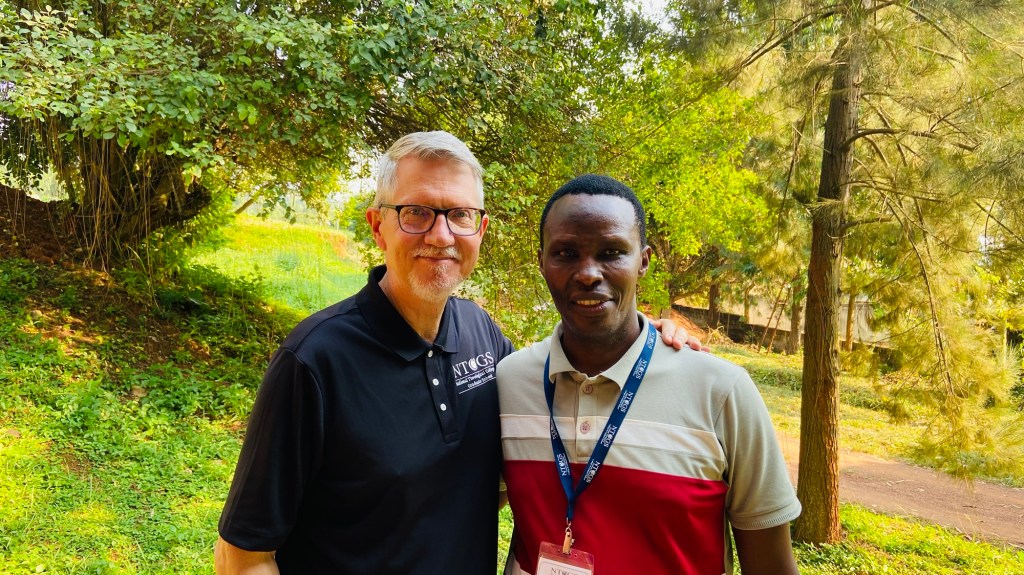
A few years later, as he grew in his faith, he worked his way through engineering school, but while working as an engineer, God called him into ministry. Now a pastor for more than a decade, he is finishing his Masters in Theology with NTCGS (National Theological College and Graduate School). David had him in his latest class.
How would you describe such a person given his horrific childhood? Would you have described him as “Blessed?” His name is Paddy Blessed Musoke.
Choosing God’s Perspective
As we discussed God’s purposes in suffering during our class time, David mentioned the seven initial responses Christians should have when facing suffering:
- God is God and I am not (Ps. 115:3, Is. 40:13-14).
- God’s ideas and plans are far beyond my human understanding (Is. 55:8-9).
- God is the sovereign over all calamities in and around my life (Job 36:32, 1 Sam. 2:6-7, Is. 45:7, Lam. 3:38, Amos 3:6, Nahum 1:3). Nothing/no one touches me without His love, permission, and design (Rom. 8:28).
- God knows exactly what I can handle with His grace, though it seems more than I can handle; He is holding back a crushing amount of suffering that might destroy my faith (1 Cor. 10:13, Dan. 3:17, 2 Pet. 2:9).
- God loves me with an everlasting love; He is always good; He is faithful and will never leave me (Psalm 119:67-68, 71, Is. 43:2, Jer. 31:3).
- God calls me to be resolutely thankful for so much during my suffering (Phil. 4:6, 1 Thess. 5:18).
- I am the servant of the Lord, immortal, invincible, and indestructible until the Lord is finished with me, and then eager to go Home when He calls me (2 Cor. 5:1-9).
Paddy came up after class and after sharing his story, related that during his devotion time in November 2023, he sensed the Lord asking him to thank Him for his hard past, for his painful childhood and difficult memories. “Thank me, Paddy.” It seemed so odd and horrible that the Spirit would ask this … and yet he knew that God had already used his past pain and street smarts in ministry. With tears, he agreed and thanked the Lord … and felt a huge burden lift from his soul knowing that the Lord had built sovereign foundations into his life, making him the man and minister that he is. He thoughtfully nodded and told us, “It is important to be thankful in all things.”
Setting Up God For A Fall
Your view of God is the most important thing about you. To the extent your view is flawed, it will distort, disturb, and disrupt your perceptions of yourself and your circumstances. Your real theology comes out in a crisis, like the squeezing of a sponge reveals whatever is inside. To use another analogy, trials are the tornado that tears off the “street view” your formal beliefs leaving exposed the basement of your functional beliefs.
There are several common ways that Christians think about God that “set Him up for failure” when they begin to suffer. In other words, popular teaching as well as the hymns and choruses we sing require more of God than the Scriptures do, so that when we suffer, we feel He has failed us, wasn’t there for us, did not hear us, or refused to respond to our deepest needs. Let’s look at some of these flawed views:
- GOD IS MY GENIE – “When I call on Him, He has magical power to grant my wishes and fix my problems.”
- GOD IS CHIEFLY MY FRIEND – “My friends don’t hurt me or let me down but run to help me in hard times however they are able … and God has infinite ability.”
- GOD HAS MY IDEA OF LOVE – “God’s love is like my love for my children, wanting only happy and positive things so that I can thrive, and His power guarantees me a smooth ride in life.”
- I HAVE FAITH IN FAITH – “If I believe, pray, and give enough, it will go well for me. If God doesn’t answer, there is some unknown sin or problem with me that is stopping Him.”
- PSALMS AND PROVERBS ARE PROMISES – “If I do what is right, God will make things good. As my shield and defender and Shepherd and Rock, He won’t allow bad things to happen to me.”
- ALL THE PROMISES OF SCRIPTURE APPLY TO ME – “As a Christian in the modern Church Age, I can claim as my own the promises God gave to ancient Israel at any time, even those given during unique circumstances.”
- “None of these diseases shall come near me” – Exodus 15
- “No weapon formed against me shall prosper” – Isaiah 54
- “He only has thoughts of good and not evil” – Jeremiah 29
God has some great relational titles: Creator, Father, Redeemer, Sanctifier, Crafter, Comforter, and Guide. I love all of those. But genie and friend are not on the list. There are no such verses that explicitly say so, and those who say God is in those roles often turn their backs on Christ, the Church, and the faith when hard trials come. “How could God … ?!” And they turn away from a God who is silent or busy or not there or not very loving. Their wrong view of God set Him up for a fall.
The role of the Holy Spirit as our Comforter is perhaps closest to the role of a friend, but God is not committed to making it easy and nice for His children as friends typically are. Ask the Old Testament prophets. Ditto John the Baptist. Ditto Jesus. Ditto all of the Apostles. Ditto the faithful martyrs through the centuries. We are caught up in the workings of a much greater plan than we can imagine, and often we need more personal shaping than we can imagine, so God’s work involves our suffering.
So when God’s Word says to give thanks in all circumstances, He knows that this will be grueling for some of us. And yet, it is curative. It embraces with tears the background sovereign purpose and design behind all our pain and loneliness so that, as Rutherford wrote, I can “praise God for the hammer, the file (rasp), and the furnace.”
“It is doubtful whether God can bless a man greatly until He has hurt him deeply.”
A. W. Tozer, The Root of the Righteous
Are you blessed?


Dear Karin,
<
div>One of my favorite blogs of yours so far.
<
div>Thank you for writing this. I need to read it aga
LikeLiked by 1 person