 Difference Between In and For
The difference between giving thanks in and giving thanks for is worth pondering.
Recently while discussing this topic with some friends, the question arose on how a person could give thanks for horrific things that had happened to them. It seems totally absurd to give thanks for trauma and abuse.
We rehearsed the verses from I Thessalonians 5:18 and Ephesians 5:20 where we are instructed to give thanks in all circumstances as well as giving thanks always for all things. How do we make sense of giving thanks for all things?
I want to compare the concept of giving thanks in the circumstance compared to giving thanks for the circumstance.
Begin with Giving Thanks IN
“Giving thanks in” is giving thanks for the good things all around your dark reality, points of light in the middle of the storm, though it feels so uncomfortable to do so. Perhaps you can only focus on Scripture’s promise that God will never leave you nor forsake you (Hebrews 13:5b). Maybe you can think thanks that this circumstance is helping you remember that life is a vapor and soon it will be gone. There is a purpose for you right now and in your immediate circumstance – you are to please God (2 Cor.5:9).
We trust in the sovereignty of our God. He has promised to not test us above what we are able. He has promised to never leave nor forsake us. We cry out to our Creator God to hold us and comfort us in our distress. He knows all we have gone through and are going through. It’s hard to trust Him though when my heart is so crushed, but we must. And we must begin to think thanks.
Rise to Giving Thanks FOR
“Giving thanks for” is actually thanking God for the dark thing itself, because by it God achieved a greater good. As time passes and you get a better view of how God is shaping things, you often recognize the great void and terrible loss of gospel opportunity there would have been without the trial. You would have been happier and busy somewhere else, and God’s profound work would have been undone. That’s when you learn to embrace the trial itself.
But that is deep blue hero stuff. It took a long journey for Joni Eareckson Tada to come to the place where she gave thanks for her horrific accident that changed her life completely. Joni became a quadriplegic as a result of a diving accident and by it has had the chance to minister to hundreds of thousands around the world. The friend that helped her through the early days of that trial, Steve Estes, said:
“God permits what he hates to accomplish what he loves.”

“I have learned to kiss the waves that throw me up against the Rock of ages.” Charles Spurgeon
 In other words they are not good bedfellows. One has to leave.
 The ‘D’ verse was “Do all things without murmuring and disputings.” (Phil. 2:14).
 You refuse to think the grumpy thoughts of complaining and instead exercise your will to think thanks about whatever is in front of you.




 Have you ever thought about what someone would find among your things after you died?





 “
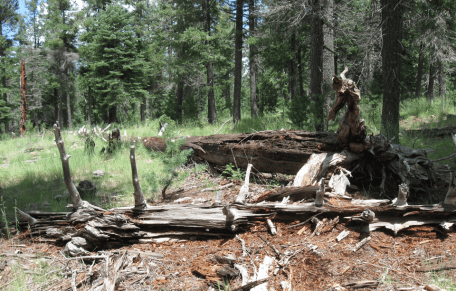
 ng thinking thanks takes time. You have to see progress in little steps at a time. Think about that path through the woods. As you step by step conquer the mess, soon the path becomes apparent.


 The outside appearance of a box can hide a multitude of things. It is often quite difficult to imagine what is inside. The actual item may be a lot smaller than the box, but the box is filled with tissue paper as a playful deception. That’s part of the giddiness of Christmas giving – concealing the contents, avoiding the predictable. At the appropriate time, however, the lid comes off and what is inside becomes visible.
 The Psalmist makes a revealing statement about the righteous person in Ps. 140:13. Someone who loves God and is cleansed by the Lamb, will surely give thanks. They will have a bent towards wanting to be th(i)nkful. It will fit for them and not feel out of place.


 THE DAILY EXCHANGE. Every day Elisa and Nicole text back and forth things they are #thinkful for. They have developed a pattern to spur each other on to look for things that they are thinking thanks about that day. Both of these ladies live in a climate where a long winter is approaching and it becomes harder to feel thankful and more necessary to think thanks. I welled up with tears to read that they were doing this. How cool! Having an accountability partner to keep you on track helps incredibly.
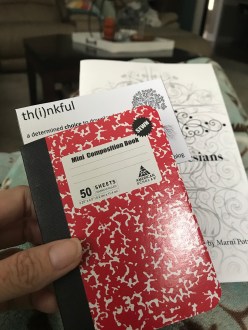 TH(I)NKFUL JOURNAL. My friend Marni sent me this picture. She had been given a small journal. It was to inspire one to write down one thing every day that your were th(i)nkful for. Our brains develop neural pathways by doing something over and over again. At first it feels like you are carving a difficult path through the woods, but as you do it over and over, it starts to happen automatically.

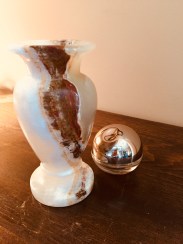 e an alabaster box filled with precious spikenard perfume and poured the ointment on Jesus. Jesus was visiting Bethany six days before his crucifixion and had been invited to a meal at Simon’s house. Resurrected Lazarus was seated at the table, and Martha was serving. Mary took a costly treasure, worth a person’s yearly wage (about $50,000.00 today), and poured it out on Jesus. Her act was taken by Jesus as preparation for His upcoming burial (Mark 14:8). John tells us the house was filled with the odor of the ointment (John 12:3). Imagine spending $50,000 for something that would disappear in a few minutes! She was obviously convinced of who Jesus really was, and must have strongly sensed that his death was close.
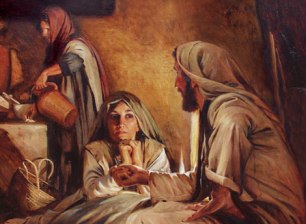 and listening at His feet (Luke 10:18-42). He had also come to them in Bethany four days after Lazarus had died and raised him from the dead (John 11). Now, He was again with them in Bethany, and Mary grabbed the opportunity of worshipping Him with probably her greatest treasure, the alabaster flask containing costly spikenard perfume. She didn’t hold back. She poured out her treasure on her even greater Treasure, the Lord Jesus, in preparation for his death and burial. She knew from experience that He had the power to raise people from the dead. Although she may not have known all the details of how Christ would die and rise again, her faith, garbed with devotion, was strong and committed.

 I Corinthians 3:12-14 states that at the Evaluation Seat of Christ all our works will be tested by fire. We’re not sure how our works will materialize into fuel nor what this fire will look like, but we are left to ponder the “burn-down factor” – what are we doing here and how that will survive the fire? Jesus said we can actually “lay up treasure in heaven” – pass our time, energies, and finances through an unseen membrane out of this life and into heaven.