Th(i)nkful and Take 5

Even a Child Can Do It

Take 5 3

Our son Nick and his family seem like a perfect family.  They look like they must always be kind to each other; their children are probably good and kind and share all the time.

Well, if you are human, you realize that is not the case.  They struggle like every family struggles.  There is always an ongoing fight to do what is right.

A while back one of their children developed a real rage problem.  I am the Yaya (what my grandchildren call me), and on one visit even I saw that this was a real difficult puzzle.  Nick and Julia asked us to pray for them to have wisdom and discernment, and so we did earnestly. I am sharing about this with their permission and with the hope that their story could help others.

One particular evening the anger again came to a head.  Take 5 1Nick and Julia had been reading different things to try and find some answers, and they had come up with a plan.  As Nick started to talk to his child he laid down some rules that the child needed to follow when he began to feel great anger.  The idea was to help him get control of these overwhelming feelings he was experiencing.  They called it “Take 5.”

Take 5

  1. Take deep breaths
  2. Count from 1 to 10, and then count backward from 10 to 1
  3. Say one thing that you are thankful for
  4. Practice smiling even if you don’t feel like it
  5. Pray to God for help

The first two cause a person to break from the aggravating situation, slow things down, and let off some steam.  But Nick and Julia chose being th(i)nkful as the exercise that tends to “overcome evil with good” (Romans 12:21).  Forcing yourself into a thought-search for positive things tends to eat the stuffings out of anger.

Take 5 has helped tremendously!  Not only has it helped their child control his anger outbursts much better, but also the parents, and grandparents (!) have benefited from this exercise.  It is simple enough for a young child to implement, but effective enough for anyone, young or old. Hearing this little guy pray to God for help is so inspiring. We, too, can pray to God for help and He hears and answers us.

After a season of their child experiencing victory, Nick and Julia happened upon a candy bar that was called Take 5.  🙂  Take5One evening their little guy was allowed to stay up after the others had gone to bed, and just Daddy, Mommy, and the little victor each got to enjoy a Take 5 bar. Hearing about this made my heart smile.

You Choose Th(i)nkfulness

Just like a little child seeking to get control over his or her emotions and choosing one thing that they are thankful for, we as adults can combat both the flurry and fury of negative emotions by choosing to be thankful. It requires a choice.

So, I shared the Take 5 concept with a friend recently and within a day she texted me that she had put it to use. At the end she commented, “Take 5 is not just for 4-year-olds!”

Thanks requires choice.  

ALMOST ~ AM LOST

On Israel’s Shore – Caesarea Maritima

Herod the Great built Caesarea in about 10 BC.  He did the impossible – conquered an unruly sea and built jetties and an entire port on the Mediterranean Sea, complete with lighthouse, temples, a palace, and a hippodrome for chariot races and gladiator games. This city was home for Rome’s leaders – Pilate, Herod Antipas, Herod Agrippa I and II.

About 30 years after Jesus died, this city was the setting for Acts 26:28 where the imprisoned Apostle Paul gave his defense to King Herod Agrippa II and Festus.  Paul skillfully related his testimony, his story of conversion, and gave a reason for his life’s commitment to spreading the gospel.  In response, Agrippa uttered his famous words, “You almost persuade me to become a Christian!”

The Problem With “Almost”

Our guide for our recent study trip to Israel chose that setting to share his own personal testimony.  As we stood cooling off our feet in the beautiful Mediterranean, he described that as a rebellious young man, he decided he was finished with church and God and was leaving home to live his own life.

As a token gesture, he went to his home church to say “good-bye.”  That evening, the sermon was on Acts 26:28.  The speaker emphasized the irony of the word ALMOST.  If you switch the L and the M in that word, you come up with a related concept ~ AM LOST.  Being almost a believer is the same as being totally lost. How very, very sad.

IMG_5978

The result in our guide’s life was that God’s Spirit used that to break his rebellion and catapult him into seeking an intimate life-giving relationship with the Lord.  Eventually he went into ministry and has been training church leaders for 25 years.

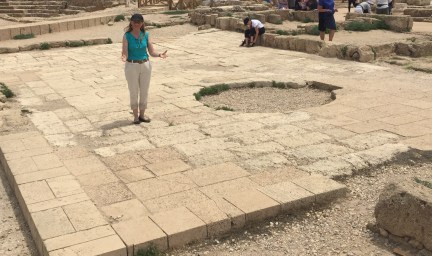
We climbed up a small hill from the beach and walked out on to the very stone pavement where Paul spoke these words. How sobering to realize the ongoing living power coming from the Biblical account that took place right where we stood.

And how amazing to think that Paul’s words to “give thanks always for all things” were written during this imprisonment.  I am th(i)nkful for our brother Paul’s faithful testimony during that long test that God sovereignly allowed in his life. How often we become very impatient with how God has written our story.  We chafe and complain because it is hard for us and we don’t see the reason for the difficulties. Ever spend three years in prison for no good reason and wonder what God is doing?

Th(i)nkful For Grace

One of the outstanding lessons for me is that I am so incredibly thankful for “grace” – unmerited help and assistance from God.  That same grace that helped Paul through all he experienced as he was imprisoned and beaten is also fully available to me.  The grace that helped our guide respond to the challenge of Acts 26:28 is freely presented to all who desire to believe. Th(i)nkful that God is so merciful and faithful, quick to forgive, and slow to wrath.

Irony of the Aqueducts

Herod’s masterpiece on the Mediterranean – like so many other things he built in Israel – is in ruins, barely visible, just toppled rocks that beg for imagination.  The Caesarean aqueductsIMG_5834 that used to bring down fresh water from the foothills of Mt. Carmel are now dried and cracked.

But God’s living water, reflected in the life, words, and ministry of Paul, is still flowing steadily for all who would drink. People like our guide are still brought to life by the words of the living water uttered on that stone platform in Caesarea years ago.  And the flow, growing stronger and stronger these days, is reaching into the spiritual deserts of countries and communities that have never heard. Sola Deo Gloria!

Lives Still Transformed

Paul gave a compelling testimony of the saving and transforming power of Jesus Christ. So did our guide in Israel.  Your story is powerful, and no one can argue with it. Our friend Josh Chapmon is a videographer who has a ministry helping Christians record videos of their testimony simply using a smart phone to upload them to the internet. Check out God’s story in the life of Chris Dew!


Then Agrippa said to Paul, “You almost persuade me to be a Christian.”  And Paul said, “I would to God, that not only you, but also all who hear me today, might become both almost and altogether such as I am, except these bonds.”

Acts 26:28-29

Th(i)nkful in Gethsemane

Journey to Gethsemane

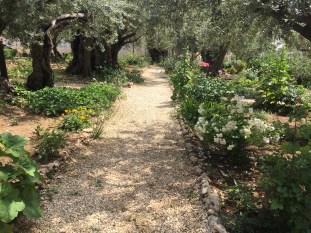
Jerusalem. David and I were experiencing a dream trip come true.  Someone had provided a way for us to join a small study group to Israel.  All my life I had desired to see the places where Jesus walked and to have my eyes opened to the events of the Bible in an extraordinary manner.  I was full of thinking thanks as we actually walked along the old Jerusalem walls, into the Kidron valley, and up the Mount of Olives into the Garden of Gethsemane. The olive trees were astounding!

As we entered I realized that it was a lot smaller than I had imagined.  Probably one reason for that was the Church of All Nations that now occupies much of the area where the garden had originally been.  The word Gethsemane means olive press.  Since the Mount of Olives is covered with olive tress, that is a most fitting name.  The garden seemed more cultivated than I expected, probably more than it was when Jesus and His disciples had gone there 2,000 years ago.  IMG_5053A fence enclosed the garden, protecting the ancient olive trees, and beautiful flowers were growing in between the old trees.  I could see walkways, but people were not allowed to enter.
Th(i)nkful for Freddie

Not sure if I was super-exhausted from travel and walking many miles a day, or because I was truly aware of the immensity of what happened on that piece of ground, but I began to cry.  Tears were streaming down my face as I peered over the fence that surrounded the garden.  I was so very th(i)nkful that Jesus “saw it through.”  For my sake, he endured through the arrest and the illegal trial that night, and then the beatings, the mocking, and the agony of the cross the next day.  The overwhelming agony was sadly juxtaposed with the underwhelmed cluelessness of his disciples who were not even able to stay awake and pray with Him.  I don’t expect I would have done any better as I so often yield to the frailty of my flesh.

IMG_5057

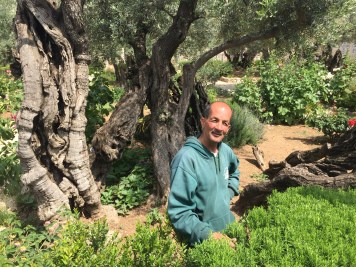
A man inside the garden walked up to me.  He noticed my tears and was gentle and kind.  He said that he had been the gardener there for 21 years, and his father for 40 years before him.  His name was Freddie; his father was from Romania and his mother an American Jew. He asked me to wait a minute while he went to get something.  He returned with some small sprigs clipped from the oldest olive tree in the garden!  As we continued to chat with him, we found out that Freddie’s mother was very sick so David asked if he could pray for her, and he did.

Some of the olive trees there were so huge and gnarled.  I had never seen such trees in all my life.  I wondered if in fact some of them could actually have been there 2,000 years ago when Jesus was there?

2000 year old olive tree

Rosemary in Gethsemane

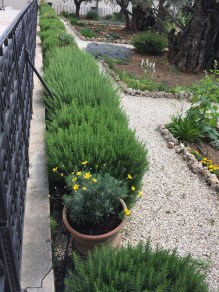
IMG_5454As an epilogue, I wanted to mention that someone once told me that there was a lot of the herb rosemary in the Garden of Gethsemane.  That connected with me.  I love rosemary, and to think that it may have been growing around the area where Jesus prayed brought me joy.  Perhaps he stroked His fingers over the rosemary and smelled it like I love to do. So I was on the lookout for that as I walked around the garden.
Sure enough I found it on the north side.  It was neatly planted in a row, but I am sure that when Jesus was there it grew more wildly.

Then Jesus went with them to a place called Gethsemane, and He said to His disciples. Sit here, while I go over there and pray. And taking with Him Peter and the two sons of Zebedee, He began to be sorrowful and troubled.  Then he said to them, My soul is very sorrowful , even to death; remain here, and watch with Me. 

Matthew 26:36-38


Giving Thanks through Barbed Wire

Giving Thanks through Barbed Wire

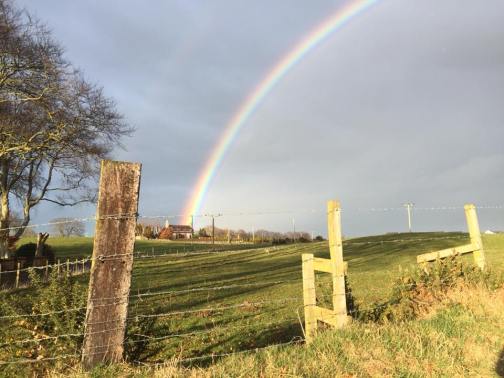
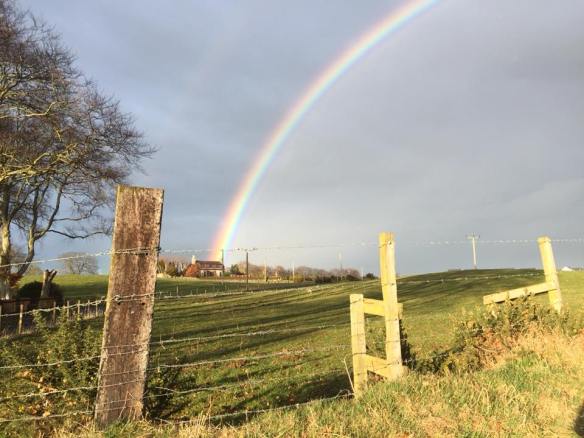
I love this photo taken recently by a friend in Scotland.  30411957_2490386290987266_4279298344771125248_nThe rainbow of God’s promise is clearly seen through the barbed wire.  The wire was put there for a reason you can be sure, and most probably served its purpose.

Life is full of ‘barbed wire’ that looks ugly and threatening, but has a useful purpose.  The concept that I take away from this picture is that I can see such beauty through the barbed wire. When we are able to focus on the promises of God, exemplified by the rainbow, and be thankful through the difficulties we are facing, there is hope. How do we “focus on the promises of God and be thankful?”

Pastoral Advice on the How-To of Thankfulness.

Dick Hester is our “pastor to missionaries” at Biblical Ministries Worldwide.Hester's  He and his dear wife, Carol, have many years of pastoral experience and have chosen to minister in the twilight of their years to missionaries all over the world.  They get on flights and fly to the uttermost parts to serve and encourage.
One of the things that Dick does is send out prayer prompters to edify and inspire us to think and live godly lives.  I was reading one that he sent out on the topic of thanksgiving and found his comments quite profound:

“Saying “Thank You” to God is an area that’s hard to measure. If I’d ask you how thankful you are in your day to day life you’d probably say “OK”. There are a lot of sins in the Bible which you know are sins: Adultery. It’s pretty black and white. Stealing. You don’t walk out of a store with something you didn’t pay for and say, “I  think I might have stolen something.” You know you did it. But this whole area of giving thanks or not giving thanks to God, or being a thankful person or not, is a hard one to measure and we may not know exactly where we are. But it is very, very important and needs to be a fundamental part of our life.

Colossians 2:6,7 tells us that,  “…as we have received Christ Jesus as Lord, we are to walk in Him…” As born again believers, we are to live like a Christian, according to the Word of God. We are  “…rooted and built up in Him, established in the faith as we have been taught; abounding—overflowing— with thanksgiving.” We are to keep growing when we become His child and here’s how: do things we ought to do (obey) and thank God, profusely.

Overflowing with gratitude is foundational to our Christian life. Study the Word of God and you will find that you communicate that you love God by simply saying, “Thank You, Lord”. The more we say that to Him, the more we’re saying, “I love You” and the more we bring glory to Him. We’re to love God with all of our heart, might, mind, and strength, and one of the major ways we do that is to say, “Thank You, Thank You!” for what He’s done for you. Our goal ought to be to have an attitude of gratitude all the time about everything.

Ephesians 5:20:  “Giving thanks always for all things to God the Father…” What is God’s will for us?”  “In everything give thanks, for this is the will of God in Christ Jesus for you.” (I Thessalonians 5:18) God tremendously blesses the ones who develop this basic discipline. One of my greatest joys in life is giving things to my kids. Do you know when I don’t like it? When they take it for granted; when they just assume. Nothing makes me warmer inside for people to say, “Thank you; I love you”, and the more grateful they are, the more I want to give.

Think about it: God created us, blessed us with spiritual blessings, sent His Son to die for us to pay the penalty for our sin. We do not have to do anything—no strings attached. We simply receive Him, believe Him, and God says, “I’ll adopt you into My family, bless you with every spiritual blessing, give you the gift of the Holy Spirit, and you get to go to heaven forever.” We don’t have to do anything if we don’t want to, because it’s a free gift. When we thank God and thank Him for everything, we bring glory to Him and He loves it. He blesses even more, those who thank Him.

Gratefulness is a character quality. I think the ultimate thanks will be for the gift of heaven. We should thank Him for that every day. If I died today I’m going to heaven. My prayer as a kid was, “Now I lay me down to sleep; I pray the Lord my soul to keep. If I should die before I wake, I pray my Lord, my soul to take. Amen!” Every day say, “Thank You, Lord, for giving me the gift of eternal life. Thank you that I am saved, and I’m going to heaven and live with You forever.”

We thank God for our food before our meals. Have you ever turned the key to start your car and thanked the Lord for your car? Not everybody has a car! Do you thank God for your house when you walk in? For your clothes, shoes, job, ministry? I know I am blessed more than 90% of the world. We take so much for granted. God says we should thank Him always, continuously, for everything. Make that your goal, for all things in your life.   First We Pray!  Give thanks!”

God delights to bless His children. I wonder how much we hold back further blessing by simply failing to say “thank you so much.” I wonder how much longer we stay tangled in the barbed wire because we haven’t pushed through and thanked Him for it. Expressing thanks benefits how we process all of life, and is done in obedience to His commands, but it is also a trigger for His sustaining grace, delivering power, and further blessing.

30411957_2490386290987266_4279298344771125248_n


Godliness with Contentment is Great Gain

Contentment

The Battle for Contentment

Contentment is being totally at peace with having nothing more and nothing else.  It is therefore the greatest wealth a person can have.  Contentment is simply wanting only what I already have.  There is no angst; no imagining, no further search.

Have you ever felt totally content?  OK, maybe after a big meal on a soft couch when you are dosing off to sleep. Most internet pictures for contentment have people relaxing in tranquil surroundings. But have you ever chosen, independent of circumstances, to be content?  It seems almost impossible for us as humans.  The relentless stream of advertisements on TV or websites are designed to ensure that we are never content; after all, one week of nationwide contentment could destroy our economy!

We all, it seems, have the “dis-ease of discontent.”  Our hearts long for more comfort and convenience, greater perfection in our things and relationships.  We try to satisfy this internal quest for harmony and heaven by relentlessly striving to achieve it here and now.  So, we never have enough or have it exactly right. We are discontent.

The Source of Contentment is Within

D. Martyn Lloyd-Jones, in Spiritual Depression: Its Causes and Cures, writes that the “godliness with contentment” mentioned in 1 Timothy 6:6 is the best virtue combination a believer can have.  The first is vertical; the second horizontal.  Both come from within. Both are independent of our outward circumstances and physical conditions. Both communicate, “all I need is a deep relationship with God – not much else matters.”  Lloyd-Jones points out that this brings great gain, a phrase not often used in Scripture. Contentment is the greatest wealth.

Contentment and Ambition

But are we to become a blob? Can athletes and scholars and artists achieve great things while being content?  The Scripture is clear that we can have godly ambition.

  • Firstly, we should have an insatiable quest to know, love and serve Him with our whole heart and life (Psalm 27:4. 63:1, Philippians 3:10).  I must never become content in my spiritual life.
  • Secondly, we should push to wholeheartedly do with excellence things that honor God by reflecting His image in us (1 Corinthians 10:31, Colossians 3:23-24).  We must be content with the gifts, appearance, power and possessions He has given us, but then use them all wholeheartedly for His glory.

Ungodly ambition is the drive for fame, validation, power, wealth, possessions and pleasures to fill up a personal void with the stuff that promises happiness and satisfaction … and that stuff will never be enough.  This is why Puritan writers felt that ambition was one of the most deceitful sins.  Many leaders “attempt great things for God” out of unholy ambition.

Being Th(i)nkful Brings Contentment

When I learn the discipline of thinking thanks, contentment oozes slowly into my heart. Gratefulness focuses on what I have, not on what I lack.  It takes away the fuel of discontent; the fire goes out.  Nothing really changes in my life, except for what I am thinking about and expressing.  I choose to be th(i)nkful.

Southern-Africa-Panorama-MapDavid and I are moving back to South Africa in a few months. We will go alone to this land; we will leave family behind.  We plan to study the Zulu language diligently, and then teach the Bible, theology and counseling to emerging Zulu leaders, and help them begin a church-planting movement.



As I am thinking about the changes that lie ahead, there are days when I struggle to think thanks.  I am tempted to think about precious children and grandchildren who will be out of reach.  That is so hard and heavy for me.  But when I think about how God has given me joys in the journey that are undoubtedly His fingerprints of mercy, I am th(i)nkful.  He will help us.  He will measure out grace. I have already started a th(i)nkful list about our move.

Join me in the discipline of thinking thanks so that together we can cultivate contentment, and in the process become more godly.

Godliness with Contentment is of Great Gain ~ I Timothy 6:6

Ministering Thoughtfully

The Power of Compassion

visiting-in-hospital-small-e1517239570647.jpg

Family Visit To Grandmother In The Hospital

Have you ever had someone come visit you in the hospital when you were sick?  Isn’t it amazing how you remember that so well?  The morning my mom died, our pastor’s wife, a dear personal friend, came to our house.  She didn’t say much, she went into the kitchen and started to do my dishes.  She was just there.  Wow!  I can hardly think back on that without tears.

What makes those visits stand out so much in our memories?  The answer is “connection,” a bond formed simply through a quiet presence and a listening heart.

Consider the difference between empathy and sympathy.  Recently I watched a 2.53 minute YouTube video by Dr. Brené Brown on that topic.  Although I may not agree with all she said, she gave me food for thought. Empathy connects a person who is going through something hard with someone who cares and listens.  When a person is going through a challenging time, the last thing they may want to hear is: “Just write down things you are thankful for.” You first have to have the connection.

oops 5


“People don’t care how much you know until they know how much you care.”

― Theodore Roosevelt

How Do You Inspire Others

Come. You need to be there. Two of the greatest promises the Lord has given us are, “I am with you always,” and “I will never leave you nor forsake you.” Being there for someone is being like Him.  We worry about what to say, but that’s not our main role. A cat or a dog can be a comfort, and they say nothing – they are just there.

Listen.  Maybe the person does want to talk about what is troubling them. Good.  Just listen.  Tell them that you are thankful they shared with you, that you can imagine it is so hard.  In time, if connection is made and the person feels safe, they may be open for solutions, but don’t rush that.  Let them become thirsty for options and ready to hear.

Pray.  Pray for them specifically, and pray for you to have wisdom. Pray for grace for them to pass this test. God is the One that untangles the mess. We cannot help everyone, but need to do the will of the Father – like Jesus did.  Discover what that is through the Word and the Spirit’s guidance.

Serve.  Look for practical things you could do for them that would be helpful. Make a meal.  Take care of their kids.  Bring a present.  Send a personal note or text.  Visit them in the hospital.

Recall. One of the most powerful ways to inspire others is to share your own story, how you came through a struggle.  No one can argue with that.  It is yours.  If you personally have been helped by cultivating gratitude in your thoughts, you can share that.

Own. Being th(i)nkful works, but you must own it yourself before you can do it well. To own something you have to believe in it. You have to be convinced that God actually means what He says in I Thessalonians 5:18. “In every circumstances give thanks; for this is the will of God in Christ Jesus concerning you.”  When sharing the concept of thinking thanks, give the other person time to own it themselves before trying it.

Share. Tuck in your pocket I Corinthians 10:13 in case you get the chance to share the promises located there. God says that He will “with the testing make a way of escape.” Notice that it is with the testing, not from the testing.  God helps give us escape while the testing is ongoing. Could a possible ‘way of escape be thinking thanks?

Three Lessons from Having Received Ministry

  1. Thank the Lord for motivating the person who did the compassionate thing and reached out.
  2. Express to that person how incredibly helpful it was to receive their ministry.
  3. Be inspired to BE that to someone else.

oops 4

Th(i)nkful: a determined choice to download grace/strength from the Lord to think thanks about every circumstance in my life and express that thanks orally or in a written form.


Leaving a Legacy

What Will You Leave Behind?

“A new study of the world’s population revealed that the expected mortality rate among humans is still 100%, researchers at Harvard University confirmed Tuesday.  The surprising study found that given enough time, every single person on this planet will pass away, completely irrespective of wealth, class, gender, race, nationality, or creed.”  This fake news from the The Babylon Bee last year is nonetheless profound!

estateHave you ever thought about what someone would find among your things after you died?

I recently did a Th(i)nkful seminar at a church in Indiana.  So fun to inspire these hard working ladies in cultivating gratitude in their lives.  Heather did a great job organizing the event.  Afterwards she mentioned to me that one thing that hit her was how being th(i)nkful affected your legacy – that when your children, grandchildren and others went through your things after you were gone, they would discover your journals with page after page listing things that you were thankful for.  What a gift to pass on to future generations!

You invest in things that you feel strongly about, whether that is staying forever attractive, a favorite hobby or activity, your family, a luxurious retirement, or eternal rewards. The physical evidence of those values and decisions will be detected as people make a final evaluation of your estate. When all is said and done, the stark truth of what you really cared about, what you loved, and what you worshiped will remain loud and clear in the things you leave behind.

A Legacy That Multiplies

Leaving a legacy

Authentic Christian living cannot be compartmentalized.  What you do publicly and what you do privately have to agree, otherwise there is discrepancy and hypocrisy.  Choosing to practice th(i)nkfulness on a regular basis is privately living out what many claim publicly.

Choosing to download grace and strength from the Lord to think thanks about every circumstance that comes my way, and then to express that thanks orally or in written form is like planting seeds of righteousness.  Those seeds may find good soil in the broken hearts of those we’ve left behind, germinate, and in time bring forth a harvest of righteousness. The simple obedient act of giving thanks in all circumstances multiplies. God gets the glory.

We will not hide them from their children, but tell to the coming generation the glorious deeds of the Lord, and his might, and the wonders that he has done.

Psalm 78:4


Pathway through the Woods

Brain Neural Pathwaywooded debris 1

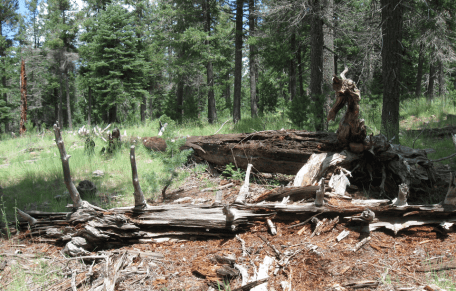
Cultivating  th(i)nkfulness can be compared to carving a path through the woods.  It  seems overwhelming at first with debris and obstructions.  It takes great effort to remove fallen logs and roots.  You may need some tools like a spade and a chainsaw, or good sharp clippers.

Our brains are similar in that forging a new brain pattern or neural pathway in order to create a new life habit is daunting at first but gets easier with time. God has created our brains to be able to do this.

Neuroplasticity is the ability of the brain to form and reorganize synaptic connections, especially in response to learning or experience or following injury.

How Do I Do It?

The first practical step you do when beginning to carve a brain path, is to deliberately lay out a plan. Your goal is to have your thoughts automatically head towards what to think thanks about in any given situation. You begin to search in your thoughts for things that you can be thankful for.

If you are in an unusually happy situation, it’s not very hard to find things to be thankful for. Even in normal, day-to-day times it’s not hard to begin to discover th(i)nkful items.

However, when hard times come, the difficulty  level rises to delineate thankful items. Let me illustrate with this example from my friend Dawn:

“My heart was tempted to complain about the mounds of laundry today. The Holy Spirit reminded me, “Be thankful. Think thanks.”

So as I’m folding I start saying in my mind…
Thank You, God for these clothes.
Thank You for your provision of new and used hand-me-downs.
Thank You that they are clothes we got to choose and that we like them. 😊
Thank You for the little (and big) legs that move to make these pants dirty.
Thank You for the soap to wash them.
Thank You for the washing machine that washes and I don’t have to do it by hand.
Thank You for the tumble dryer that works in my basement, and that I don’t have to air dry them in the cold.
Thank You for the dryer that gets the wrinkles out so I don’t have to iron.
Thank You that I am able to be at home and squeeze this chore in between schooling.
Thank You for the energy and wellness to do this. I’m not sick in bed.
The list could go on…
Be th(i)nkful. Think thanks when you’re tempted to complain in your heart.

She chose to download grace and begin carving the neural brain pathway of thinking thanks about the situation.  She then expressed it.  Engaging in the discipline of being th(i)nkful ended up not only helping her mindset, but encouraging others to do likewise.

Patiently Conquer Step by Step

The habit of cultivatipath through woodsng thinking thanks takes time.  You have to see progress in little steps at a time.  Think about that path through the woods. As you step by step conquer the mess, soon the path becomes apparent.

In time you will be able to run that path.  How cool!!

This exercise is much more that just creating a better mindset for us.  Practicing th(i)nkfulness is an act of worship to our Redeemer who has given us a command.  Give thanks in all circumstances.  He knows that being grateful is a key to our sanctification and maturity in Him.

So… I just wanted to get you started this year on developing that brain pathway through the ‘woods.’

Who doesn’t enjoy a walk in the woods anyway?? 🙂

wooded-path-e1513099191945.jpg

Cutting Produces Thirst

Cutting the Christmas Tree

David and I just picked out our Christmas tree.  The fresh scent of Fraser fir filled our senses as we browsed through the trees available.  We finally settled on a lovely tree that looked full and balanced.

After we paid, the attendant cut off the lower branches to make it manageable to put into the Christmas tree stand, and he cut a fresh piece off the trunk.  The purpose of cutting the main trunk was to open up the pores and allow the tree to drink in a lot of water, thereby allowing it to stay fresher longer.cutting a fir tree 1

The pores had begun to close after the initial cut a while back when it was brought from the farm in North Carolina. Without water, those exposed fibers were dead now. The trunk needed a fresh cut to open those pores again and satiate the thirst of the poor thing. This cut was for the good of the tree, to enable it to fulfill its purpose well. Now the tree could stay hydrated longer to keep its needles, and grace a family’s living room.

A Fresh Cut Will Make Me Thirsty

I thought about how this compares with our lives.  Our spiritual “pores” will often close or grow calloused over time; I don’t feel the need for God, and I don’t talk with Him, like ever.  It is when I receive a fresh “cut” – the pang of a trial – that the pores are wide open and thirsty again. My life is a Psalm again – crying out to the Lord and taking hope and courage in my Rock, my Fortress, and my Deliverer.

Familiarity and sameness is lovely and predictable, but they can make me grow apathetic.  I especially am a person that loves to cling to schedule and expectations.  I have found over time though, that what I need to cling to is the Lord and rest in His values and expectations, His schedule.  He often will allow a fresh cut to make me more thirsty for Him and not get too comfortable in my routine in this world.

When I have developed the habit of being th(i)nkful, there is a coping mechanism that is engaged when the cut happens. I know what to do. I begin to draw up the character and purposes of the Water of Life, and brainstorm things that I can think thanks about in the difficult situation.  Stress, anger, fear, or sadness may try to get me off track, but if I download the grace the Lord offers, and engage my thoughts to think thanks and express that thanks, there is a peace that begins to flow.

Cutting a fir tree 4

Let the fresh cuts of the Lord in your life open you wide to drink deeply from the One who offers living water that satisfies your soul.

“It is good for me that I was afflicted, that I might learn your statutes”
Psalm 119:71


Th(i)nkful for Mary’s Worship

Gratitude and worship are closely connected.  We worship God by thinking and expressing our thanks. He is the recipient of our wrapped up gifts of thanks.

Today, I want to focus on being th(i)nkful to God for people, not just things. It is easy to focus on being thankful for health or comforts or gifts or recent events that brought joy, but people are more important than things. For one, people will live somewhere forever; events will fade from memory and the things we can see will all burn one day. Let’s focus on thanking God for the people who have affected us.

One of my favorite people in the Bible is Mary of Bethany.  In the three settings we find her, there is much to learn, but my favorite is when she pours out the precious perfume on the Lord Jesus a few days before He was to die on the cross. There are three truths that stand out to me in the way she gratefully worships.

Mary Gave Extravagantly

Mary of Bethany gave an extraordinary gift to Jesus in Mark 14:3. She brokIMG_3193e an alabaster box filled with precious spikenard perfume and poured the ointment on Jesus. Jesus was visiting Bethany six days before his crucifixion and had been invited to a meal at Simon’s house. Resurrected Lazarus was seated at the table, and Martha was serving.  Mary took a costly treasure, worth a person’s yearly wage (about $50,000.00 today), and poured it out on Jesus.  Her act was taken by Jesus as preparation for His upcoming burial (Mark 14:8). John tells us the house was filled with the odor of the ointment (John 12:3). Imagine spending $50,000 for something that would disappear in a few minutes! She was obviously convinced of who Jesus really was, and must have strongly sensed that his death was close.

Mary Grabbed an Opportunity

Mary with her siblings, Martha and Lazarus, were friends of Jesus.  John 11:5 records that Jesus loved Martha, Mary, and Lazarus.  He had visited their home earlier and taught lessons about choosing the “better part” of sittingMary of Bethany 3 and listening at His feet (Luke 10:18-42).  He had also come to them in Bethany four days after Lazarus had died and raised him from the dead (John 11).  Now, He was again with them in Bethany, and Mary grabbed the opportunity of worshipping Him with probably her greatest treasure, the alabaster flask containing costly spikenard perfume. She didn’t hold back.  She poured out her treasure on her even greater Treasure, the Lord Jesus, in preparation for his death and burial.  She knew from experience that He had the power to raise people from the dead.  Although she may not have known all the details of how Christ would die and rise again, her faith, garbed with devotion, was strong and committed.

Mary Was Given Honor

Mary’s act was shamed and ridiculed by people around her.  They were indignant about the supposed waste that she had done – so expensive, no special event, and now it was all just gone.  Jesus defends her.  I love this part.  He accepts her work of worship and commends her to the point of saying that wherever the gospel is preached throughout the whole world, this story will be mentioned as a memorial to her. I am doing that right here in 2017.  Mary’s act of costly worship is an intense example for us and she was given honor for her act.

So How Does That Affect Me

What would be my extravagant gift of worship that I could pour out on my Savior?

IMG_5921

Do I take advantage of opportunities for sacrifice or expressing my thanks as I move through my day? Am I feverishly gathering the wood, hay, and stubble of the here and now, or am I giving up current enjoyments to invest in gold, silver, and precious stones for the crowning day of my King, the Lord Jesus?

judgment fireI Corinthians 3:12-14 states that at the Evaluation Seat of Christ all our works will be tested by fire.  We’re not sure how our works will materialize into fuel nor what this fire will look like, but we are left to ponder the “burn-down factor” – what are we doing here and how that will survive the fire? Jesus said we can actually “lay up treasure in heaven” – pass our time, energies, and finances through an unseen membrane out of this life and into heaven.

I am certainly th(i)nkful for the hope I have in Jesus.  Because He came and died, and rose again, I have been reconciled to God. I can completely rely on Jesus’ promise in John 3:16 – if I believe in Him, I will not perish.

BUT, then there is also the issue of what I am doing with my life.  I do wonder if, when I get to the great Evaluation Seat, I will wish that I had lived my life differently, taken more risks, given more extravagantly, and walked away from more comforts for the cause of the gospel.  Am I entranced by time, or do I have eternity stamped on the back of my eyelids?

As you cultivate the thinking of thanks this week, who is a person, living or dead, that you admire and for whom you are thankful to God?  I would love to hear who and why.

Mary 1

“She has done what she could; she has anointed my body beforehand for burial.  And truly, I say to you, wherever the gospel is proclaimed in the whole world, what she has done will be told in memory of her.”  Mark 14:8-9