Envelop?
The scent was faint at first, but slowly the delicious smell grew stronger as the Swedish Tea Ring was baking in the kitchen. The tantalizing odor enveloped me as I studied in the next room.
Have you ever used the verb envelop?
Envelop: to wrap around something completely; to surround, either literally or figuratively
Literally, fog can envelop a city, or a mom can envelop her child. Figuratively, peace can envelop your mind, or Christ can envelop your life. In fact, the Apostle Paul’s use of “in Christ” and “in the Spirit” has this idea of enveloping a person totally.
Envelop Your Prayers
Thankfulness should wrap around our prayers completely. When I come to God with my circumstances or with people that I am lifting up to Him, I am giving Him no new information – He knows and has ordained what is happening. In reality, I can bring Him two things: thankfulness for the situation or person, and a petition for His help. To truly envelop a prayer with thanksgiving, you start with it and end with it.
This is the key difference between praying to a sovereign God and asking favors from the genie of the lamp. Many Christians treat God like a genie: “Please do this, and do that, and when you’re done, I need this as well.” There is no recognition that the genie has caused our circumstances for His glory and our good, and we don’t say thanks because the genie is our servant. It is said that if we treat our friends like we treat our God we wouldn’t have friends. To say thanks is to fully acknowledge that He is in control and is working out a perfectly calculated plan.


So, we should begin and end our prayer with thankfulness. Paul gives us multiple examples of praying with thanksgiving.
“Continue steadfastly in prayer, being watchful in it with thanksgiving.” Colossians 4:2
“Do not be anxious about anything, but in everything by prayer and supplication with thanksgiving let your requests be made known to God.” Philippians 4:6
“Rejoice always, pray without ceasing, give thanks in all circumstances, for this is the will of God in Christ Jesus for you.” I Thessalonians 5:16-18
Paul also demonstrates how he envelops his prayers with thankfulness when praying for people.
- First, I thank my God through Jesus Christ for all of you, because your faith is proclaimed in all the world (Romans 1:8)
- I give thanks to my God always for you because of the grace of God that was given you in Christ Jesus (I Corinthians 1:4)
- I do not cease to give thanks for you, remembering you in my prayers (Ephesians 1:16)
- We always thank God, the Father of our Lord Jesus Christ, when we pray for you (Colossians 1:3)
- We give thanks to God always for all of you, constantly mentioning you in our prayers (I Thessalonians 1:2)
- We ought always to give thanks to God for you, brothers, as is right, because your faith is growing abundantly, and the love of every one of you for one another is increasing (2 Thessalonians 1:3)
- First of all, then, I urge that supplications, prayers, intercessions, and thanksgivings be made for all people (I Timothy 2:1)
- I thank my God always when I remember you in my prayers (Philemon 1:4)
Trust Foundation
One key to praying thankfully is having the “foundation of trust” in good shape. I am currently working through Ole Hallesby’s book on Prayer and he writes:
“We realize that this deficiency in our prayer life is really due to the fact that we do not trust our blessed Lord. We think that we understand better than He does when and how our prayers should be answered.”
In order to envelop thanksgiving into our prayers, we have to trust the Lord God with all our mind, soul, and heart. He is completely trustworthy. On that basis I can be th(i)nkful and agree to receive what He is doing in my circumstances, though I don’t understand the whys and what fors, and may never understand them.
Th(i)nkful for Carmen
Her life is not easy. She has difficulties that many of us are not familiar with.  But our friend Carmen loves God and runs to Him in prayer, with thankfulness.
This precious lady in Pennsylvania is a prayer warrior for us and the mission work here in South Africa. She thanks God on our behalf and provides prayer cover for us continually.
She is growing spiritually and envelops her prayers to the Lord with thinking thanks. And I reciprocate, thanking my Lord for her as I lift my prayer to Him.
So How Do You Start?
The beauty of being th(i)nkful is that it is not hard. Even if you have not been in the habit of enveloping your requests to God with th(i)nkfulness, just start with one thing. Here are some examples:
- Thank You, God, for the people who pray for me
- Thank you, God, for the opportunity to trust you and your character today
- Thank you, God, that I am not alone in my struggles, but I can come to you
- Thank you for the access and freedom I have, through Jesus, to come boldly to the throne of grace
- Thank you for the grace that is helping me start a new neural pathway of thinking thanks
- Thank you for the person that shared the good news of hope with me
Why not start right now in enveloping a prayer to God with thankfulness?


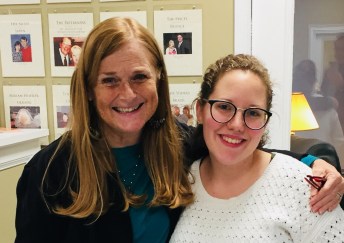
 Marc and their daughter are her joys. She has a strong love for the hurting; that does not mean just humans, but also animals of all kinds. 🙂 She struggles to see someone in pain and works so hard as a doctor to help.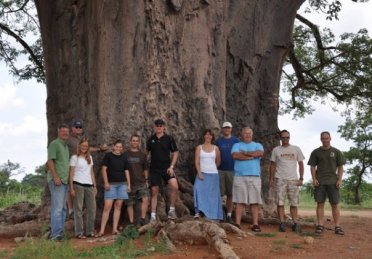

 I moved there when I was four years old. I have so many fond memories of that little town, two and a half hours north of Oslo. That is where I learned to speak Norwegian. That is where I began to attend the primary school known as Fagerlund Skole. I had the most amazing teacher, Fru Mørland.
 No big deal really, it is just the laundry detergent that she used. The look of the box stuck with me.
 Everything can be an absolute mess all around you, but when you let yourself get pulled into that moment and the beauty in such a small thing … you can breathe. In such moments, I am always reminded that God gives opportunity for us to stop and appreciate Him and everything He’s given us ALL THE TIME … it’s up to us to take those opportunities, catch those little breathers, be amazed at the world around us, and be thankful for what we have.
 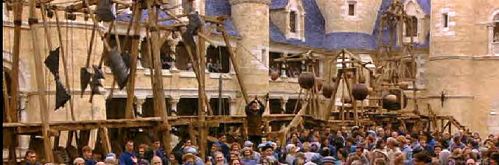 how Lancelot willingly volunteered to run the gauntlet? There were blades, spikes, swords, bludgeons, paddles, and heavy balls whirling about him at different speeds, and from different directions.
 around 10 pm and we arrive in Amanzimtoti, South Africa, on Thursday morning, Lord willing. These past few months we have been so busy preparing and packing … and today we go.
 The second category is known as Development – helping the needy by working with them to improve their general living conditions, developing their skills, giving them a hand up and not a hand out. Think of Israel leaving part of the harvest for widows like Ruth in Deuteronomy 24:19-22.
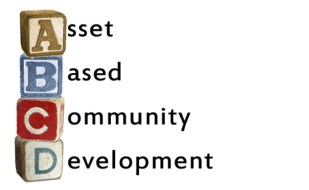 Asset-Based Community Development – is helping a struggling community improve itself by sitting down with residents and inquiring about what they already have.😊 When Moses resisted getting involved with God’s plan, God asked him, “What is that in your hand?” (Exodus 4:2). That’s where we begin. We look at what is, not at what is missing.
 This approach promotes a philosophy of thankfulness and a “can do” spirit. In other words, a community looks to its own members to identify what assets are already present around them.
 My friend bought a leaf cutter from Hobby Lobby craft store (using the 40% coupon) :). She then went to Walmart and asked if she could have paint-color samples. She took the paint-color sample papers and cut out ‘leaves.’
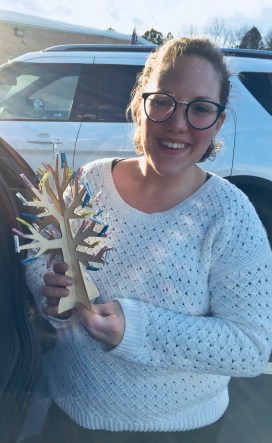 It displayed the leaves.
 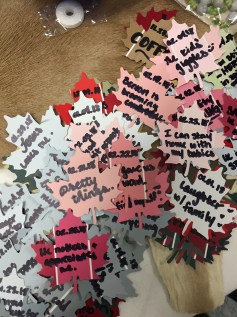 She brought the tree and the leaves to show me one evening when we were speaking at a missions conference at her church.
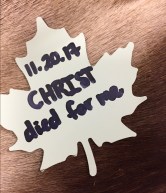 Th(i)nkful: a determined choice to download grace/strength from the Lord to think thanks about every circumstance in my life and to express that thanks orally or in a written form.


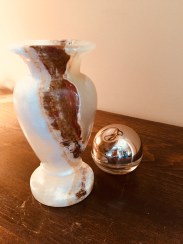 e an alabaster box filled with precious spikenard perfume and poured the ointment on Jesus. Jesus was visiting Bethany six days before his crucifixion and had been invited to a meal at Simon’s house. Resurrected Lazarus was seated at the table, and Martha was serving. Mary took a costly treasure, worth a person’s yearly wage (about $50,000.00 today), and poured it out on Jesus. Her act was taken by Jesus as preparation for His upcoming burial (Mark 14:8). John tells us the house was filled with the odor of the ointment (John 12:3). Imagine spending $50,000 for something that would disappear in a few minutes! She was obviously convinced of who Jesus really was, and must have strongly sensed that his death was close.
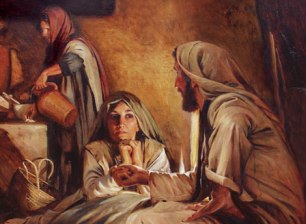 and listening at His feet (Luke 10:18-42). He had also come to them in Bethany four days after Lazarus had died and raised him from the dead (John 11). Now, He was again with them in Bethany, and Mary grabbed the opportunity of worshipping Him with probably her greatest treasure, the alabaster flask containing costly spikenard perfume. She didn’t hold back. She poured out her treasure on her even greater Treasure, the Lord Jesus, in preparation for his death and burial. She knew from experience that He had the power to raise people from the dead. Although she may not have known all the details of how Christ would die and rise again, her faith, garbed with devotion, was strong and committed.
 I Corinthians 3:12-14 states that at the Evaluation Seat of Christ all our works will be tested by fire. We’re not sure how our works will materialize into fuel nor what this fire will look like, but we are left to ponder the “burn-down factor” – what are we doing here and how that will survive the fire? Jesus said we can actually “lay up treasure in heaven” – pass our time, energies, and finances through an unseen membrane out of this life and into heaven.
 l be over one day and we will finally be with the Lord. Live life full of thanks and joy will bubble up. It may sputter up slowly, but slowly it WILL come. Start now.
 th(i)nkful