What Will You Leave Behind?
“A new study of the world’s population revealed that the expected mortality rate among humans is still 100%, researchers at Harvard University confirmed Tuesday. The surprising study found that given enough time, every single person on this planet will pass away, completely irrespective of wealth, class, gender, race, nationality, or creed.” This fake news from the The Babylon Bee last year is nonetheless profound!
 Have you ever thought about what someone would find among your things after you died?
I recently did a Th(i)nkful seminar at a church in Indiana. So fun to inspire these hard working ladies in cultivating gratitude in their lives. Heather did a great job organizing the event. Afterwards she mentioned to me that one thing that hit her was how being th(i)nkful affected your legacy – that when your children, grandchildren and others went through your things after you were gone, they would discover your journals with page after page listing things that you were thankful for. What a gift to pass on to future generations!
You invest in things that you feel strongly about, whether that is staying forever attractive, a favorite hobby or activity, your family, a luxurious retirement, or eternal rewards. The physical evidence of those values and decisions will be detected as people make a final evaluation of your estate. When all is said and done, the stark truth of what you really cared about, what you loved, and what you worshiped will remain loud and clear in the things you leave behind.
A Legacy That Multiplies

Authentic Christian living cannot be compartmentalized. What you do publicly and what you do privately have to agree, otherwise there is discrepancy and hypocrisy. Choosing to practice th(i)nkfulness on a regular basis is privately living out what many claim publicly.
Choosing to download grace and strength from the Lord to think thanks about every circumstance that comes my way, and then to express that thanks orally or in written form is like planting seeds of righteousness. Those seeds may find good soil in the broken hearts of those we’ve left behind, germinate, and in time bring forth a harvest of righteousness. The simple obedient act of giving thanks in all circumstances multiplies. God gets the glory.
We will not hide them from their children, but tell to the coming generation the glorious deeds of the Lord, and his might, and the wonders that he has done.
Psalm 78:4


 l be over one day and we will finally be with the Lord. Live life full of thanks and joy will bubble up. It may sputter up slowly, but slowly it WILL come. Start now.
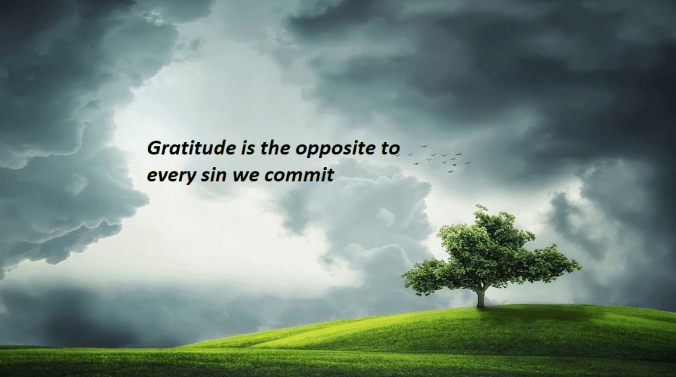 Recently I was listening to a lecture by Heath Lambert in preparation for my ACBC certification exam. Lambert said something that grabbed my attention. He said that gratitude is the opposite to every sin we commit.
 th(i)nkful