Th(i)nkful Anniversary

7 Years

Today has been seven years since the first Th(i)nkful post was published!!

https://thinkful.blog/2017/05/07/first-blog-post/

There have now been 35,705 views in 134 countries!! Praise God! I had no idea that God would be able to use something like this for His glory. Praise Him forever!!

Background

The reason we celebrate anniversaries is usually to help us remember. Take the Passover for example and how God wanted the children of Israel to remember – so He told them to celebrate every year.

In 2016 David and I had a great sorrow.

We had purchased and fixed up a tiny little cottage in the Northwoods of Wisconsin close to a Christian university where we envisioned that we would spend our remaining days serving the Lord by training tomorrow’s Christian leaders. BUT, that was not God’s vision for our future. He closed that school down. We were left with having to sell our little home and discover through the Shepherd’s guidance what next steps He had for us. Now eight years down the road we can see at least part of the reason. He wanted us back in southern Africa. There was more for us to do.

But back then, it was hard and we felt low. I remember distinctly that the Lord impressed upon me that I needed to be thankful even in my pain. It catapulted me into researching what it meant in the Scriptures to obey those commands of giving thanks in everything, in all circumstances. Our emotions were urging us to discouragement and even despair, but meditating on our faithful God and His ways began to upend the heaviness. Our eyes were pulled upward to get a different perspective. This life is not what it is all about. This life is a vapor James tells us in 4:14. We are headed to a Celestial City where all will be set right (Hebrews 13:14).

“Receive every inward and outward trouble, every disappointment, pain, uneasiness, temptation, darkness, and desolation, with both thy hands, as a true opportunity and blessed occasion of dying to self, and entering into a fuller fellowship with thy self-denying, suffering Saviour.”

William Law, 17-Century Puritan

God was teaching me to choose to think thanks for all things that come my way. He was shaping me to be more conformed to the image of His Son, and He may use any means that He sees fit to accomplish that task. It is good.

As I now accumulate more and more days under my belt and get closer to the finishing line, whether by death or the rapture, I am becoming convinced that every minute is a gift and only as we discern the Father’s will and delight in doing it with thankfulness do we truly live without regrets.

One thing I can say from experience is that writing out my thinkful list every evening has become easy and delightful. It’s not hard at all. God is so good to us. His character, promises and sovereignty are trustworthy and dependable.

“God is faithful“

I Corinthians 10:13

Enablers

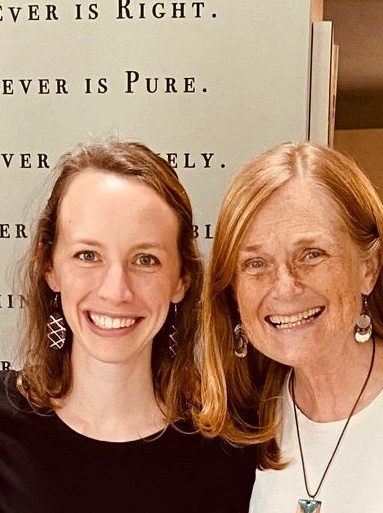
These are our children. They are all grown now, but such a joy in our lives. Our son Nicolas is the one who encouraged me to start the blog to see if there would be any interest in reading on this topic. Our daughter Stephanie is the one who helped me create the word “th(i)nkful.”

But the one who has tirelessly helped me the most is my beloved husband David. He edits every one of these blog posts and gives input.

Looking Ahead

So, looking forward in time, I want to maybe publish a Th(i)nkful book, if God wills. Maybe it can be a tool God further uses to inspire people to cultivate thinking thanks in whatever situation they find themselves.

God’s Word lays out the exhortation.

“giving thanks always and for everything to God the Father in the name of our Lord Jesus Christ,”

Ephesians 5:20

“give thanks in all circumstances; for this is the will of God in Christ Jesus for you.”

I Thessalonians 5:18

What About You?

How are your thinkful neural pathways doing? Have you established a pattern that is easy to maintain because you consistently follow God’s command? Are you reflecting to others the Lord Jesus Christ by the way you process things that come your way?

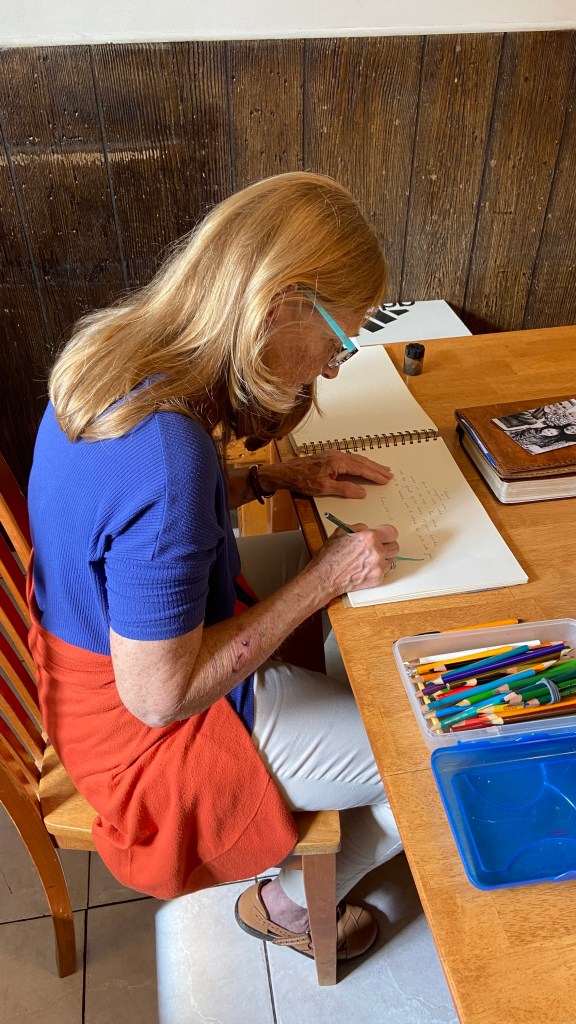
One way to start that process is to get a little journal and every day write a few things down for which you think thanks to God. It doesn’t have to take a lot of time. Maybe a minute or two.

If you like, you could get one of these African thinkful journals, made locally here, but you don’t need a fancy leather one. You could just get a cheap one. You just need space to write a few things down.

Example

Grace is my friend and co-worker in the gospel. She asked me about four years ago if I would hold her accountable every week to think thanks. So every Monday we send each other a text with a list of things that we are thankful for. Most times when I finish reading her list I am so full of praise myself. Her example is contagious and very becoming. I think thanks to God for Grace.

God’s Book of Remembrance

Did you know that God wrote a remembrance journal?

“Then those who feared the LORD spoke with one another. The LORD paid attention and heard them, and a book of remembrance was written before him of those who feared the LORD and esteemed his name. ‘They shall be mine, says the LORD of hosts, in the day when I make up my treasured possession, and I will spare them as a man spares his son who serves him.’”

Malachi 3:16-17

How beautiful to think of the Lord listening to us talk to each other of how we are thankful for Him!

Let’s be known for thinking thanks for all God is doing and has done. He is greatly to be praised!!

“Great is the LORD, and greatly to be praised,
and his greatness is unsearchable.
One generation shall commend your works to another,
and shall declare your mighty acts.”

Psalm 145:3-4

Creating Pearls

An Irritant???

Have you ever become annoyed or frustrated at something that irritates you or ruins your normal comfort and just won’t go away?

Like if a little stone gets in your shoe while you are walking … and you think, “whoa, what got in there?” But you try to keep going … then reassess, “ugh, it’s not going away; this is irritating.” You try and shake your foot around as you’re walking to get the pebble to a more innocuous spot … only to realize you’re being watched by other curious people. So, you stop and sit down; you’ve got to address the irritation and get it out. With that tiny bit of God’s creation removed, you are just so thankful for the change and the relief.

What if you couldn’t get the irritant out? What if you needed to accept the truth that the irritant would be present longterm? Neither your will nor your arms could remove it?

The Making of Pearls

An oyster is part of the mollusk family. When they sense an irritant, like a parasite or piece of grit, that has lodged in their shell, they have no arms to remove the irritant. But God has exquisitely designed them to slowly secrete layers of aragonite and conchiolin (the rainbow-like iridescent coating often called nacre) to coat the invader. In time, those secretions day after day turn an irritant into a pearl.

The oyster or mussel slowly secretes layers of aragonite and conchiolin, materials that also make up its shell, to form nacre, also known as mother-of-pearl, which encases the irritant and protects the mollusk from it.

Natural History Museum

How incredible is that?? Something that irritates and causes frustration is dealt with using a process that in time creates a pearl, a gemstone of great value. Only God!!

Irritating People

I have been musing on this concept. Could I respond like an oyster to irritating things in my life? Weather conditions, financial conditions, or health conditions that are outside my control? That’s hard!!

People can also be an enormous source of irritation or frustration in life. Perhaps you are thinking of someone right now? They may be within your immediate family, extended family, in your church, or a colleague at work. Perhaps you avoid the irritation by simply avoiding contact.

We live in South Africa, a nation with a history of apartheid (1948-1988), which could be simplistically described as state-enforced separation of people who were irritating to each other. There are eleven official languages and even more cultures here. There are many people-groups supposedly trying to live together in harmony, but the irritation breaks through far too often.

As humanity, we are very much in the same boat: God created us all in His image and likeness, and we are all fallen, sinful, and broken. Similarly, the Bible is for all people groups. It transcends eras, cultures, and individual preferences. And the two-fold Great Commandment, woven throughout its pages, is to love God supremely and your neighbor (created in His image) as yourself.

Nacre of the Spirit

Could we respond like the oyster when irritations occur? What if we did our own “nacre” around irritating challenges? If we have idols in our heart where we love control, love comfort, and love people-pleasing, then we will not respond well to irritants or irritating people. Idols create a “no-nacre zone.”

Loving someone means either overlooking their faults, praying and searching for subtle ways to help them work on their faults, or committing to help make up the difference where their faults may cause a problem. Loving someone is using my own Spirit-enabled internal resources (nacre) to absorb their oddities, prickles, and dysfunctions, and not let them irritate me. I stay when I could walk away. Love is accommodating someone’s weakness while you are thankful for, and celebrate, what is good. This applies to relatives. This applies to orphans. This applies to witchdoctors. This applies to people in other political parties.

Here is a for instance. In your office you need to closely monitor a coworker from a very different culture … different morals, a different work ethic, and different views of authority. They look different and they value things that are totally out of your orbit. Irritants abound!

BUT….. there are some very beautiful things about them as well. What if you choose to search for ways to think thanks to God even for them? You might express one thing that you are thankful for in them each day.

  • You could express your thankfulness for them in prayer to God (as you also ask God to fix them … and fix your heart so that you can show selfless love to them)
  • You could write your thankfulness in your th(i)nkful journal, or even better …
  • You could express your thankfulness to the coworker for something you have noticed in them!

When we choose to meditate and express our thanks for those beautiful things, it is like applying nacre in the making of the pearl. Perhaps I need to get into the pearl-making business! May I learn to put th(i)nkful nacre around my irritants, especially humans that God has put in my life for a purpose. I could become very rich with all my pearls!

Blessed

Blessed?

How would you describe a man whose mother was the ninth wife of a polygamist, and due to persecution by the other wives, chose to flee from the home forever leaving her toddler baby boy to grow up as the abandoned one among all the “other children?” He would never see her again.

When he reached his primary school years, there was so much strife in the home that he left as well, becoming a street-kid sleeping outside under bridges or wherever. Amazingly, he cheerfully and dutifully did odd jobs for people in town to buy food and pay his own way through primary school. In his early teens, he returned home only to find that his father and family were involved in intense witchcraft, so he fled home again.

As he worked his way through high school, there was a German-language teacher who had the boys come to his home for a meal, and he shared the gospel with them. God spoke to this young man’s heart, and he received Christ. He received forgiveness for his sins and a new purpose for living.

A few years later, as he grew in his faith, he worked his way through engineering school, but while working as an engineer, God called him into ministry. Now a pastor for more than a decade, he is finishing his Masters in Theology with NTCGS (National Theological College and Graduate School). David had him in his latest class.

How would you describe such a person given his horrific childhood? Would you have described him as “Blessed?” His name is Paddy Blessed Musoke.

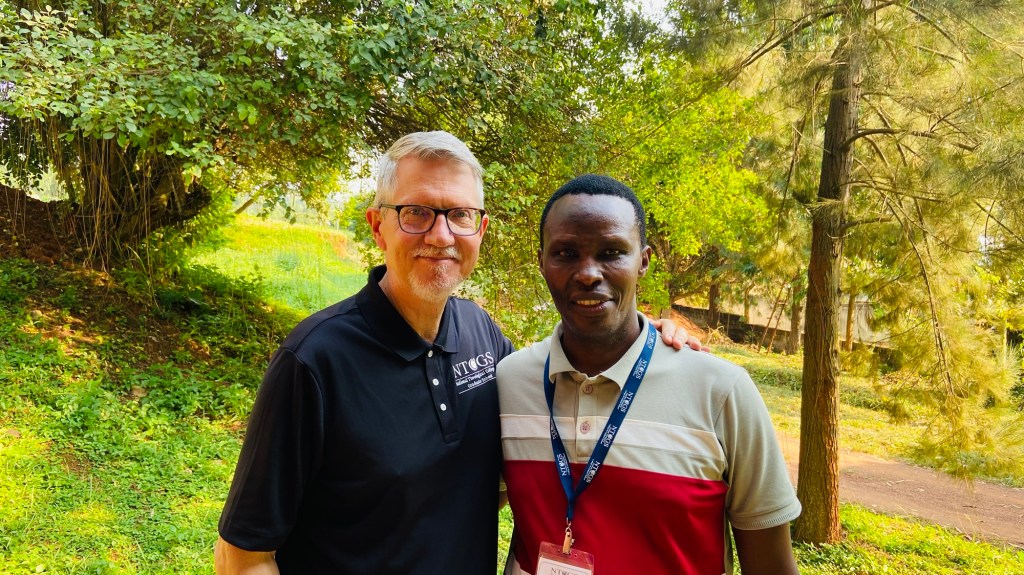
David and Paddy (Paddy gave me permission to tell his story)

Choosing God’s Perspective

As we discussed God’s purposes in suffering during our class time, David mentioned the seven initial responses Christians should have when facing suffering:

  1. God is God and I am not (Ps. 115:3, Is. 40:13-14).
  2. God’s ideas and plans are far beyond my human understanding (Is. 55:8-9).
  3. God is the sovereign over all calamities in and around my life (Job 36:32, 1 Sam. 2:6-7, Is. 45:7, Lam. 3:38, Amos 3:6, Nahum 1:3). Nothing/no one touches me without His love, permission, and design (Rom. 8:28).
  4. God knows exactly what I can handle with His grace, though it seems more than I can handle; He is holding back a crushing amount of suffering that might destroy my faith (1 Cor. 10:13, Dan. 3:17, 2 Pet. 2:9).
  5. God loves me with an everlasting love; He is always good; He is faithful and will never leave me (Psalm 119:67-68, 71, Is. 43:2, Jer. 31:3).
  6. God calls me to be resolutely thankful for so much during my suffering (Phil. 4:6, 1 Thess. 5:18).
  7. I am the servant of the Lord, immortal, invincible, and indestructible until the Lord is finished with me, and then eager to go Home when He calls me (2 Cor. 5:1-9).

Paddy came up after class and after sharing his story, related that during his devotion time in November 2023, he sensed the Lord asking him to thank Him for his hard past, for his painful childhood and difficult memories. “Thank me, Paddy.” It seemed so odd and horrible that the Spirit would ask this … and yet he knew that God had already used his past pain and street smarts in ministry. With tears, he agreed and thanked the Lord … and felt a huge burden lift from his soul knowing that the Lord had built sovereign foundations into his life, making him the man and minister that he is. He thoughtfully nodded and told us, “It is important to be thankful in all things.”

Setting Up God For A Fall

Your view of God is the most important thing about you. To the extent your view is flawed, it will distort, disturb, and disrupt your perceptions of yourself and your circumstances. Your real theology comes out in a crisis, like the squeezing of a sponge reveals whatever is inside. To use another analogy, trials are the tornado that tears off the “street view” your formal beliefs leaving exposed the basement of your functional beliefs.

There are several common ways that Christians think about God that “set Him up for failure” when they begin to suffer. In other words, popular teaching as well as the hymns and choruses we sing require more of God than the Scriptures do, so that when we suffer, we feel He has failed us, wasn’t there for us, did not hear us, or refused to respond to our deepest needs. Let’s look at some of these flawed views:

  1. GOD IS MY GENIE – “When I call on Him, He has magical power to grant my wishes and fix my problems.”
  2. GOD IS CHIEFLY MY FRIEND – “My friends don’t hurt me or let me down but run to help me in hard times however they are able … and God has infinite ability.”
  3. GOD HAS MY IDEA OF LOVE – “God’s love is like my love for my children, wanting only happy and positive things so that I can thrive, and His power guarantees me a smooth ride in life.”
  4. I HAVE FAITH IN FAITH – “If I believe, pray, and give enough, it will go well for me. If God doesn’t answer, there is some unknown sin or problem with me that is stopping Him.”
  5. PSALMS AND PROVERBS ARE PROMISES – “If I do what is right, God will make things good. As my shield and defender and Shepherd and Rock, He won’t allow bad things to happen to me.”
  6. ALL THE PROMISES OF SCRIPTURE APPLY TO ME – “As a Christian in the modern Church Age, I can claim as my own the promises God gave to ancient Israel at any time, even those given during unique circumstances.”
    • “None of these diseases shall come near me” – Exodus 15
    • “No weapon formed against me shall prosper” – Isaiah 54
    • “He only has thoughts of good and not evil” – Jeremiah 29

God has some great relational titles: Creator, Father, Redeemer, Sanctifier, Crafter, Comforter, and Guide. I love all of those. But genie and friend are not on the list. There are no such verses that explicitly say so, and those who say God is in those roles often turn their backs on Christ, the Church, and the faith when hard trials come. “How could God … ?!” And they turn away from a God who is silent or busy or not there or not very loving. Their wrong view of God set Him up for a fall.

The role of the Holy Spirit as our Comforter is perhaps closest to the role of a friend, but God is not committed to making it easy and nice for His children as friends typically are. Ask the Old Testament prophets. Ditto John the Baptist. Ditto Jesus. Ditto all of the Apostles. Ditto the faithful martyrs through the centuries. We are caught up in the workings of a much greater plan than we can imagine, and often we need more personal shaping than we can imagine, so God’s work involves our suffering.

So when God’s Word says to give thanks in all circumstances, He knows that this will be grueling for some of us. And yet, it is curative. It embraces with tears the background sovereign purpose and design behind all our pain and loneliness so that, as Rutherford wrote, I can “praise God for the hammer, the file (rasp), and the furnace.”

“It is doubtful whether God can bless a man greatly until He has hurt him deeply.”

A. W. Tozer, The Root of the Righteous

Are you blessed?

Thanksgiving Connected to Peace?

Philippian Exhortation

A few weeks ago David and I visited a new gathering of God’s people, Redeemer Community Church. We knew of people that had joined this new work, and wanted to visit one day; then the opportunity arose. It was so good. Refreshing and edifying. Pastor Erik shared from Philippians 4:4-9. He emphasized how we are to rejoice in the Lord ALL the time (verse 4).

But, how is this done, practically speaking? How do I rejoice when I see the earth or my country destabilizing? How do I rejoice with my recent medical diagnosis? How do I rejoice when my loved ones are making the decisions they are? How could Paul write this while sitting in prison?

The key is simply this: Rejoicing, or having joy, is a calm enthusiastic confidence in 1) the goodness of God’s character, 2) the reliability of God’s promises to His children, and 3) the absolute perfection of His sovereign plans. So many of us begin with the unspoken presumption that God’s job is to protect my world, keep me comfortable, free from sudden downturns in health, finances, and relationships, and to slowly carry me to a peaceful death at some ancient age. But God is not “about us” and has made no such promises.

We can rejoice when we choose not to be anxious (let go of our expectation of our world going as planned), but instead, through prayer and supplication with THANKSGIVING (affirming His choices in our circumstances), we take our requests to God (verse 6). Only then can we experience God’s overwhelming peace, described in verse 7.

God’s Peace Follows Prayer with Thanksgiving

“And the peace of God, which surpasses all understanding, will guard your hearts and your minds in Christ Jesus.”

Philippians 4:7

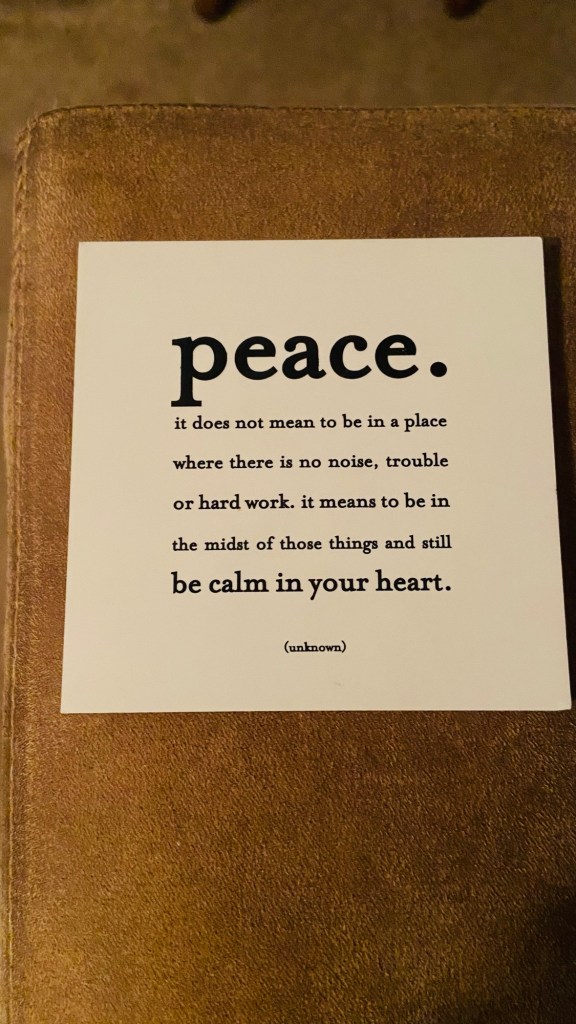
Have you ever meditated on what that verse is really saying? It’s pretty amazing to experience peace … like when you find one of God’s lovely places far away from tech and humanity. But what about a peace that surpasses all our understanding?? A peace that causes others to scratch their head, or accuse me of being in denial of my circumstances?

I really WANT that peace. I want my heart and mind to be “kept” or guarded. I want God to carry through on His perfect plans, even if it means hardship for me. I am determined to keep my eye on Him because I know His eye is on me, as Peter when he walked on the stormy waters.

Perhaps I should ponder how to discipline myself to pray with thanksgiving?

12 Monthly Verses

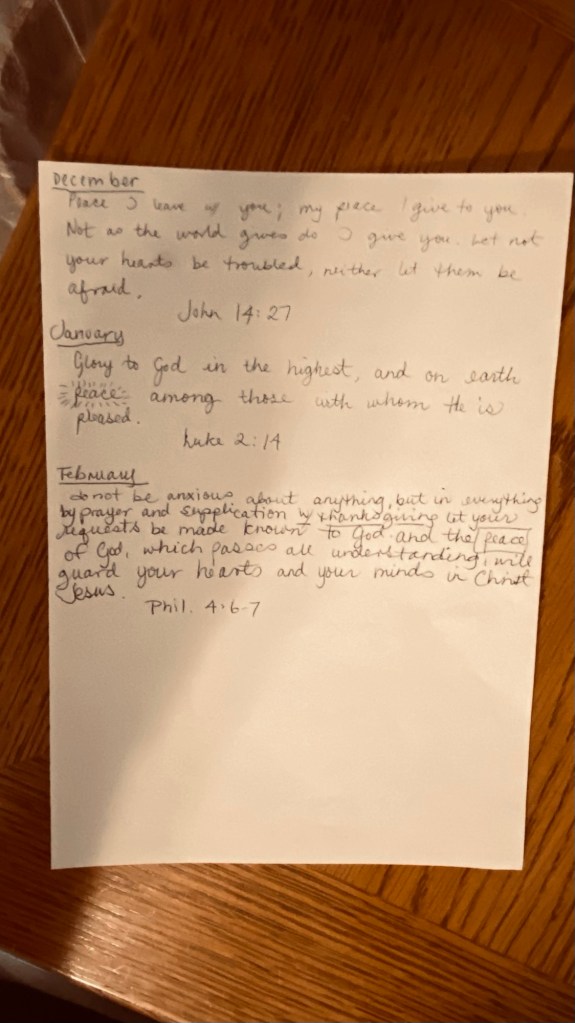
I am choosing the theme of “Peace” this year and am memorizing a verse on peace each month. I want to know these verses so well that I can pull them up in my mind and meditate on them at any time I want. OK, I cheated and started in December.

John 14:27 is urging us to receive His peace, not worldly peace, but God’s peace.

So you may say, “that sounds wonderful, but you don’t know what is happening in my life. There’s everything but peace. I have sorrow, worries, fears, and pain … physical pain, emotional pain, spiritual pain. The road to experiencing peace is too gnarled. Not sure I could ever get to peace, much less peace that passes my understanding.”

Well, I am here to say that you can! It is not dependent on your circumstances. It doesn’t have to do with that. It is dependent on something else!!

Because of what Christ did on the cross when He paid for our sin, and when He defeated death, sin, and oppression by rising again, we too can “defeat our circumstances” by trusting in the character of God to work things together somehow for our good, our becoming like Jesus. Romans 8:28-29 states that is what God desires in our lives. Like a great sculptor with a rough rock, He is chiseling away in my soul anything that doesn’t look like Jesus. He has to use different “tools” such as pain and sorrow to make that happen. And it takes time.

Thinking Thanks is Part of the Journey to Peace

To envelope our burdens and challenges by choosing to think thanks about them, and in the midst of them, is a path of hope that leads to peace, God’s peace.

To identify gifts from the Lord right in the hardships is vital. Thanking God for His presence, His wisdom, His sovereignty is a good place to begin if you feel at loss to know on what to think thanks.

May God fill you with His surprising PEACE this year as you set your mind on Him.

You will keep him in perfect peace whose mind is set on You.”

Isaiah 26:3

Count

1…2…3…4…

“Just a minute, it won’t take me long.”

I told David I was recording things in my th(i)nkful journal. Every evening before bed, I seek to count and express things for which I thank God. I find that it is not difficult at all. I usually don’t have enough room in my journal. Over time, the discipline becomes a delight as God gives you a heart to look around and recount His good gifts.

When I first started this habit in July of 2017, it took some conscious thought to discover items to write down, but now…. super easy. As I am going through my days now, my th(i)nkful search engine stays busy in the back of my mind. Is this something that I will record tonight in my th(i)nkful journal?

In giving counseling homework, I am adamant about including thinking thanks. I want my counselees to write down things daily, or to verbally express things, that they are thankful for. I want to inspire them to begin to count.

Take Into Account

The definition of count is take into account. I think of a bookkeeper who carefully logs the correct numbers to keep accurate records.

I will recount the steadfast love of the LORD, the praises of the LORD, according to all that the LORD has granted us,

Isaiah 63:7

… that I may recount all your praises,

Psalm 9:14

We give thanks to You, O God; we give thanks, for Your name is near. We recount your wondrous deeds.

Psalm 75:1

But we your people, the sheep of Your pasture, will give thanks to you forever; from generation to generation we will recount Your praise.

Psalm 79:13

I shall not die, but I shall live, and recount the deeds of the LORD.

Psalm 118:17

The Lord seems to want us to recount His blessings. To recount is to count again, which means stopping, backing up in time, and counting again. It’s like the word “recollect” – which means to collect again because, like doves when their cage is opened, things we can be thankful for fly away.

Do you recount? Do you recollect?

Count It All Joy

There is another place in the Word where we are exhorted to count. In James 1:2 it states that we are to “count it all joy” when we meet various trials because they have a purpose to produce steadfastness in us. This is a different kind of count. It means to consider, deem. We are to regard the trials in our life as joy.

That’s a little harder. We like counting good things, but counting hardships as joy?? They don’t seem to belong in the joy column! There’s a dark, dismal, disaster, discouragement column for those! We have to look carefully at the verses.

“Count it all joy, my brothers, when you meet trials of various kinds, for you know that the testing of your faith produces steadfastness. And let steadfastness have its full effect, that you may be perfect and complete, lacking in nothing.”

James 1:2-4

There’s a purpose to the trial, a greater good God is accomplishing. The testing of our faith produces steadfastness – “sticktuitiveness” – the ability to stay steady and not freak out under pressure. One way to look at it is that we are like functioning, active products that the Lord is manufacturing. You wouldn’t want to use an appliance or drive a car that had never been tested. That testing-refining-testing-improving process is what matures us, helping us to become “just perfect” for the job God has for us to accomplish.

So, we have to value, and even celebrate, our trials because God is using them to make us different from our original selves, to reconfigure our thoughts, desires, behaviors, and responses to be like His Son. As we increasingly understand the character of God, we can try to figure out and appreciate what He wants to do in us through the trials. This is not so easy and sometimes takes years.

Count Your Many Blessings

Johnson Oatman, Jr. was born in Medford, NJ. He lived from 1856-1922. Count Your Blessings, written in 1897, was Oatman’s masterpiece and E. O. Excell wrote the music for it.

Johnson is known for writing many hymns, but this one is his most popular one. It seemed to find favor with God’s people right from the beginning. While in London, revivalist Rodney “Gipsy” Smith announced the hymn to his audience by saying, “Down in South London the men sing it, the boys whistle it, and the women rock their babies to sleep to the tune.”

When upon life's billows you are tempest tossed,
When you are discouraged, thinking all is lost,
Count your many blessings, name them one by one,
And it will surprise you what the Lord hath done.

  REFRAIN: Count your blessings, name them one by one;
  Count your blessings, see what God hath done;
  Count your blessings, name them one by one;
  Count your many blessings, see what God hath done.

Are you ever burdened with a load of care? 
Does the cross seem heavy you are called to bear? 
Count your many blessings, ev'ry doubt will fly, 
And you will be singing as the days go by. [Refrain] 

When you look at others with their lands and gold, 
Think that Christ has promised you His wealth untold; 
Count your many blessings, money cannot buy 
Your reward in heaven, nor your home on high. [Refrain] 

So, amid the conflict, whether great or small, 
Do not be discouraged, God is over all; 
Count your many blessings, angels will attend, 
Help and comfort give you to your journey's end. [Refrain]

Maybe you need to do some counting, even as a family around the Thanksgiving dinner table. We discover that when we begin to number the many blessings, our perspective changes. We are so incredibly blessed. God has been so good to us. We have been redeemed and given an overwhelmingly different future if we have placed our faith in the work of Christ on the cross. If we face trials, we know that we have a Divine designer and developer managing every detail for our long-term good and His long-term purposes. Even if we face leaving this world, we can be at peace because our mind is stayed on the Lord and we trust in Him (Isaiah 26:3).

I will give thanks to the Lord with my whole heart;
    I will recount all of your wonderful deeds.

Psalm 9:1

Can You Thank Me?

Helen’s Story

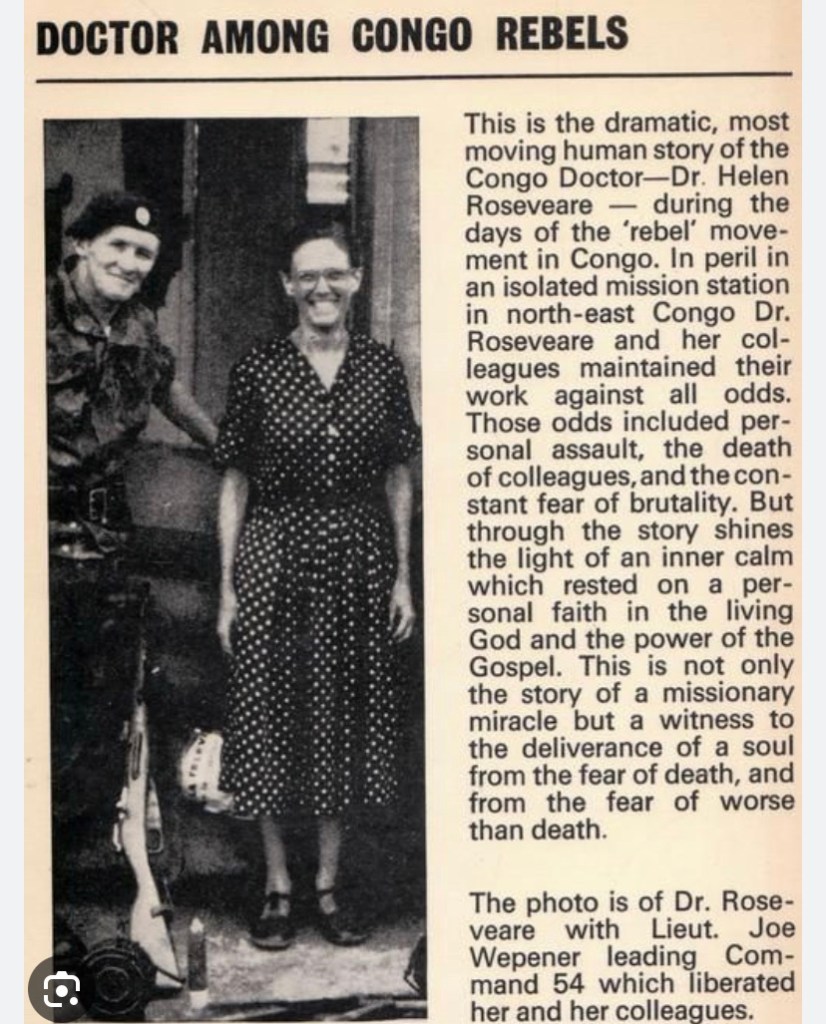
Helen Roseveare was being forcibly pushed down the corridor of her simple Congolese mission home. The Rebels had attacked. Now it was her turn. They had smashed and demolished her home, saying they were looking for something.

As she was being physically abused, her mind called out to God, “Where are you?” Suddenly, she felt His presence and it was like He was asking her a question:

“Can you thank me for trusting you with this hard experience even if you don’t know why?”

The way we view God says everything about us.

“What comes into our minds when we think about God is the most important thing about us.”

A.W.Tozer

Helen Roseveare was a servant of the Most High God who had given Him her life, her everything. After graduating from Cambridge Medical College she wanted to spend her life serving God as a missionary. She studied tropical medicine and French, and then took off for the Congo.

The Lord allowed great suffering in her life, but she was able to process her trauma as a privilege to enter into the fellowship of His sufferings (Philippians 3:10).

Grace Infusion

My husband and I are serving in KwaZuluNatal, South Africa. We are involved in a rural ministry called 7 Rivers Outreach based out of nearby Grace Baptist Church in Amanzimtoti. Recently we began building our first Community Centre called the Thola Centre. It is so exciting to see the walls being built and to imagine the ministry that will take place within those walls. We, too, are looking to build a health clinic at that site. It will not be a hospital or even close to what Helen Roseveare was involved in, but it will be a start.

When I read about Helen’s attitude when she went though such hardship, my heart was pricked. Would I have responded in that manner? I am not sure I would have. I marveled at the way she was processing things that could have completely destroyed her. Even when enduring the gruesome act of rape, she said that she had given her body to the Lord and that when they hurt her, they were hurting the Lord Jesus. If you are interested in learning more about Helen, click on her name above.

When we go through different kinds of “hard,” there is a grace infusion into us that is not normally there. With the trial comes the grace. I can walk with my God, my Abba, my Shepherd today and know that He will never leave me, nor forsake me. He has promised to be with me to the end of the age. Helen’s faith enabled her to download that grace infusion to process her trauma with His help.

Can You Thank Me?

But with a great trial and His grace-infusion rising in equal measure, God at times communicates inaudibly to your soul. Amidst all the noise and jostling, she heard Him ask her something. She later wrote about His puzzling question:

“Can you thank me for trusting you with this hard experience even if you don’t know why?”

There is a big difference between thanking God in the trial and thanking God for the trial. When we fully are able to see God as completely sovereign and trustworthy, we move into a different category. God would give both a sense of His presence and His grace to mentally-emotionally process the trauma she would go through. Like Israel, God would send her through fire and deep waters, but He would be with her.

“When you pass through the waters, I will be with you; and through the rivers, they shall not overwhelm you; when you walk through fire you shall not be burned, and the flame shall not consume you.” (Isaiah 43:2)

Toward the end of his trial, God communicated with Job, not answering why he was suffering, but describing His own creative genius and power such that Job was left speechless. When Job got this inside and over-the-top view of who God really was, he was able to process his trauma differently. Instead of accusing God, Job put his hand over his mouth (Job 38-42).

God is God, and I am not.

“Whatever the LORD pleases, He does, in heaven and on earth, in the seas and all deeps.”

Psalm 135:6

Lord, help me to trust You even when I don’t understand all that You are doing. Help me to walk by faith and cling to Your grace and peace.

Helen went home to be with the Lord at the age of 91. The Lord was faithful to her to the end. He didn’t shield her from harsh difficulties, but He helped her through them. She was even able to be thinkful, to think thanks for the most gruesome happenings, because she fully acknowledged the control and unknown purposes of her Master and Savior (Isaiah 55:8-9) and she entered into the fellowship of His sufferings (Philippians 3:10).

Pockets of Thankfulness

“Pockets of Thankfulness”

Where do little boys put their treasures?

A seven year boy went on a walk with his family recently. Rounding a corner he suddenly called out, “Pockets of thankfulness.

Such an artistic statement grabbed the attention of one family member. “Pockets of thankfulness?” they asked. “Yeah,” he replied, “we have breastplates of righteousness, helmets of salvation … why not pockets of thankfulness?” He was just continuing what he considered to be the logical progression of the armor of God.

Love it!!

Although the writer of Ephesians 6 did not included pockets of thankfulness, the picture seems to fit so perfectly as both a defensive and offensive piece of a Christian’s armor. Thankfulness shields us from temptation, and strikes back at the tempter.

In Isaiah 11:5 the author uses two descriptions of putting on a belt. “Righteousness shall be the belt of his waist, and faithfulness the belt of his loins.”

In Isaiah 59:17 the Lord God puts on righteousness as a breastplate, and a helmet of salvation on His head; He puts on garments of vengeance for clothing, and wraps Himself in zeal as a cloak.

In I Thessalonians 5:8 we are exhorted to be sober, putting on the breastplate of faith and love and the helmet of the hope of salvation.

The visual image of a piece of clothing to illustrate a spiritual truth is powerful. Having the direct command of Ephesians 5:20 to give thanks always perhaps gives us grounds to include pockets of thankfulness?

Fill those pockets with things, thoughts, and Scripture that will motivate gratitude!

Pocket Contents

“I’ll just put it in my pocket so I can get it easily.”

Does that sound familiar? A pocket keeps things handy. It is designed to hide things in a place where they can be brought out quickly. I know I often put things quickly in my pocket to have it readily available. Maybe I will need a tissue, or my phone, or some cash?? I will just put it here in my pocket.

Pockets first began appearing on waistcoats and trousers about 500 years ago. As you may remember, about half the population wasn’t wearing trousers back then. In Medieval times, both men and women wore bags that tied around their waists and filled them with whatever bits and bobs they needed.

Embry Roberts

Unfortunately, many Christians keep thankfulness locked up in a trunk to be opened once a year at Thanksgiving, or on the odd occasion where they are almost killed in an automobile accident or are experiencing cancer in remission. But thankfulness is NOT meant for your locked trunk. It should be in your pockets. Handy. A part of your routine even more than checking social media. Something you can quickly share with a friend. Oh, to have some really big pockets, heh?

What Would Be In Your Pockets?

Maybe the first thing you would put in that pocket would be cash. Seems like you would be so thankful to find some money when reaching into your pocket (even after it’s been through the laundry).

What would you make sure was in your pocket of thankfulness?

If you are a teacher or mother, could I suggest getting a visual of a pocket that you could use in teaching gratitude? Get a big square of blue jean material and sew a pocket on it, then pin it to a bulletin board.

IDEA 1: At the beginning or end of the day, write something you’re thankful for on a piece of paper. Put it in the pocket … for later times when the ingratitude seems to be winning in your life … or maybe for the end of the week when it’s time to count our blessings.

IDEA 2: Ask your children to put in a small object that represents something that they are thankful for and letting them share why that is special to them? The next day you could have a quiz holding up an object from the pocket of thankfulness and ask who remembers what it represented.

IDEA 3: See the inside flyleaf of your Bible as your “pocket.” I have a slip of paper readily available with at least five things that I can think thanks for. I want my eyes to often peruse that paper. We need reminders. We need them often.

Just as a side note ~ that seven year old boy who imagineered “pockets of thankfulness” just happens to be my precious grandson. #thinkful

“The unthankful heart discovers no mercies; but the thankful heart will find, in every hour, some heavenly blessings.”

Henry Ward Beecher

Release Yourself Through Forgiveness

Opportunity for Wisdom

She lied! There was actually no doubt about the action. It was a blatant, outright falsehood. How could Sam forgive her? The damage to his trust, to their relationship, had been done. Why did he need to tell her the truth anymore? Why not betray her trust as she had done his? That seemed fair.

As Sam met with his friend and shared about his pain and anger, the friend pointed him to Ephesians 4:32. “Be kind to one another, tenderhearted, forgiving one another, as God in Christ forgave you.” The contrast was glaring. Sam’s friend suggested that the response to the hurt be kindness in return. What??

In Scripture, we often see the irony of opposites. Tozer once wrote about these opposites. “[A Christian] empties himself in order to be full, admits he is wrong so he can be declared right, goes down in order to get up, is strongest when he is weakest, richest when he is poorest, and happiest when he feels worst. He dies so he can live, forsakes in order to have, gives away so he can keep, sees the invisible, hears the inaudible and knows that which passeth knowledge.”

Now, when we have been mistreated, abused, and sinned against, it is correct to confront in love and to speak truth to the offender. But you also need to forgive, not because they deserve to be forgiven, but because God through Christ, has forgiven you. We don’t forgive because we don’t really appreciate the depths to which we ourselves have been forgiven.

Forgiveness Linked to Being Th(i)nkful

When a person is working through what it means to forgive and not harbor bitterness, there’s a battle within. It feels wrong that the offender doesn’t get what they deserve. And then there is an ‘aha’ moment when we realize that we don’t forgive an offender because they deserve to be forgiven. We forgive because we are so enormously thankful for how God forgave us through Jesus. Forgiveness begins with thankfulness. How thankful we are that we didn’t get what we deserved!!

Think about this admonition.

“Bless those who persecute you; bless and do not curse them. Rejoice with those who rejoice, weep with those who weep. Live in harmony with one another. Do not be haughty, but associate with the lowly. Never be wise in your own sight. Repay no one evil for evil, but give thought to do what is honorable in the sight of all. If possible, so far as it depends on you, live peaceably with all. Beloved, never avenge yourselves, but leave it to the wrath of God, for it is written, ‘Vengeance is mine, I will repay, says the Lord.’ To the contrary, ‘if your enemy is hungry, feed him; if he is thirsty, give him something to drink; for by so doing you will heap burning coals on his head.’ Do not be overcome by evil, but overcome evil with good.”

Romans 12:14-21

As we think thanks about God’s forgiving us for the millions of evil thoughts, motives, actions and words we have had through our lifetime, and continue pondering the new foundation of the Word, the Spirit and a clean conscience He has given us to stand on, we can release the stone of unforgiveness towards the one who has maltreated us. It may take time. It may need to be worked through with a counselor. But as we think thanks on how God has forgiven us, it gives us a motive to forgive, too.

Releasing Them Releases Us

We don’t forgive others just because we have been forgiven. We also forgive because harboring bitterness and waiting to take revenge is a toxin that poisons us, not them; a cage that imprisons us, not them. Harboring unforgiveness and bitterness has mental, emotional, and biological consequences for us.

There is a release and renewed vigor when we choose to forgive. There is a wonderful freedom that comes from forgiving a person that has hurt us, even if that person has since died. God has created us and He knows that forgiving is what will eventually bring deep healing. The irony is that people often hug their prison cage and sip at their poison. God forgives us so that we can release others and thereby release ourselves. The Lord will deal with the wicked and the unrepentant.

Sure, the optimal scenario is when the offender comes and seeks forgiveness. Until then, we give “accorded forgiveness” based on our own resources as those who are thankful that we have been forgiven much. But when an offender seeks forgiveness, then we enthusiastically give our “completed forgiveness.” Forgiving doesn’t mean forgetting, but it is one big decision followed by a thousand small decisions not to bring the matter up again by way of revenge. Forgetting is weakness. Forgiving is strength.

To forgive is to imitate the God who forgave us and continues to forgive us even when we fail to ask. We are so very thankful for His steadfast love and faithfulness, and our forgiving others begins with that thankfulness.

“We don’t forgive because we don’t really appreciate the depths to which we ourselves have been forgiven.”

David Brown

I Do Not Take It For Granted

Removed

In April of 2022 the area around Durban, South Africa, received torrential rains.

Highways were flooded and homes were destroyed from landslides and water. At least 430 were reported to have passed away, with many more still missing. Such devastation and ruin. Food parcels were assembled and distributed. Collections for help to rebuild homes were taken up.

In our little complex of flats, we only lost water and power for several days. Otherwise, were just fine. It was interesting to see how frail we are in our great and powerful Western civilization; just take away our water and electricity, and we are in an absolute crisis. We had to carry water to flush the toilets and boil for drinking. It gave us a clearer picture of what it is like in our nearby rural communities to carry water for your daily needs.

Day after day we got the opportunity to learn that having access to water and power is something to be very thankful for indeed. We took it for granted, and when it wasn’t granted, we learned to value it.

The rural African lives far more like Jesus than we do. When Jesus walked on earth, He did not have running water, electricity, air conditioning, automobiles, or wifi. What was normal for him would now be a crisis for us.

All Of A Sudden

Then one morning I awoke to David saying that the power was back on. Hallelujah!! Later, water trickled from the faucet for several hours, but eventually came back in full.

I was so hit with the fact that I must NEVER take these things for granted. I am now so thankful for the absolute magic of looking intently, turning a faucet handle slowly … and there comes clean water!!

I am more thankful after going through the removal of the object. Like the old adage, “love knows not its own depth until the hour of separation.”

I know that my fleshly tendency will be to gravitate towards taking it for granted after a while, but I am fighting that with my whole being. I want to etch deeply in my mind that I must continue to be thankful for the conveniences technology has brought us, while being reminded not to let them make me too soft.

Thank You, Lord, for Reminders

Physical reminders can be quite effective. Going without water and electricity for many days sharply embedded in me a reminder to be thankful for those daily gifts. But I was meditating on a spiritual analogy to this loss of water as well.

Water in the Scripture is a picture of spiritual life itself. The nonbeliever goes about searching for meaning in the myriad dry wells of our cultures. The mirage of the new draws them foolishly to yet another dry well. They are like a desert shrub, like the chaff that the wind drives away (Psalm 1, Jeremiah 17:6).

But when God opens a lost person’s heart to the gospel and he or she receives the Word, they experience the washing of regeneration (Titus 3:5, Ephesians 5:26). Their reborn spirit, indwelled by the Holy Spirit and fed by the Word of God, is referred to as “living water” which will never run dry and will bubble over for the benefit of others (John 4:14, 7:38).

Despite these lovely truths, there are times when I realize that I am spiritually thirsty and dried up. Sometimes it is because I have given out emotionally and spiritually for days without much of a rest. Sometimes it is because I have poured months of counsel into a soul only to experience their betrayal or to see them make woefully bad decisions. Sometimes it is because I have an idol or sin that I am not parting with (Psalm 32:4). Most often it is because I am not washing my mind with the Word to regain God’s perspective. I turn on the faucet and nothing comes out.

But I go down on my knees with tears, and I go to the Word, and I go to the Throne and pour out my heart … and that brokenness dislodges whatever stone was covering the well. The water begins to flow again. “It’s going to be ok. Self, speak truth! Self, give me God-soaked counsel!”

“Well,” I whisper to myself, “through Jesus’ sacrifice in my place, I was forgiven of all my sins (from the cradle to the grave) all at once, I was reconciled with the Creator God and was placed in right standing in His family and Kingdom. I am set to inherit from Him one day. One day soon, Jesus will return for me and my brothers and sisters. This earth is my only hell, and I will live out His mission for my life …” and I end up shouting out with my finger in the air, “because I want to make Him happy, and that’s all that matters!” Guess what? The water is on. He has washed me with His word.

Meditating and saturating my thoughts on all that I have in Christ is fodder for thinking thanks. Recently my husband handed out a paper during a message with the title “Who I Am In Christ.” I have it tucked in my Bible to remind me daily. He has given me so very much in Jesus.

Changed

This temporal removal of having something I needed every day, changed me. It prompted thinking thanks. I want to remain changed. May I not take gifts from the Father for granted.

Water and power are wonderful commodities, but even more importantly, spiritual cleansing and power are essential. I must have that living water and not let the well get blocked. Worse yet, I must never go after the empty wells of my culture.

God offers water full and free flowing to me and to you. It will always be there for us. Torrential rains and flooding will not obstruct it. Receive it with gratitude and cherish it.

I do not take it for granted!

Gratitude Rewires

Thinkful for Percimony

My youngest granddaughter Perci is learning to walk. She lurches, wobbles, and falls, but gets back up. It is so precious to see her try to move one foot in front of the other and maintain balance. Not an easy feat!

But after awhile, she will “learn” – she will have actually unwittingly hardwired her brain to move her body toward her goal without thinking through the steps. She will simply lean and start, alternate between legs, maintain her balance, turn left and right, and achieve her little goals!

It takes months of trial and error, but once the neuro-pathways are developed, it will happen automatically. Percimony will know how to walk.🚶‍♀️

Percimony is also developing a much deeper skill for life – problem solving. She had a desired target across the room (the piano). She decided to take stock of her resources to get there, which were not good since she lacked coordination. She could have sat in a puddle of weeping and woes, but she decided to work at it; trying and failing until she felt her skills getting better. In time, she got there.

How Is Your Brain Wired?

The beautiful thing about Percimony’s brain is that it is new. It is getting wired and programmed for the first time, and wow does it learn quickly. For the rest of us, the ability to learn is getting slower and more difficult as time goes by. What is even more difficult is the task of learning something differently from the way you’ve always done it. This is what the Bible calls “renewing,” which requires a bit of “undoing” first.

To “renew your mind” (Romans 12:2, Ephesians 4:23) is to actively examine your thinking in the light of God’s Truth (John 17:17) to assure that you are thinking correctly. It is to identify and root out wrong perceptions of who God is, who Jesus is, who the Spirit is, who your neighbor is, who you are, and how you should relate to these others. Paul wrote that we are to “destroy arguments and every lofty opinion raised against the knowledge of God, and take every thought captive to obey Christ” (2 Corinthians 10:5). We may need to identify and painfully pull down idols of the heart like the desires for control, comfort, and affirmation that have woven their way through all our thoughts.

We are then to plug in thinking that pleases God. This takes work, repetition, and time. It may take an accountability partner to help give you a little signal when “you’re doing it again.” You will likely need to memorize verses in areas where you are weak, and meditate on those truths (Psalm 1:2).

Rewiring for Gratitude!

So perhaps you’re grumpy, chronically unthankful, a glass-half-empty, little black raincloud to all who know you. Perhaps you dismiss it as just being a problem-spotter, or being an idealist, or “just stating the obvious.” While improvements are normally helpful, the truth is that God commands us to give thanks in everything (Ephesians 5:20). Even if it needs fixing, we can begin with thinking thanks. It helps wire our brains correctly to first search for and highlight the good, then move on to remedies.

I love it when the secular experts “discover” what God has long said is actually really good for us.

“Studies have shown that performing simple gratitude exercises, like keeping a gratitude diary or writing letters of thanks, can bring a range of benefits.”

Christian Jarrett

One notable study followed over 40 participants seeking treatment for depression and anxiety. Half were asked to write letters expressing gratitude before the first few counseling sessions, while the rest formed a control group who attended “therapy-as usual.” Three months later, both groups were asked to perform a generosity task while being measured by MRI.

According to Jarrett: “The participants who’d completed the gratitude task months earlier not only reported feeling more gratefulness two weeks after the task than members of the control group, but also, months later, showed more gratitude-related brain activity in the scanner. The researchers described these ‘profound’ and ‘long-lasting’ neural effects as ‘particularly noteworthy’..[This suggests] that the more practice you give your brain at feeling and expressing gratitude, the more it adapts to the mindset…a sort of gratitude ‘muscle’ that can be exercised and strengthened.”

NeuroImage Volume 128, March 2016, Pages 1-10

Exercising My Gratitude Muscle

YAY!!!! Percimony took steps into her daddy’s arms. So much celebration followed. Perci even clapped for herself. :). I am exercising my gratitude muscle as I rehearse so many things for which I am thankful to God. He is a good, good Father and is helping me renew my mind to think on what is true, what is good, what is sufficient, and what is trustworthy. I can give thanks to Him for everything because He is the ultimate Authority in all my days and moments, and does all things well.

“Enjoy the little things, for one day you may look back and realize they were the big things.”

Robert Brault