Do You Have a Thorn?
Probably most of you who read this blog have something hard in your life….something that you could in one way or another call a “thorn.”
Why is that? We want to fix things and try to get to that place in our lives where everything is going well, going smoothly, where everything is figured out, and everything is under control … but usually that’s an elusive place, and that euphoria never comes. The Lord seems to purposefully work through “thorns” in our lives for our good.
The Lord certainly doesn’t promise to keep us from thorns, rivers, or furnaces. In fact, He specifically tells us that He will be with us through those difficult times.
“When you pass through the waters, I will be with you; and through the rivers, they shall not overwhelm you; when you walk through fire you shall not be burned, and the flame shall not consume you.”
Isaiah 43:2

We pray, “God, deliver me from the furnace, from the floods, from the thorns!” But God providentially controls those things, and even sends those things, for His reasons … and with His company. He often says, “My child, I sent those to deliver you from you. I want to see My Son in you.”
Studying how Paul dealt with his thorn gives some clarity as to God’s view on our difficulties. Paul was so frustrated with this thorn that he asked three times if God would please remove it.
“So to keep me from becoming conceited because of the surpassing greatness of the revelations, a thorn was given me in the flesh …”
2 Corinthians 12:7
God answered that His grace was sufficient for him, that His power was made perfect in weakness.
We are not sure what Paul’s thorn was. Some have speculated that it was epilepsy, or perhaps his eyesight, maybe even recurring malaria. Others have guessed that it was a vexatious person who kept dogging and opposing Paul wherever he went. Perhaps it is a good thing that we don’t know what type of thorn it was so that we can insert our own thorn to learn how to handle these challenges.
Paul was entrusted with this difficulty to keep him from becoming conceited because of the surpassing greatness of the revelations he had received. The hardship countered the negative side effects of blessing. This hardship was carefully designed by the Lord for Paul’s own good and for the good of the churches that heard and read his words.
How Did He Handle It?
A few years after 2 Corinthians was written, Paul was put in prison in Rome. It was during this time in the early 60’s AD that Paul wrote what we call “the Prison Epistles” ~ Ephesians, Philippians, Colossians and Philemon. No doubt his thorn was still bothering him, but he chose to continue to serve the Lord and write these letters to encourage and instruct the believers. From what God was teaching him, he shared through the inspiration of the Spirit with others.
Paul knew that God has a big picture of everything going on, even in his individual struggles and challenges. Paul looked at himself as a servant of God called to accomplish a lifelong mission. He understood that the goal in life was not to be trouble-free, pain-free, bump-free, and bend-free … but instead to be conformed to the image of Jesus.
One of the skills Paul had learned to cope with thorns was to think thanks in every aspect of his life, even living with the thorn. One of these Prison Epistles is Colossians. Take a closer look at how Paul highlighted thinking thanks in that letter.
Thankfulness in Colossians
Colossians has special interest to me. It only has four chapters, but in every single chapter there is a verse dealing with thankfulness. In fact, in chapter three there are three verses in a row that address thankfulness!
Do you know where in the world Colossae is? It is located in modern day Turkey.
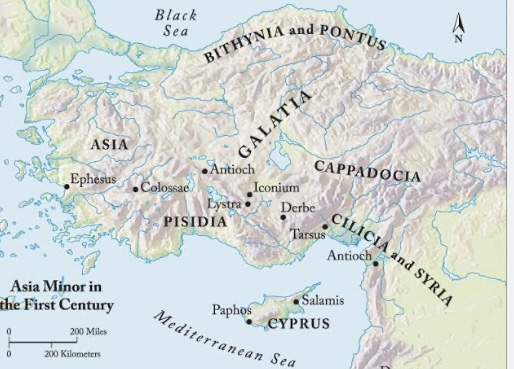
Epaphras had been changed in Ephesus! He had heard Paul speak and Epaphras had responded and trusted in Jesus as the Messiah. He was so changed that he had to take the news of the gospel back to his home in Colossae.
He shared that Jesus had come and died and that he had risen again. Through Jesus’ work on the cross we could have forgiveness of sins and be adopted into the family of God. We could be reconciled to the Creator from the breach that our sin had caused going all the way back to Adam. The second Adam had come and fixed things!!

This is a picture of modern day Colossae.
The people of Colossae responded in faith. They believed and a church was established there.
Later there were some heresies that started to creep into the church, and Epaphras was so concerned that he travelled all the way to Rome to talk to Paul. Although Paul never actually visited that church, he prayed fervently for them. So Paul is writing this letter to encourage them and help them grow in their walk in Christ. And although he is in prison, Paul doesn’t ask for blankets, food, medicines, or visits. His ability to give thanks in his circumstances freed him to focus on others.
One of the fruits of being in Christ is being th(i)nkful. Look at how Paul addresses thankfulness in the four chapters:
- In chapter one, Paul shares a prayer that he prays for the believers in Colossae. He prays for them to be filled with the knowledge of His will in all spiritual wisdom and understanding. In verse twelve Paul prays for them to give thanks to the Father. He knows that thinking thanks and expressing it, is part of the mature Christian life.
- In chapter two, he admonishes the Colossians to walk in Christ, being rooted and built up in Him and established in the faith, abounding in thanksgiving.
- In chapter three, Paul gives three verses in a row, 15-17, that include thanksgiving. “And let the peace of Christ rule in your hearts….and be thankful. Let the word of Christ dwell in your richly, teaching and admonishing one another in all wisdom, singing psalms and hymns and spiritual songs, with thankfulness in your hearts to God. And whatever you do, in word or deed, do everything in the name of the Lord Jesus, giving thanks to God the Father through Him.”
- In the fourth and last chapter, Paul starts out with verse one encouraging the believers to continue in prayer, being watchful with thanksgiving.
What About Your Thorn?
Thanking God for your thorn, for your flood, for your furnace, is only done through the work of Christ in you. It is only as we view our human suffering in light of the gospel that things start to make sense. This life is momentary, our suffering is not even worthy to be compared to the glory that will be revealed (Romans 8:18). As we begin to see through the glasses of God’s perspective, we can even join James in counting it all joy as we see the trials develop steadfastness and endurance in us.
Could you take any help from Paul in the book of Colossians? Do you process things in your life with th(i)nkful glasses? Could you wrap that yucky thorn with thinking thanks of how it is making you like Jesus?
I am not saying it is easy, just that when we process the thorn God’s way, it changes us.
Abound in thanksgiving……..
 th(i)nkful